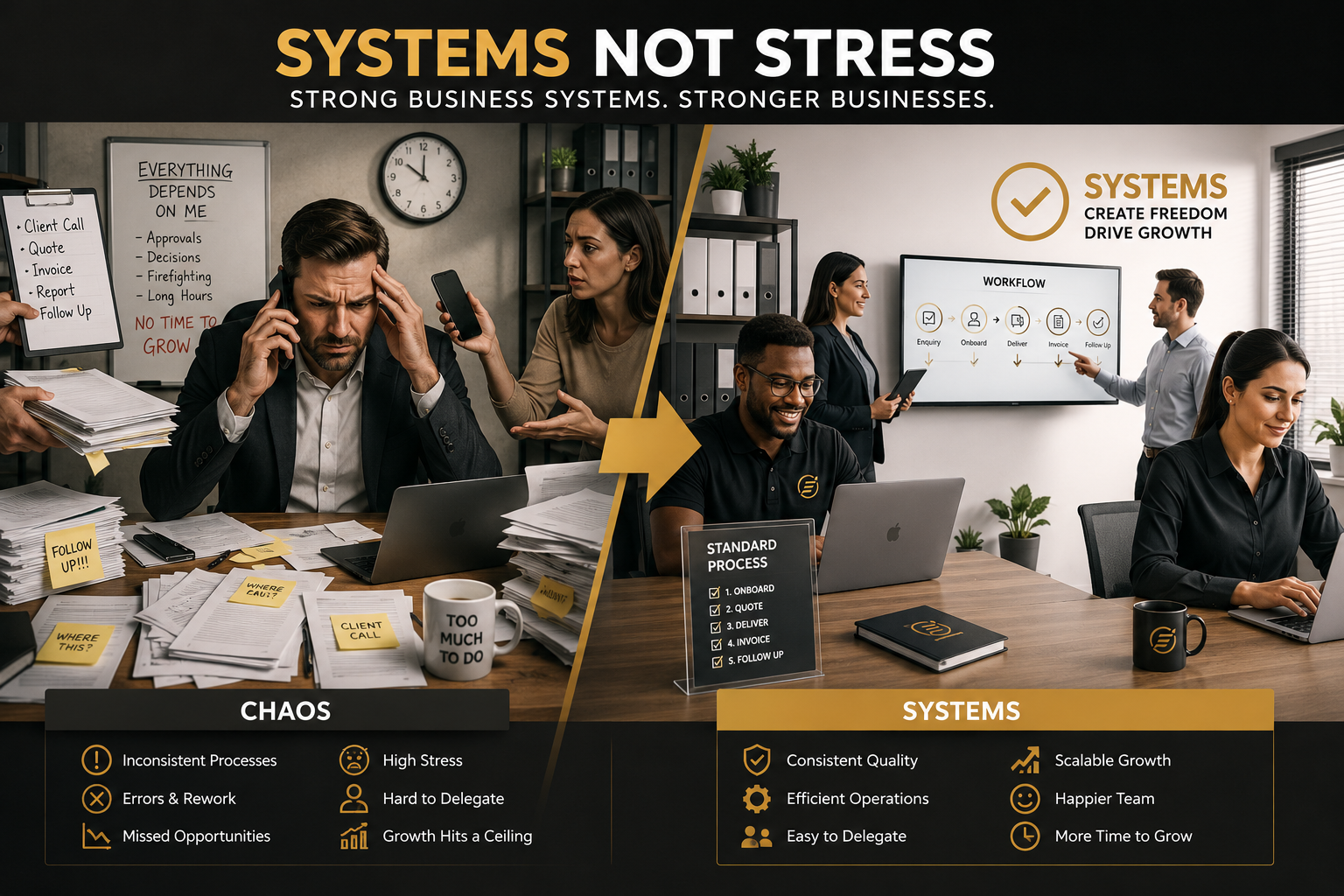
Many businesses are built on hard work.
Founders work long hours, solve problems quickly and do whatever it takes to keep customers happy. In the early stages of a business, this approach is often enough to create momentum and establish a loyal customer base.
As the business grows, however, hard work alone becomes less effective.
More customers, more employees and more complexity require a different way of operating. Businesses that continue to grow successfully usually do so because they replace reliance on memory and individual effort with well-designed business systems that create consistency, efficiency and accountability.
What Are Business Systems?
Business systems are the documented processes, procedures and workflows that guide how work is completed throughout the business.
They don’t need to be complicated.
A business system can be as simple as a customer onboarding checklist, a documented quoting process or a standard procedure for responding to customer enquiries.
The objective is not to create unnecessary administration.
The objective is to ensure that important activities are completed consistently, regardless of who performs them.
Strong business systems reduce uncertainty, improve communication and create a more reliable experience for both customers and employees.
Why Business Systems Matter
Businesses without documented systems often rely on individuals remembering how things should be done.
This may work while the team is small, but it becomes increasingly difficult as the business grows.
Staff begin performing the same task in different ways.
Important steps are forgotten.
Training takes longer because knowledge is transferred verbally rather than through documented processes.
Customers receive inconsistent service depending on who they deal with.
Strong Operations & Delivery helps businesses eliminate this inconsistency by creating repeatable ways of working that improve quality and efficiency.
Systems Improve Efficiency
One of the greatest benefits of business systems is improved efficiency.
Employees spend less time asking questions, searching for information or correcting mistakes because the correct process is already documented.
Routine tasks become easier to complete.
Managers spend less time supervising everyday activities.
Business owners are able to focus on improving the business instead of constantly solving operational problems.
Small improvements in efficiency made consistently across the business can have a significant impact on profitability, customer satisfaction and employee productivity.
Systems Make Delegation Easier
Many business owners find delegation difficult.
Often this is not because employees lack capability, but because expectations have never been documented.
When knowledge exists only in the founder’s head, every decision eventually returns to the owner.
Documented business systems create clarity.
Employees understand what is expected.
Managers are able to coach consistently.
New employees become productive more quickly because they follow established processes instead of learning everything through trial and error.
Delegation becomes far more effective when the business relies on systems rather than memory.
Systems Support Sustainable Growth
Growth places increasing pressure on every part of a business.
More customers generate more enquiries, more orders, more support requests and more operational complexity.
Without strong systems, growth often creates confusion instead of progress.
Businesses with documented processes are able to maintain quality standards while expanding their teams and customer base.
This creates confidence that growth can continue without reducing service quality or placing additional pressure on the founder.
Systems Reduce Business Risk
One of the seven pillars of the Business Evolution Framework is Resilience & Risk .
Business systems play an important role in reducing operational risk.
When critical knowledge is documented, the business is less vulnerable to staff turnover, unexpected absences or changes within the organisation.
Knowledge becomes part of the business rather than remaining with individual employees.
This creates a more resilient organisation that is better prepared for future growth and change.
Signs Your Business Needs Better Systems
Many businesses don’t realise they have a systems problem until the symptoms become obvious.
Common warning signs include:
- Staff regularly asking the same operational questions.
- Customers receiving inconsistent service.
- Important tasks being forgotten.
- New employees taking a long time to become productive.
- The owner becoming involved in every decision.
- Mistakes being repeated because there is no documented process.
These challenges are often indicators that stronger business systems are needed rather than additional staff or longer working hours.
Building Better Business Systems
Developing business systems doesn’t require expensive software or complex documentation.
Most businesses achieve significant improvements by documenting their most important recurring activities first.
Examples include:
- Customer onboarding.
- Sales and quotation processes.
- Invoice and payment procedures.
- Customer service workflows.
- Employee induction.
- Operational checklists.
As each process becomes more consistent, the business becomes easier to manage, easier to scale and less dependent on individual people.
Measure Your Operational Capability
The Business Evolution Score measures how effectively a business performs across several operational capabilities, including Operations & Delivery .
Rather than simply asking whether systems exist, the assessment evaluates how consistently they support efficiency, quality, resilience and sustainable growth.
Strong businesses are not built on hard work alone.
They are built on repeatable systems that allow ordinary business activities to be performed consistently, efficiently and with confidence every day.
Ready to Measure Your Business Evolution?
The free Business Evolution Score assessment evaluates your business across seven critical areas, helping you identify strengths, risks and the next actions that will have the biggest impact.
Whether you’re focused on growth, cashflow, marketing, leadership or resilience, you’ll receive a personalised Business Evolution Score along with practical recommendations to help your business evolve.