Tag: business systems

  • Why Business Systems Matter More Than Hard Work

    Why Business Systems Matter More Than Hard Work

    Many businesses are built on hard work.

    Founders work long hours, solve problems quickly and do whatever it takes to keep customers happy. In the early stages of a business, this approach is often enough to create momentum and establish a loyal customer base.

    As the business grows, however, hard work alone becomes less effective.

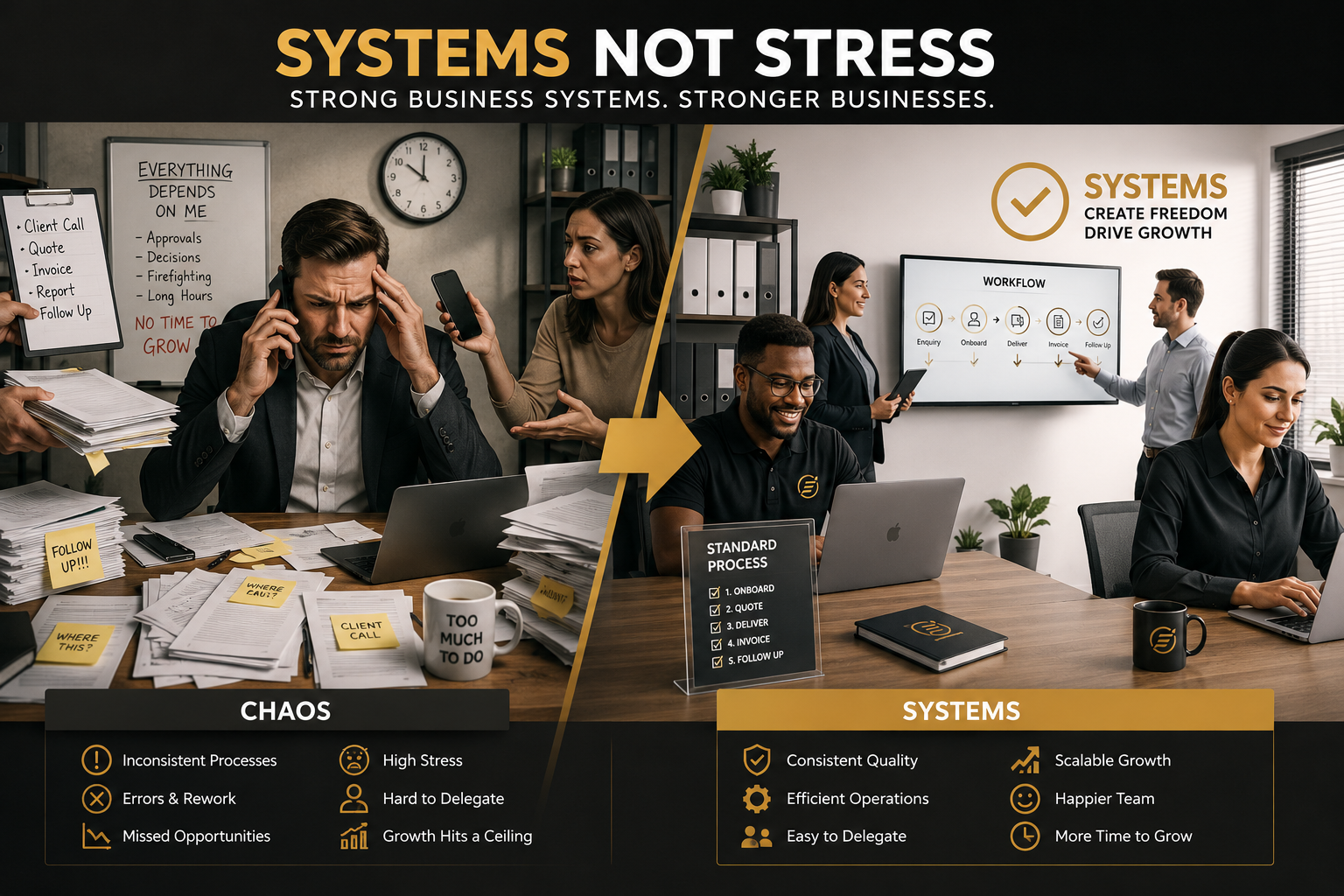
    More customers, more employees and more complexity require a different way of operating. Businesses that continue to grow successfully usually do so because they replace reliance on memory and individual effort with well-designed business systems that create consistency, efficiency and accountability.


    What Are Business Systems?

    Business systems are the documented processes, procedures and workflows that guide how work is completed throughout the business.

    They don’t need to be complicated.

    A business system can be as simple as a customer onboarding checklist, a documented quoting process or a standard procedure for responding to customer enquiries.

    The objective is not to create unnecessary administration.

    The objective is to ensure that important activities are completed consistently, regardless of who performs them.

    Strong business systems reduce uncertainty, improve communication and create a more reliable experience for both customers and employees.


    Why Business Systems Matter

    Businesses without documented systems often rely on individuals remembering how things should be done.

    This may work while the team is small, but it becomes increasingly difficult as the business grows.

    Staff begin performing the same task in different ways.

    Important steps are forgotten.

    Training takes longer because knowledge is transferred verbally rather than through documented processes.

    Customers receive inconsistent service depending on who they deal with.

    Strong Operations & Delivery helps businesses eliminate this inconsistency by creating repeatable ways of working that improve quality and efficiency.


    Systems Improve Efficiency

    One of the greatest benefits of business systems is improved efficiency.

    Employees spend less time asking questions, searching for information or correcting mistakes because the correct process is already documented.

    Routine tasks become easier to complete.

    Managers spend less time supervising everyday activities.

    Business owners are able to focus on improving the business instead of constantly solving operational problems.

    Small improvements in efficiency made consistently across the business can have a significant impact on profitability, customer satisfaction and employee productivity.


    Systems Make Delegation Easier

    Many business owners find delegation difficult.

    Often this is not because employees lack capability, but because expectations have never been documented.

    When knowledge exists only in the founder’s head, every decision eventually returns to the owner.

    Documented business systems create clarity.

    Employees understand what is expected.

    Managers are able to coach consistently.

    New employees become productive more quickly because they follow established processes instead of learning everything through trial and error.

    Delegation becomes far more effective when the business relies on systems rather than memory.


    Systems Support Sustainable Growth

    Growth places increasing pressure on every part of a business.

    More customers generate more enquiries, more orders, more support requests and more operational complexity.

    Without strong systems, growth often creates confusion instead of progress.

    Businesses with documented processes are able to maintain quality standards while expanding their teams and customer base.

    This creates confidence that growth can continue without reducing service quality or placing additional pressure on the founder.


    Systems Reduce Business Risk

    One of the seven pillars of the Business Evolution Framework is Resilience & Risk .

    Business systems play an important role in reducing operational risk.

    When critical knowledge is documented, the business is less vulnerable to staff turnover, unexpected absences or changes within the organisation.

    Knowledge becomes part of the business rather than remaining with individual employees.

    This creates a more resilient organisation that is better prepared for future growth and change.


    Signs Your Business Needs Better Systems

    Many businesses don’t realise they have a systems problem until the symptoms become obvious.

    Common warning signs include:

    • Staff regularly asking the same operational questions.
    • Customers receiving inconsistent service.
    • Important tasks being forgotten.
    • New employees taking a long time to become productive.
    • The owner becoming involved in every decision.
    • Mistakes being repeated because there is no documented process.

    These challenges are often indicators that stronger business systems are needed rather than additional staff or longer working hours.


    Building Better Business Systems

    Developing business systems doesn’t require expensive software or complex documentation.

    Most businesses achieve significant improvements by documenting their most important recurring activities first.

    Examples include:

    • Customer onboarding.
    • Sales and quotation processes.
    • Invoice and payment procedures.
    • Customer service workflows.
    • Employee induction.
    • Operational checklists.

    As each process becomes more consistent, the business becomes easier to manage, easier to scale and less dependent on individual people.


    Measure Your Operational Capability

    The Business Evolution Score measures how effectively a business performs across several operational capabilities, including Operations & Delivery .

    Rather than simply asking whether systems exist, the assessment evaluates how consistently they support efficiency, quality, resilience and sustainable growth.

    Strong businesses are not built on hard work alone.

    They are built on repeatable systems that allow ordinary business activities to be performed consistently, efficiently and with confidence every day.


    Ready to Measure Your Business Evolution?

    The free Business Evolution Score assessment evaluates your business across seven critical areas, helping you identify strengths, risks and the next actions that will have the biggest impact.

    Whether you’re focused on growth, cashflow, marketing, leadership or resilience, you’ll receive a personalised Business Evolution Score along with practical recommendations to help your business evolve.
  • The Hidden Cost of Founder Dependency

    The Hidden Cost of Founder Dependency

    Many business owners wear their busyness as a badge of honour.

    They’re involved in every important decision, approve every payment, solve every customer problem and answer every difficult question.

    At first, this feels like good leadership.

    Over time, however, it often becomes one of the biggest barriers to business growth.

    This is known as founder dependency.

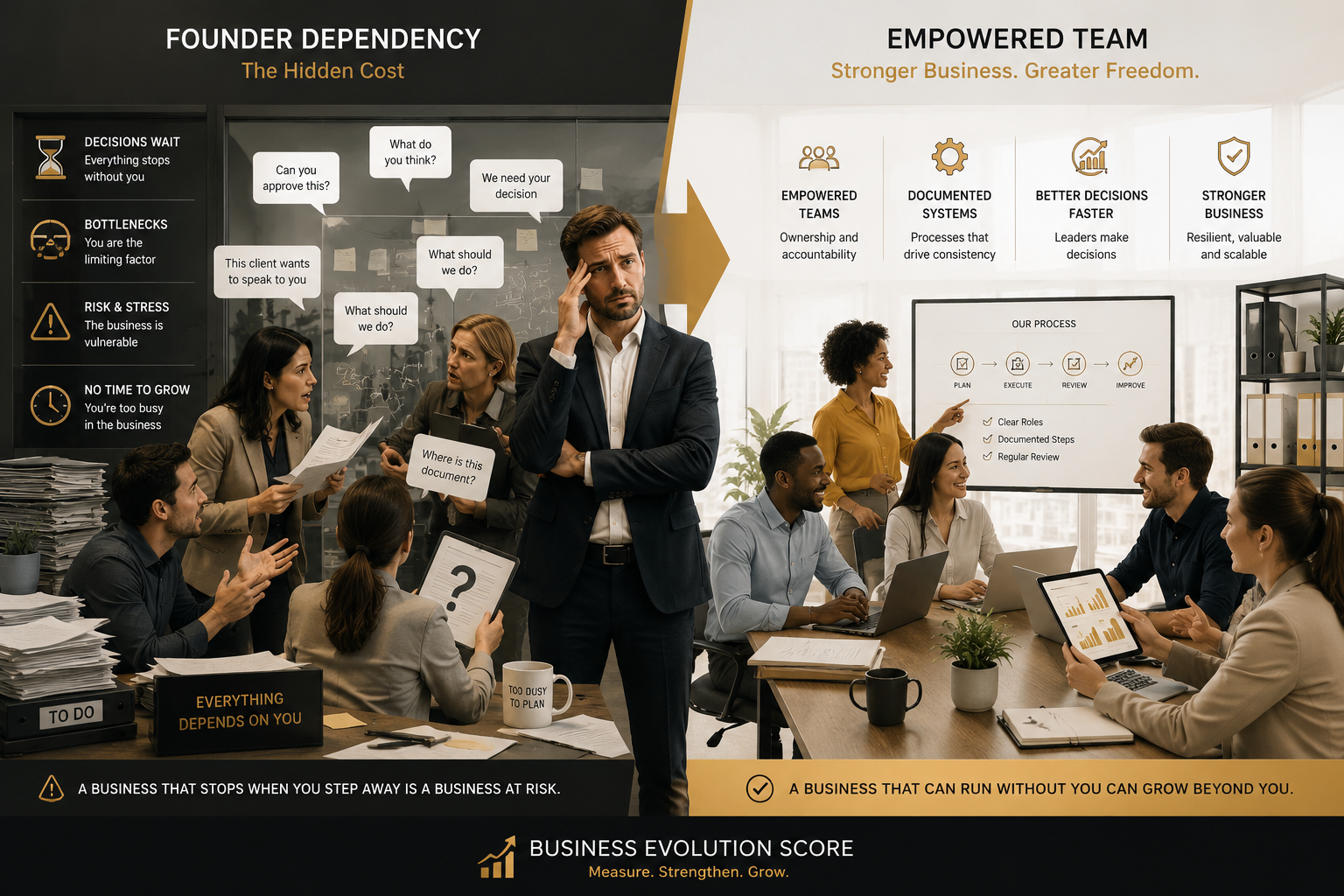
    When a business depends on one person to keep everything moving, growth becomes slower, risk increases and the long-term value of the business declines.


    What Is Founder Dependency?

    Founder dependency occurs when the owner becomes central to almost every part of the business.

    Examples include:

    • Clients only want to speak to the owner.
    • Staff wait for the owner to make decisions.
    • Sales stop when the owner isn’t involved.
    • Important knowledge exists only in the owner’s head.
    • The business struggles whenever the owner is away.

    Many small businesses start this way.

    The challenge is recognising when founder involvement becomes founder dependency.


    The Hidden Cost of Founder Dependency

    Founder dependency affects far more than the owner’s workload.

    It influences almost every aspect of the business.

    Growth Slows Down

    Every decision eventually waits for one person.

    As the business grows, this creates bottlenecks that limit capacity.


    Teams Stop Taking Ownership

    When employees believe every decision needs approval, initiative disappears.

    Strong People & Leadership encourages accountability and empowers teams to solve problems confidently.


    Customers Become Attached to One Person

    Customers often build strong relationships with founders.

    While this creates trust, it also creates risk.

    If every important relationship depends on one individual, the business becomes vulnerable.


    Business Value Declines

    Businesses that rely heavily on their founders are generally more difficult to sell.

    Potential buyers want systems, capable teams and predictable performance—not a business that depends on one person’s daily involvement.


    Founder Dependency Is Also a Risk

    One of the seven pillars of the Business Evolution Framework is Resilience & Risk.

    Founder dependency is one of the biggest risks facing many growing businesses.

    Illness, holidays or unexpected life events should not bring the business to a standstill.

    Resilient businesses are designed to continue operating even when the founder steps away.


    Reducing Founder Dependency

    Reducing founder dependency doesn’t mean becoming less involved.

    It means building a stronger business.

    Practical steps include:

    • Document important processes.
    • Delegate decision-making.
    • Develop future leaders.
    • Build systems instead of relying on memory.
    • Encourage accountability across the team.

    These improvements create a business that is stronger, healthier and easier to grow.


    Building a Business Beyond Yourself

    As I discuss in The Purposeful Entrepreneur, one of the greatest transitions for any entrepreneur is moving from being the business to building a business that can succeed without constant founder involvement.

    That shift creates freedom for the owner while making the business more resilient and valuable over the long term.


    Measure Your Founder Dependency

    The Business Evolution Score assesses founder dependency as part of its People & Leadership and Resilience & Risk pillars.

    Rather than relying on assumptions, you’ll receive practical insights into how dependent your business is on you and the steps you can take to strengthen it.

    If you’re wondering whether your business could continue operating without you for two weeks, it’s worth finding out.

    Take the free Business Evolution Score assessment and discover where your business stands.

    👉 Get My Free Business Evolution Score

  • Why Business Systems Matter: Building a Business That Can Grow Without Chaos

    Why Business Systems Matter: Building a Business That Can Grow Without Chaos


    Most business owners don’t wake up one morning and decide to create chaos.

    It happens gradually.

    The business wins more customers. The team grows. New products or services are added. Before long, everyone is busy, but nobody seems to know the best way to do things.

    The owner answers the same questions every day.

    Mistakes become more common.

    Customer experiences become inconsistent.

    Simple tasks take longer than they should.

    Sound familiar?

    The problem usually isn’t the people.

    It’s the lack of systems.

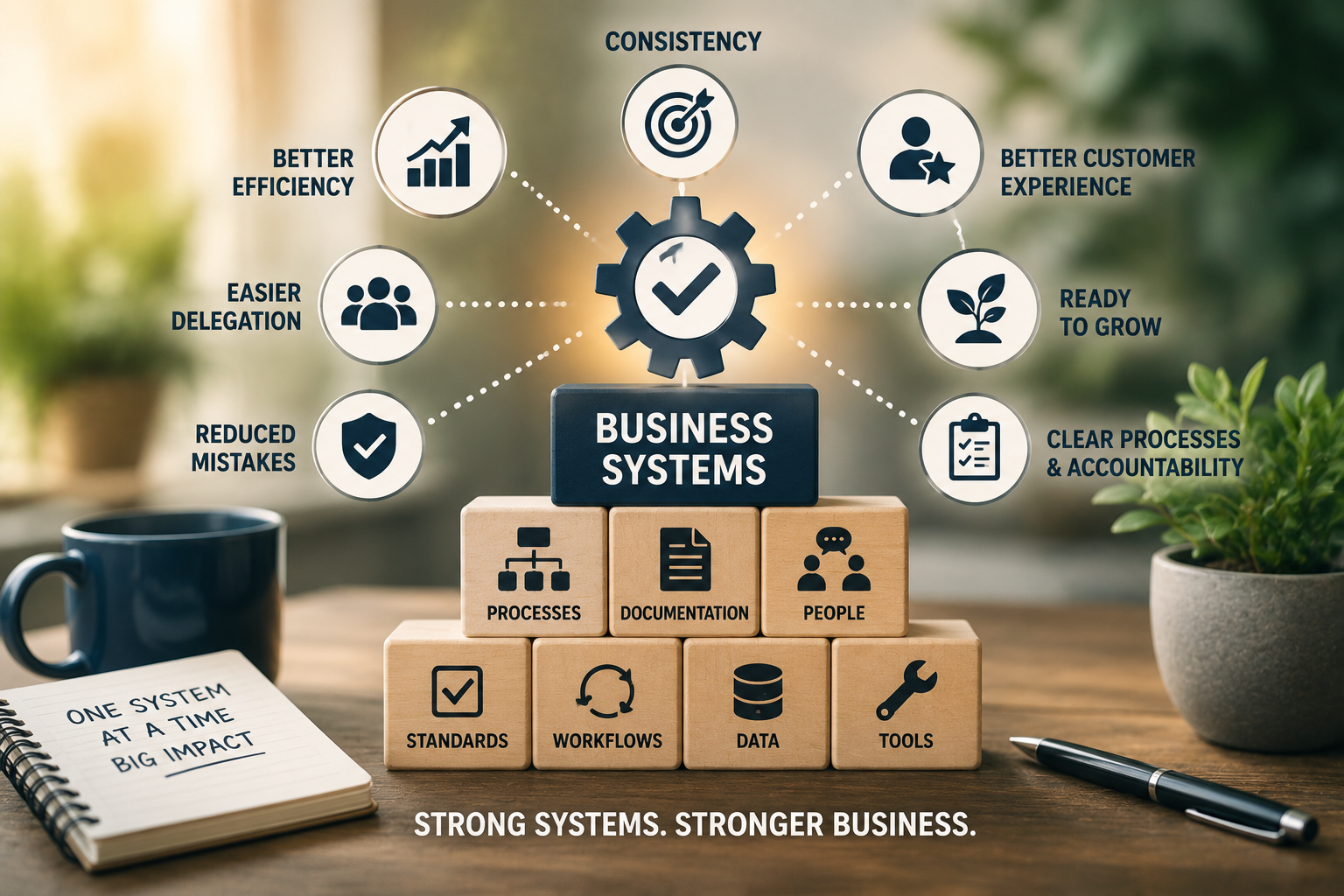
    Business systems are what allow a business to deliver consistent results, regardless of who is doing the work. They reduce confusion, improve quality and create the foundations for sustainable growth.

    Without systems, growth often creates complexity.

    With the right systems, growth becomes far more manageable.


    What Are Business Systems?

    Business systems are the documented processes, workflows and ways of working that enable a business to operate consistently.

    They’re not software.

    They’re not expensive technology.

    They’re simply agreed ways of doing important work.

    A good system answers questions like:

    • How do we onboard a new customer?
    • How do we prepare a quote?
    • How do we invoice clients?
    • How do we handle complaints?
    • How do we deliver a project?

    The Operations & Delivery pillar of the Business Evolution Framework explores how well your business delivers consistently through documented processes and operational excellence.


    Why Small Businesses Resist Systems

    Many founders believe systems are something only large companies need.

    In reality, the opposite is true.

    Small businesses have fewer people, less time and less margin for error.

    Without systems, the owner becomes the system.

    Every decision flows through one person.

    Every exception lands on the owner’s desk.

    Every new employee requires constant supervision.

    That isn’t sustainable.

    Good systems create freedom, not bureaucracy.


    Five Benefits of Strong Business Systems

    1. Consistency

    Customers expect a consistent experience every time they deal with your business.

    Systems ensure that quality doesn’t depend on who’s working that day.

    Consistency builds trust.


    2. Better Efficiency

    When everyone follows the same process, work gets done faster.

    There’s less duplication.

    Less confusion.

    Less rework.

    Efficiency improves naturally because the team spends less time figuring out what to do.


    3. Easier Delegation

    One of the biggest reasons founders struggle to delegate is that nothing has been documented.

    People can’t follow a process that only exists in the owner’s head.

    Documented systems make delegation far easier.

    The People & Leadership pillar explores how delegation reduces founder dependency and creates stronger teams.


    4. Better Customer Experience

    Reliable systems create reliable service.

    Customers receive consistent communication.

    Projects are delivered on time.

    Problems are resolved more quickly.

    Over time, this consistency becomes a competitive advantage.

    The Customers & Revenue pillar explains how delivering consistently helps improve customer retention and long-term revenue.


    5. Businesses That Can Scale

    Growth places pressure on every business.

    Without systems, pressure creates chaos.

    With systems, pressure becomes manageable because the business already knows how work should flow.

    That’s one of the reasons operational maturity plays such an important role in long-term growth.


    Systems Don’t Need To Be Complicated

    Many business owners imagine thick operations manuals that nobody reads.

    That’s not what we’re talking about.

    A good business system can be:

    • A simple checklist
    • A one-page process
    • A documented workflow
    • A standard operating procedure
    • A shared template

    The goal isn’t perfection.

    The goal is consistency.

    Start with the activities your business performs every day.

    Improve one system at a time.


    Signs Your Business Needs Better Systems

    Ask yourself a few questions.

    • Do people regularly ask how to do routine tasks?
    • Does work get completed differently depending on who does it?
    • Are mistakes becoming more common?
    • Does the owner answer the same questions every day?
    • Is onboarding new staff difficult?
    • Does quality vary between projects?

    If you answered “yes” to several of these questions, improving your business systems could have one of the biggest impacts on your business.


    Systems Support Strategic Growth

    Many businesses focus on sales while overlooking operations.

    But growth without systems often creates stress rather than success.

    Strong businesses improve both.

    The Strategy & Growth pillar looks at how planning, decision-making and operational readiness support sustainable business growth.

    Likewise, resilient businesses rely on strong systems to maintain quality and adapt when circumstances change. Learn more in the Resilience & Risk pillar.


    Build Systems Before You Need Them

    The best time to improve your systems isn’t after your business becomes overwhelmed.

    It’s before.

    Every documented process, checklist and workflow reduces complexity and creates a stronger foundation for growth.

    You don’t need hundreds of systems.

    You simply need the right systems for the stage your business is in today.

    Over time, those small improvements compound into a business that’s easier to manage, easier to grow and more valuable.


    Continue Exploring


    Ready to Measure Your Business Evolution?

    The free Business Evolution Score assessment evaluates your business across seven critical areas, helping you identify strengths, risks and the next actions that will have the biggest impact.

    Whether you’re focused on growth, cashflow, marketing, leadership or resilience, you’ll receive a personalised Business Evolution Score along with practical recommendations to help your business evolve.

  • Founder Dependency: The Growth Problem Most Business Owners Ignore

    Founder Dependency: The Growth Problem Most Business Owners Ignore

    Introduction

    Many small businesses start with a founder who does everything.

    They generate sales, solve problems, manage customers, oversee delivery, handle finances and make most of the important decisions.

    In the early stages this level of involvement is often necessary.

    The problem is that what helps a business survive can eventually prevent it from growing.

    This is known as founder dependency.

    When too much knowledge, responsibility and decision-making sits with one person, the business becomes difficult to scale and vulnerable to disruption.


    What Is Founder Dependency?

    Founder dependency exists when the business relies heavily on the owner for day-to-day operations and key decisions.

    Common signs include:

    • Customers always ask for the owner
    • Team members cannot make decisions independently
    • Key processes exist only in the founder’s head
    • The business slows down when the owner is away
    • Growth creates stress rather than opportunity

    The owner becomes the bottleneck.


    Why Founder Dependency Is Risky

    Growth Becomes Limited

    A founder only has so many hours available.

    Eventually growth reaches a point where the owner cannot personally manage everything.

    Decision-Making Slows Down

    When every decision requires founder approval, work becomes delayed and opportunities can be missed.

    Team Development Suffers

    Employees may avoid taking ownership if they know the owner will ultimately make every decision.

    Business Value Decreases

    A business that depends entirely on its founder is often less attractive to investors or potential buyers.


    Quick Self-Assessment: Is Your Business Too Dependent On You?

    Ask yourself the following questions:

    • Can the business operate effectively for two weeks without you?
    • Can team members make routine decisions without your approval?
    • Are key processes documented and repeatable?
    • Do customers have relationships with the business, or only with you?
    • Would important work continue if you were unavailable tomorrow?

    If you answered “No” to most of these questions, founder dependency may be limiting your growth and increasing business risk.


    How To Reduce Founder Dependency

    Document Key Processes

    Create simple documentation for recurring activities.

    The goal is not complexity.

    The goal is consistency.

    Delegate Outcomes, Not Tasks

    Give team members ownership of results rather than isolated tasks.

    Develop Leaders

    Identify people who can take responsibility for specific areas of the business.

    Build Accountability

    Ensure responsibilities are clearly defined and measured.

    Make Knowledge Transfer A Priority

    Critical information should not live in one person’s head.


    The Goal Is Not To Become Invisible

    Reducing founder dependency does not mean removing the owner from the business.

    It means creating a business that can function effectively without requiring the founder to be involved in every decision and activity.

    The owner should be able to focus on strategy, growth and leadership rather than constantly solving operational problems.


    Related Business Evolution Pillars

    Founder dependency affects more than leadership. It can influence growth, operational performance and business resilience.

    People & Leadership

    The People & Leadership pillar measures how effectively responsibility is shared across the business. Areas such as delegation, accountability, communication and leadership development all contribute to reducing dependence on the owner.

    Resilience & Risk

    Founder dependency is also a business risk. If critical decisions, customer relationships or operational knowledge sit with one person, the business becomes vulnerable when that person is unavailable. The Resilience & Risk pillar evaluates founder dependence, key person risk, knowledge documentation and succession readiness.

    Strategy & Growth

    Many businesses struggle to scale because the owner becomes the bottleneck. Strong growth often requires systems, delegation and leadership capability that allow the business to grow beyond the founder’s direct involvement.


    Final Thoughts

    Many business owners believe growth requires working harder.

    In reality, sustainable growth often requires building systems, developing people and reducing dependency on the founder.

    A healthy business should be able to continue operating even when the owner is not directly involved in every activity.


    Ready to Measure Your Business Evolution?

    The free Business Evolution Score assessment evaluates your business across seven critical areas, helping you identify strengths, risks and the next actions that will have the biggest impact.

    Whether you’re focused on growth, cashflow, marketing, leadership or resilience, you’ll receive a personalised Business Evolution Score along with practical recommendations to help your business evolve.