Most business owners don’t wake up one morning and decide to create chaos.
It happens gradually.
The business wins more customers. The team grows. New products or services are added. Before long, everyone is busy, but nobody seems to know the best way to do things.
The owner answers the same questions every day.
Mistakes become more common.
Customer experiences become inconsistent.
Simple tasks take longer than they should.
Sound familiar?
The problem usually isn’t the people.
It’s the lack of systems.
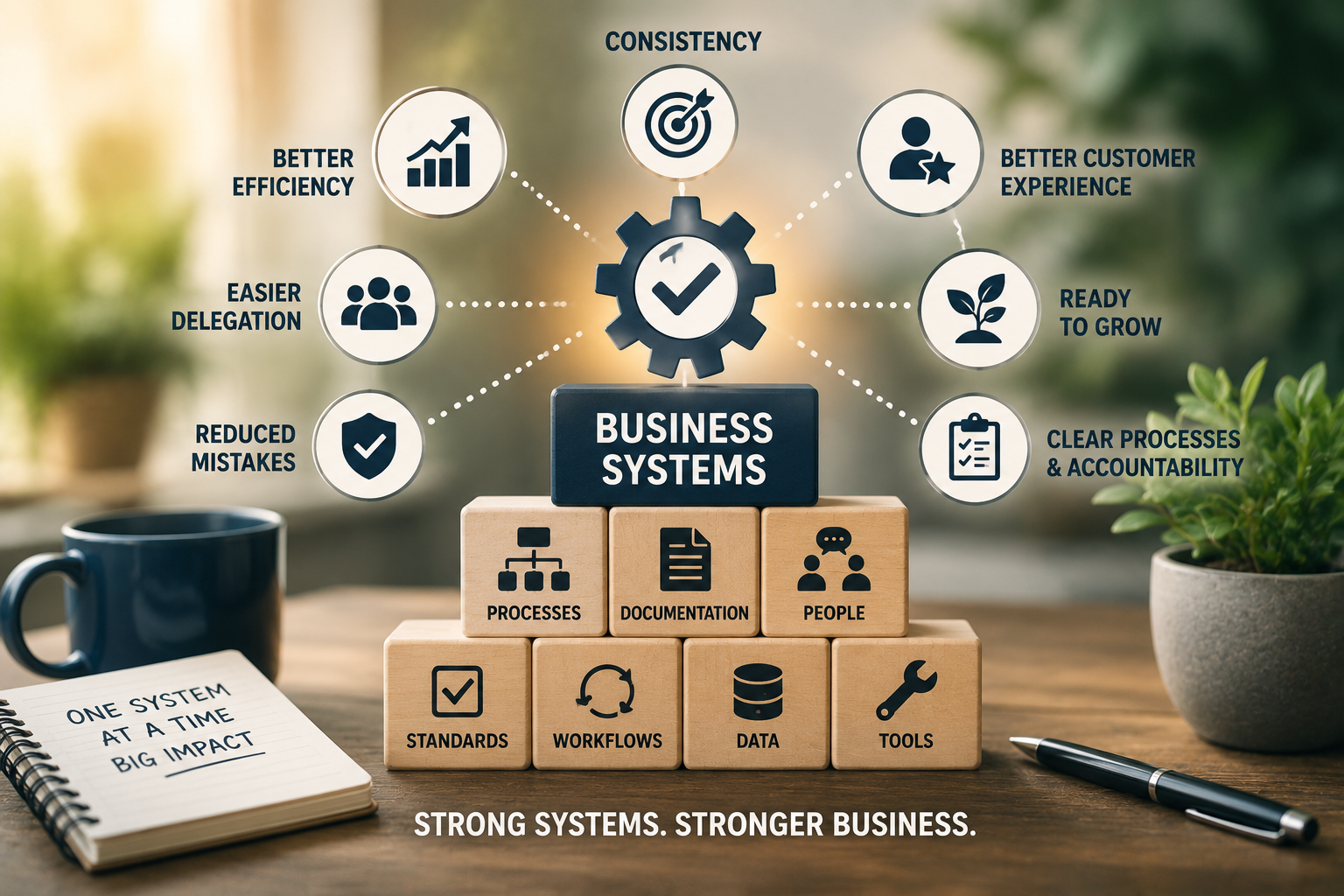
Business systems are what allow a business to deliver consistent results, regardless of who is doing the work. They reduce confusion, improve quality and create the foundations for sustainable growth.
Without systems, growth often creates complexity.
With the right systems, growth becomes far more manageable.
What Are Business Systems?
Business systems are the documented processes, workflows and ways of working that enable a business to operate consistently.
They’re not software.
They’re not expensive technology.
They’re simply agreed ways of doing important work.
A good system answers questions like:
- How do we onboard a new customer?
- How do we prepare a quote?
- How do we invoice clients?
- How do we handle complaints?
- How do we deliver a project?
The Operations & Delivery pillar of the Business Evolution Framework explores how well your business delivers consistently through documented processes and operational excellence.
Why Small Businesses Resist Systems
Many founders believe systems are something only large companies need.
In reality, the opposite is true.
Small businesses have fewer people, less time and less margin for error.
Without systems, the owner becomes the system.
Every decision flows through one person.
Every exception lands on the owner’s desk.
Every new employee requires constant supervision.
That isn’t sustainable.
Good systems create freedom, not bureaucracy.
Five Benefits of Strong Business Systems
1. Consistency
Customers expect a consistent experience every time they deal with your business.
Systems ensure that quality doesn’t depend on who’s working that day.
Consistency builds trust.
2. Better Efficiency
When everyone follows the same process, work gets done faster.
There’s less duplication.
Less confusion.
Less rework.
Efficiency improves naturally because the team spends less time figuring out what to do.
3. Easier Delegation
One of the biggest reasons founders struggle to delegate is that nothing has been documented.
People can’t follow a process that only exists in the owner’s head.
Documented systems make delegation far easier.
The People & Leadership pillar explores how delegation reduces founder dependency and creates stronger teams.
4. Better Customer Experience
Reliable systems create reliable service.
Customers receive consistent communication.
Projects are delivered on time.
Problems are resolved more quickly.
Over time, this consistency becomes a competitive advantage.
The Customers & Revenue pillar explains how delivering consistently helps improve customer retention and long-term revenue.
5. Businesses That Can Scale
Growth places pressure on every business.
Without systems, pressure creates chaos.
With systems, pressure becomes manageable because the business already knows how work should flow.
That’s one of the reasons operational maturity plays such an important role in long-term growth.
Systems Don’t Need To Be Complicated
Many business owners imagine thick operations manuals that nobody reads.
That’s not what we’re talking about.
A good business system can be:
- A simple checklist
- A one-page process
- A documented workflow
- A standard operating procedure
- A shared template
The goal isn’t perfection.
The goal is consistency.
Start with the activities your business performs every day.
Improve one system at a time.
Signs Your Business Needs Better Systems
Ask yourself a few questions.
- Do people regularly ask how to do routine tasks?
- Does work get completed differently depending on who does it?
- Are mistakes becoming more common?
- Does the owner answer the same questions every day?
- Is onboarding new staff difficult?
- Does quality vary between projects?
If you answered “yes” to several of these questions, improving your business systems could have one of the biggest impacts on your business.
Systems Support Strategic Growth
Many businesses focus on sales while overlooking operations.
But growth without systems often creates stress rather than success.
Strong businesses improve both.
The Strategy & Growth pillar looks at how planning, decision-making and operational readiness support sustainable business growth.
Likewise, resilient businesses rely on strong systems to maintain quality and adapt when circumstances change. Learn more in the Resilience & Risk pillar.
Build Systems Before You Need Them
The best time to improve your systems isn’t after your business becomes overwhelmed.
It’s before.
Every documented process, checklist and workflow reduces complexity and creates a stronger foundation for growth.
You don’t need hundreds of systems.
You simply need the right systems for the stage your business is in today.
Over time, those small improvements compound into a business that’s easier to manage, easier to grow and more valuable.
Continue Exploring
Ready to Measure Your Business Evolution?
The free Business Evolution Score assessment evaluates your business across seven critical areas, helping you identify strengths, risks and the next actions that will have the biggest impact.
Whether you’re focused on growth, cashflow, marketing, leadership or resilience, you’ll receive a personalised Business Evolution Score along with practical recommendations to help your business evolve.