Growth is one of those words we use constantly in business.
We talk about growing revenue, growing the team, winning more customers and expanding into new markets. If this year’s turnover is higher than last year’s, we naturally assume the business is moving in the right direction.
And often it is.
Some of the biggest business growth challenges begin when increased revenue, more customers and a larger team stop translating into a stronger business.
But there comes a point in many businesses where something strange starts happening. Revenue continues to increase, there is more work than ever before, the team is larger and everybody seems incredibly busy — yet somehow the business doesn’t feel stronger.
Cash is still tight. Margins aren’t improving. Customer problems seem to take longer to resolve. The founder is working harder than ever and adding another employee somehow hasn’t created the breathing room everyone expected.
That’s when it’s worth asking a slightly different question.
Is the business actually growing, or have we simply created a bigger workload?
There is an important difference between the two.
More Revenue Doesn’t Automatically Mean a Better Business
Revenue is an obvious measure of growth because it’s easy to see. If turnover increases from R5 million to R7 million, something has clearly grown.
What the revenue number doesn’t tell you is what happened underneath it.
Perhaps you needed three additional employees to generate that extra R2 million. Maybe your gross margin declined because the new work was more price-sensitive. Perhaps customers are taking longer to pay, which means the business needs considerably more working capital just to support the additional sales.
You might even discover that the extra revenue has created more complexity than profit.
None of this means revenue growth is bad. Businesses need customers and sales, and most owners would rather deal with the challenges created by demand than the problems caused by having none.
The point is simply that revenue growth and business improvement aren’t always the same thing.
A healthier question is whether the growth is creating a business with greater capability than the one you had before.
The Systems That Got You Here May Not Get You There
Small businesses are remarkably good at finding ways to make things work.
When there are five people in the company, communication can happen across the room. Everyone knows what is happening with the important customers. The founder remembers most of the commitments that have been made, and if something goes wrong, somebody normally notices and sorts it out.
There may not be much process, but there doesn’t need to be. The business is small enough that people can fill in the gaps.
Then the company grows.
There are twelve people instead of five. There are more customers, more projects and more conversations happening at the same time. The founder can no longer know everything that’s going on, but the business still operates as though they do.
Things begin slipping through the cracks.
Another person gets hired to help.
For a while, that solves the immediate problem. Then more work arrives and another person is needed. Before long, the business has added a surprising amount of cost without really changing the way the work gets done.
This is one of the reasons growth can feel so exhausting.
The business has become larger, but its operating model hasn’t evolved with it.
Adding people to a broken process usually gives you a more expensive broken process.
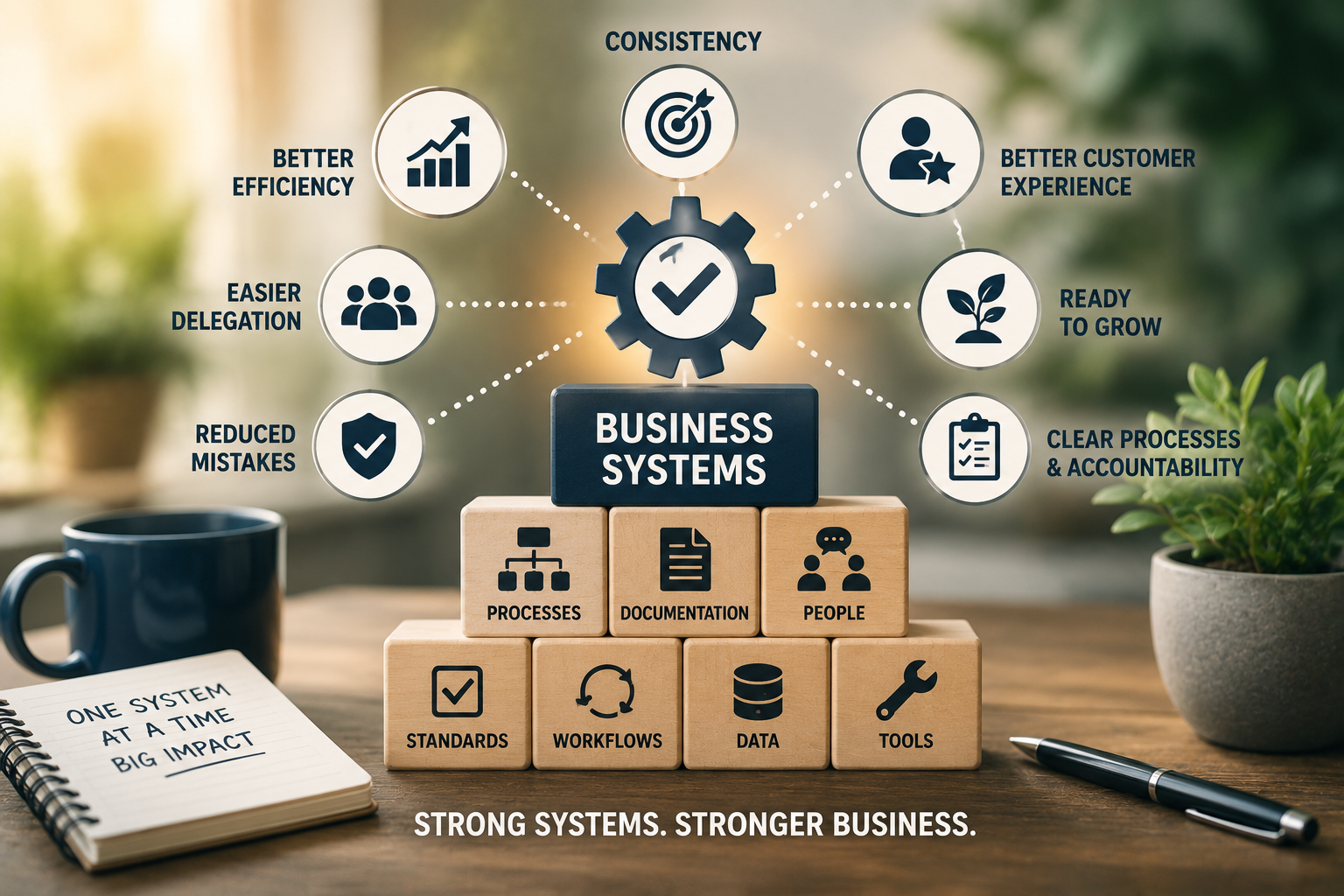
There comes a stage where growth requires something different: clearer responsibilities, better processes, useful systems, stronger management and more deliberate ways of getting work through the business. This is where Operations & Delivery becomes increasingly important as a business grows.
Not because you’re trying to turn a small company into a corporate bureaucracy, but because informal coordination has limits.
Busyness Can Hide Problems for a Long Time
A very busy business can feel reassuring.
Phones are ringing. Orders are coming in. Everyone has a full diary. The team is working late and customers are waiting for delivery.
It certainly doesn’t look like a business with a demand problem.
But busyness can hide inefficiency remarkably well.
If the team is constantly rushing, nobody has time to ask why the same problem keeps happening. Work gets fixed rather than improved. Customer requests are handled manually because building a better process can wait until things quieten down.
Of course, things never quieten down.
The founder becomes the person who solves exceptions because it’s quicker than teaching somebody else. Experienced employees become indispensable because important knowledge lives in their heads. Meetings multiply because the systems don’t provide enough visibility into what is actually happening.
Everybody is working hard.
That’s not the same thing as everybody being productive.
And it’s certainly not the same thing as building capacity.
Growth Should Create Capacity Somewhere
One of the things I would look for in a growing business is whether investment is eventually creating more capacity.
If you hire another employee, does the business eventually become capable of handling more work without everyone else working longer hours?
If you implement a better system, does something become easier, faster or more reliable?
If you improve a process, does it reduce mistakes, shorten delivery times or remove unnecessary decisions?
If you develop someone into a manager, does the founder genuinely become less involved in the day-to-day work that person now owns?
Not every investment produces an immediate return. Sometimes you deliberately create spare capacity before the revenue arrives. Sometimes a new employee needs months before they’re fully productive. Systems take time to implement and processes need to settle.
That’s normal.
The important thing is whether the business is gradually becoming more capable, rather than simply more expensive.
The Founder Is Often the Best Warning Sign
There’s another measure of growth that rarely appears on a management report.
Look at the founder.
As the business has grown, has their role changed?
In the early stages, the founder naturally does almost everything. They sell, solve customer problems, approve purchases, manage employees, check the bank account and make most of the important decisions.
That’s not necessarily founder dependency. At that stage, it’s simply called starting a business.
But if the company has doubled or tripled in size and the founder is still involved in exactly the same decisions, something hasn’t evolved.
In fact, the founder can become busier as the business grows because more people and more customers create more questions requiring their attention.
Eventually, every road leads back to the same person.
That creates a ceiling.
The business may continue increasing revenue, but its ability to grow becomes constrained by the founder’s time, attention and decision-making capacity.
If every additional million in revenue requires more of the founder, the business may be scaling its dependency rather than scaling its capability.
That doesn’t mean the founder should disappear from the business. It means their contribution should evolve as the company does. That evolution is an important part of People & Leadership as a business moves beyond being dependent on the founder for every important decision.
Cash Can Get Worse While Sales Get Better
One of the more confusing experiences in a growing business is watching sales increase while the bank account becomes progressively more uncomfortable.
Growth often requires cash before it produces cash.
You may need to hire employees before they generate revenue. Buy stock before customers purchase it. Pay suppliers before customers pay you. Invest in vehicles, equipment, technology or marketing before the return arrives.
The faster the business grows, the larger those requirements can become.
This is why looking only at sales can give a very misleading picture of growth. A company can have a record year for revenue and still find itself under enormous financial pressure.
Healthy growth therefore needs to consider Finance & Cashflow alongside sales. Can the business afford the growth it is pursuing? Does it understand the working capital required? Are margins improving, holding steady or quietly deteriorating?
Growth that continuously consumes more cash without creating stronger economics eventually becomes difficult to sustain.
So How Do You Know Whether You’re Really Growing?
There isn’t one perfect measure.
I wouldn’t replace the obsession with revenue with an obsession over another single number. Business health doesn’t work like that.
Instead, I’d look at the direction of several things together.
Is revenue growing while profitability remains healthy? Is the business generating enough cash to support itself? Is delivery becoming more reliable? Are systems and processes allowing more work to flow through the business without a proportional increase in effort?
Is the team developing greater capability? Are decisions moving to the right people? Is the founder gradually spending more time on where the business is going and less time rescuing today’s problems?
And perhaps most importantly: is the business becoming easier to operate as it becomes larger, or progressively harder?
Not every answer needs to improve every year. Growth is messy, and there will be periods where investment makes the numbers or workload look worse before they get better.
What matters is the overall direction.
Sometimes Slowing Down Is Part of Growing Up
There is enormous pressure on entrepreneurs to keep pushing for more.
More revenue. More employees. More customers. More locations.
But sometimes the smartest growth decision is to stop adding complexity for a while and strengthen what you’ve already built.
That might mean documenting a process that only one employee understands. Developing a manager. Improving financial reporting. Fixing a delivery bottleneck. Implementing a system properly instead of adding another workaround.
It may mean saying no to certain work because the margin doesn’t justify the complexity it creates.
From the outside, that period might not look particularly exciting. Revenue growth could even slow temporarily.
Inside the business, however, something important is happening.
You’re building the capacity that makes the next stage possible.
That’s not a failure to grow.
That’s part of growing up.
A Bigger Business Should Eventually Become a Stronger Business
There will always be periods when growth feels uncomfortable.
A growing company stretches people, systems and cash. Problems that didn’t matter at one size suddenly become important at another. Things that used to happen naturally need to become more deliberate.
That’s part of business evolution.
The danger is when constant pressure becomes normal and everyone assumes that’s simply what growth feels like.
It doesn’t have to be.
The goal isn’t to build the largest business possible. It’s to build the business you actually want — one that works commercially, serves its customers well and doesn’t become progressively more fragile every time it grows.
Revenue matters.
Customers matter.
Growth matters.
But ultimately:
Growth should eventually make the business stronger, not simply make everybody busier.
Is Your Business Becoming Stronger as It Grows?
Growth is only one part of business health. The Business Evolution Score looks across Strategy & Growth together with Operations & Delivery, Finance & Cashflow, Customers & Revenue, Marketing & Demand, People & Leadership, and Resilience & Risk.
The free assessment helps you step back from the day-to-day activity and look at how the business is actually performing across all seven areas. You’ll receive your overall Business Health Score, pillar scores, key strengths and risks, practical recommendations and a personalised 90-day action plan.
Take the Business Evolution Score →
Author’s Note
Michael Hamilton is an entrepreneur, author of The Purposeful Entrepreneur, and founder of Business Evolution Score. Having built and worked with businesses across multiple industries, he created Business Evolution Score to give business owners a practical framework for understanding, measuring and improving the health of their businesses.