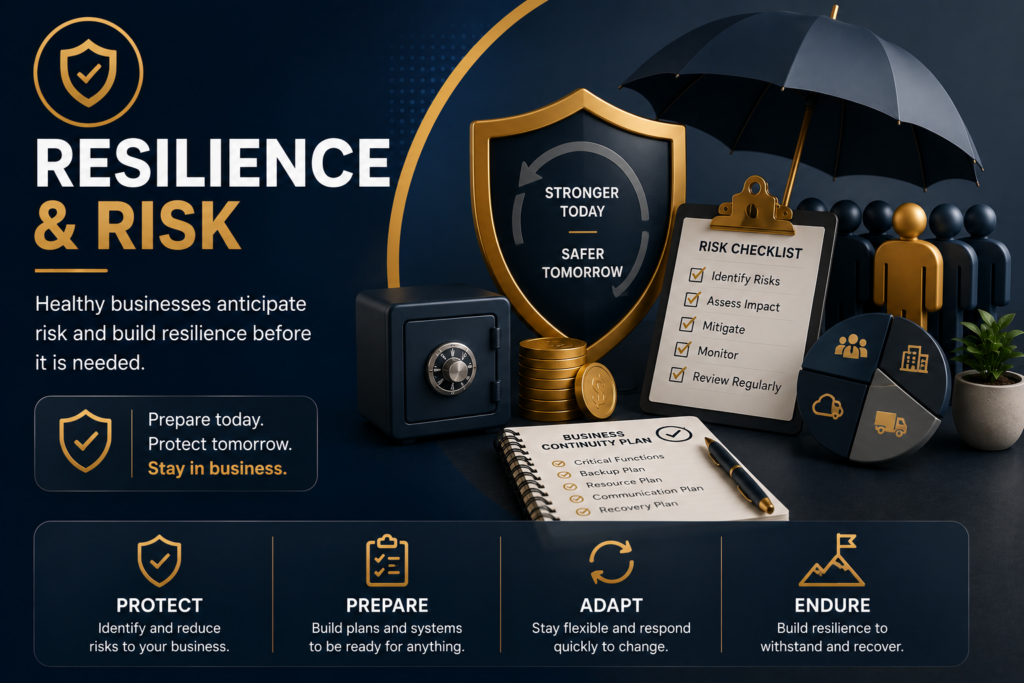
How Resilient Is Your Business?
Every business faces uncertainty.
Markets change, customers leave, economic conditions shift and unexpected challenges emerge. Businesses that survive and thrive are not necessarily those that avoid risk, but those that understand and manage it effectively.
The Resilience & Risk pillar evaluates how prepared your business is to withstand disruption, reduce vulnerability and recover from setbacks.
Strong businesses build resilience by reducing dependency, diversifying risk and strengthening their foundations over time.
Why Resilience & Risk Matters
Strong resilience helps businesses:
- Reduce vulnerability
- Manage uncertainty
- Protect revenue
- Improve stability
- Support sustainable growth
- Recover more quickly from setbacks
Businesses that ignore risk often discover weaknesses only when a crisis occurs.
Understanding risk before problems arise allows business owners to make better decisions and build stronger foundations.
Common Challenges Business Owners Face
Many businesses experience one or more of the following risks.
Founder Dependency
The business relies heavily on the owner for sales, delivery, decision-making or customer relationships.
Customer Concentration
A significant percentage of revenue comes from a small number of customers.
Limited Cash Reserves
The business lacks sufficient financial buffers to manage unexpected challenges.
Operational Vulnerability
Key processes depend on individuals, undocumented knowledge or informal systems.
Lack Of Risk Planning
Potential threats have not been identified or considered.
What Healthy Businesses Do Differently
Businesses with strong resilience typically:
Reduce Founder Dependency
Knowledge, responsibilities and relationships are distributed throughout the organisation.
Diversify Revenue Sources
Revenue is spread across multiple customers, markets or offerings.
Build Financial Buffers
Cash reserves help absorb unexpected shocks.
Document Critical Processes
Important activities can continue even if key individuals are unavailable.
Plan For Disruption
Potential risks are identified and contingency plans are considered.
How Business Evolution Score Measures Resilience & Risk
The Resilience & Risk pillar evaluates several important business capabilities.
Founder Dependency
How reliant is the business on the owner?
Customer Concentration
Does the business depend too heavily on a small number of customers?
Financial Resilience
Can the business withstand financial disruption?
Business Continuity
Can critical operations continue during unexpected events?
Risk Awareness
Does the business actively identify and manage risk?
Together, these capabilities provide a clear picture of business resilience and long-term sustainability.
Signs This Area May Need Attention
Your Resilience & Risk score may require attention if:
- The business cannot operate effectively without the founder
- A single customer represents a large portion of revenue
- Cash reserves are limited
- Critical processes are undocumented
- Key knowledge is concentrated in a few individuals
- Risks are rarely discussed or reviewed
- Unexpected events create significant disruption
Addressing these issues can improve stability, confidence and long-term sustainability.
Improving Your Resilience & Risk Score
Building resilience often starts with practical improvements.
Consider:
- Documenting key business processes
- Reducing founder dependency
- Diversifying revenue sources
- Building emergency cash reserves
- Identifying critical business risks
- Reviewing continuity plans
- Strengthening operational systems
Small improvements made consistently can significantly reduce vulnerability over time.
Strong Businesses Prepare For Uncertainty
No business can predict every challenge.
However, resilient businesses prepare for uncertainty by building strong foundations, reducing avoidable risks and developing the ability to adapt.
The goal is not to eliminate risk.
The goal is to create a business that can continue moving forward despite change and disruption.
Measure. Improve. Evolve.
The Business Evolution Score helps business owners understand how resilient their business is and where vulnerabilities may exist.
By assessing Resilience & Risk alongside the other key business pillars, owners gain a more complete picture of business health, stability and long-term sustainability.
How Resilience & Risk Connects To Other Business Areas
Risk exists across every part of a business.
Customer concentration affects revenue stability. Founder dependency impacts leadership effectiveness. Weak financial management increases vulnerability during periods of uncertainty.
Explore the related pillars:
Ready To Discover Your Score?
Find out how your business performs across Resilience & Risk and six other critical business areas.
Get your Business Evolution Score in less than 10 minutes.