If I asked you how your business was performing, what would be the first number that comes to mind?
For many business owners, it’s revenue. Others might think about profit, cash in the bank or perhaps the number of new customers they’ve won this month. These are all important measures, and every business owner should keep an eye on them. The problem is that, on their own, they don’t tell you whether your business is actually healthy.
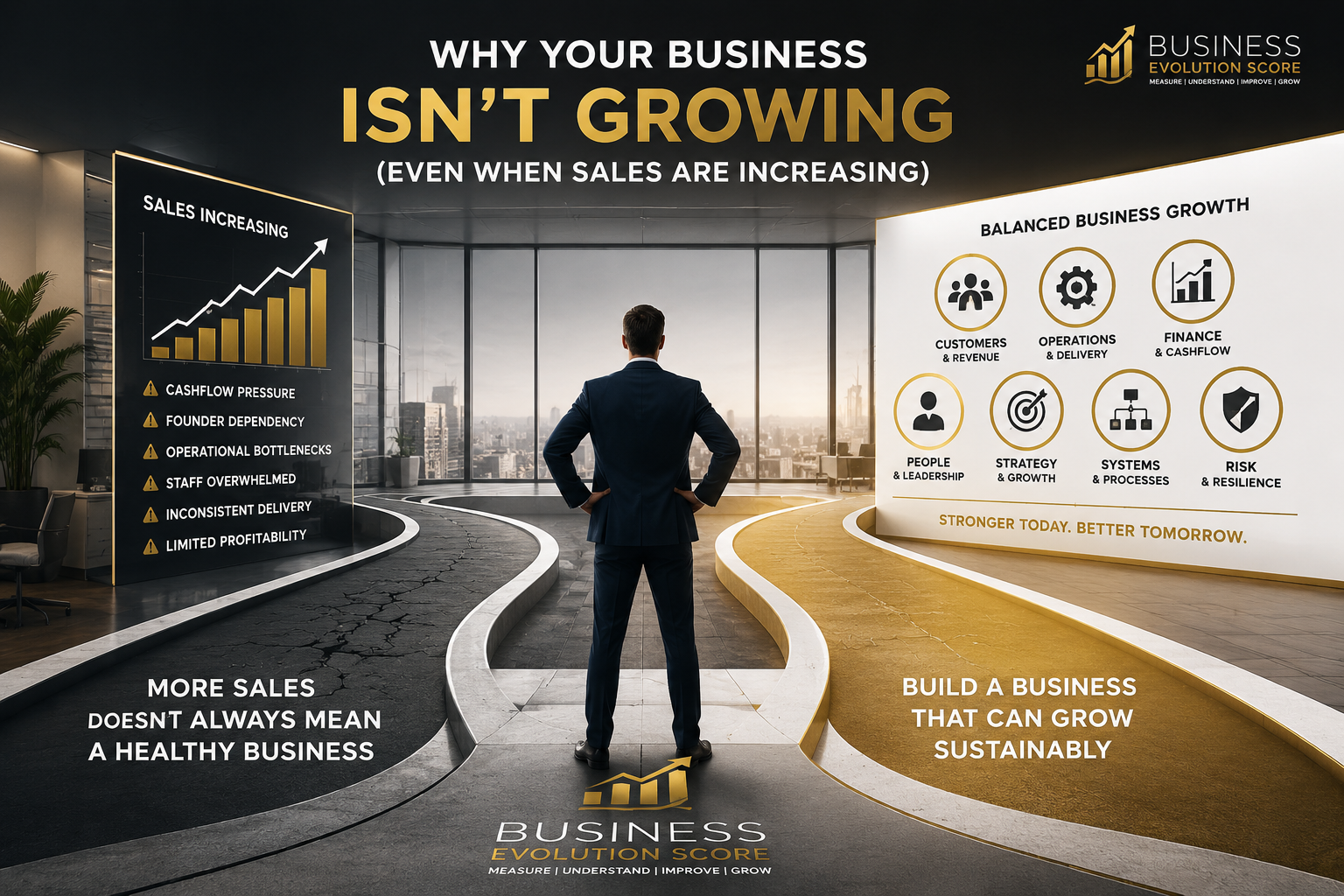
Over the years, I’ve met businesses that appeared to be thriving. Sales were growing, the phones were ringing and the team was expanding. From the outside, they looked like success stories. Yet, after spending a little time with the owners, a different picture often emerged. Cash flow was under pressure, one or two customers accounted for most of the revenue, the owner was working longer hours than ever, and there was no clear plan for the future.
I’ve also met businesses that weren’t growing at breakneck speed. They weren’t making headlines or winning awards, but they had loyal customers, healthy cash reserves, efficient systems and owners who could confidently step away for a few days without worrying that everything would fall apart. Those businesses were healthy.
That experience taught me an important lesson. A successful business and a healthy business are not always the same thing.
Looking Beyond the Financials
When people think about business performance, financial results naturally dominate the conversation. Revenue, profit and cash flow are essential, but they’re outcomes. They tell you what has happened, not necessarily why it happened or whether it can be sustained.
Imagine going for an annual health check. Your doctor wouldn’t base their diagnosis solely on your weight or your blood pressure. They would consider a range of factors before forming a view of your overall health.
Businesses deserve the same approach.
A company might be profitable today because it has one large customer, but what happens if that customer leaves? Another business may have strong sales, but inefficient processes mean every new client creates more stress rather than more profit. A third business might have excellent systems but struggle to generate enough new opportunities because its marketing has been neglected.
Each of these businesses has strengths, but each also carries risks that may not be obvious if you’re only looking at the financial statements.
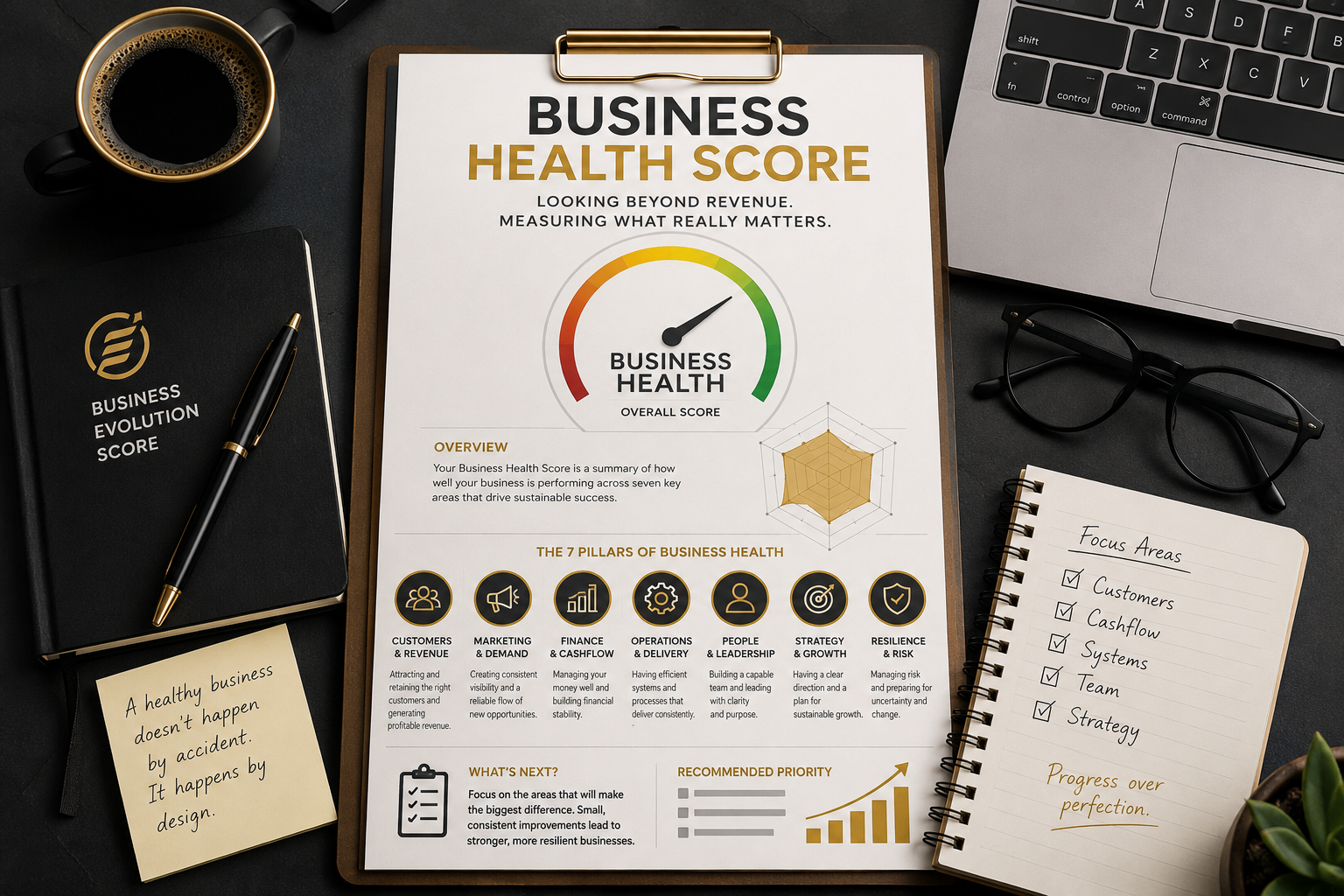
So, What Is a Business Health Score?
A Business Health Score is a way of measuring the overall strength of your business by looking beyond the numbers.
Rather than asking, “How much money did you make?” it asks questions like:
Are you consistently attracting the right customers?
Can your business generate new opportunities without relying solely on referrals?
Do you understand your cash flow well enough to make confident decisions?
Are your systems helping the business grow, or are they creating bottlenecks?
Is your team equipped to support the next stage of growth?
Do you have a clear strategy, or are you simply reacting to whatever comes next?
When you bring those answers together, you begin to see a much more complete picture of your business.
The Seven Pillars of a Healthy Business
While every business is unique, I’ve found that the same themes appear time and again. Whether the challenge is stalled growth, inconsistent sales or founder burnout, the underlying cause usually sits within one of seven key areas.
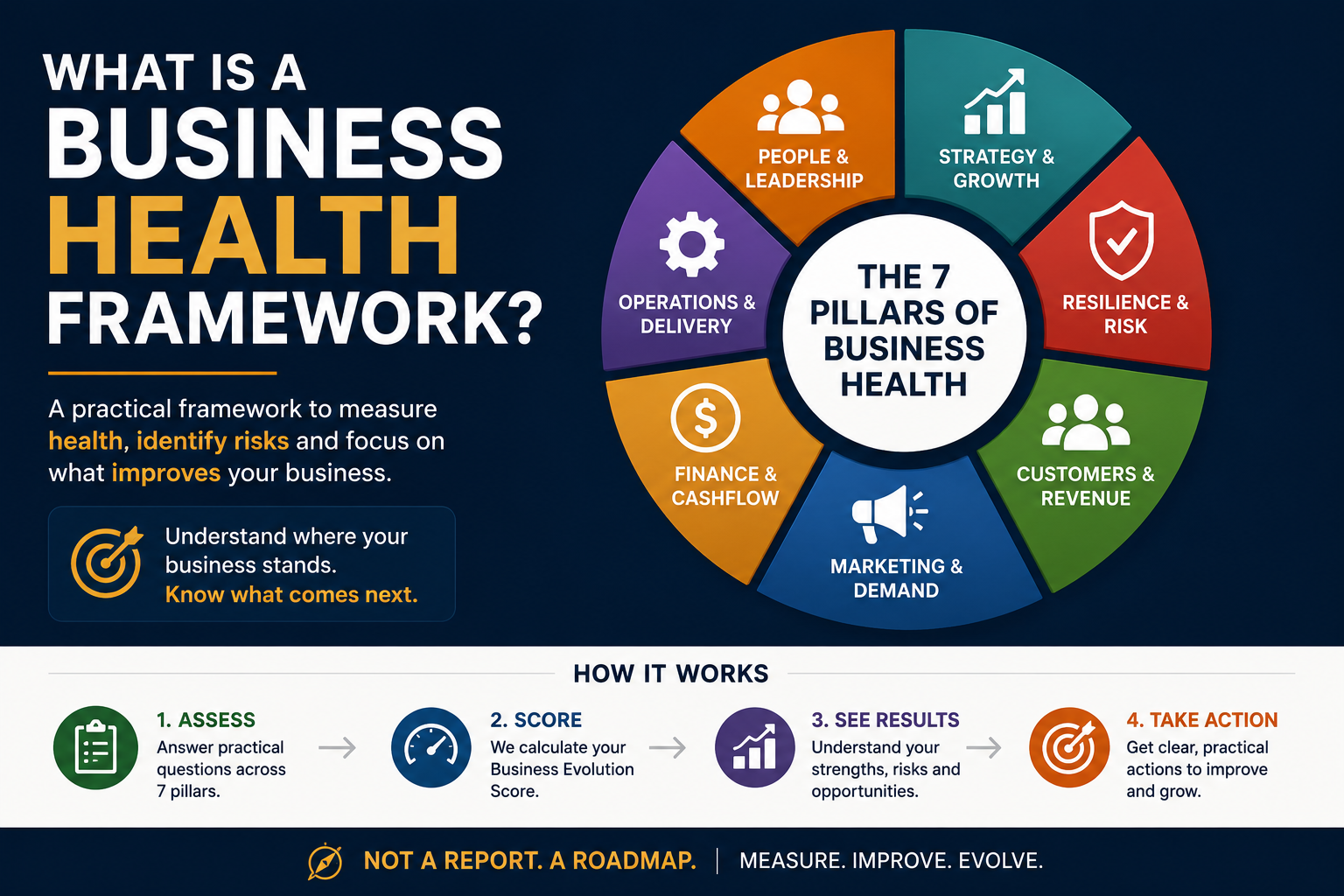
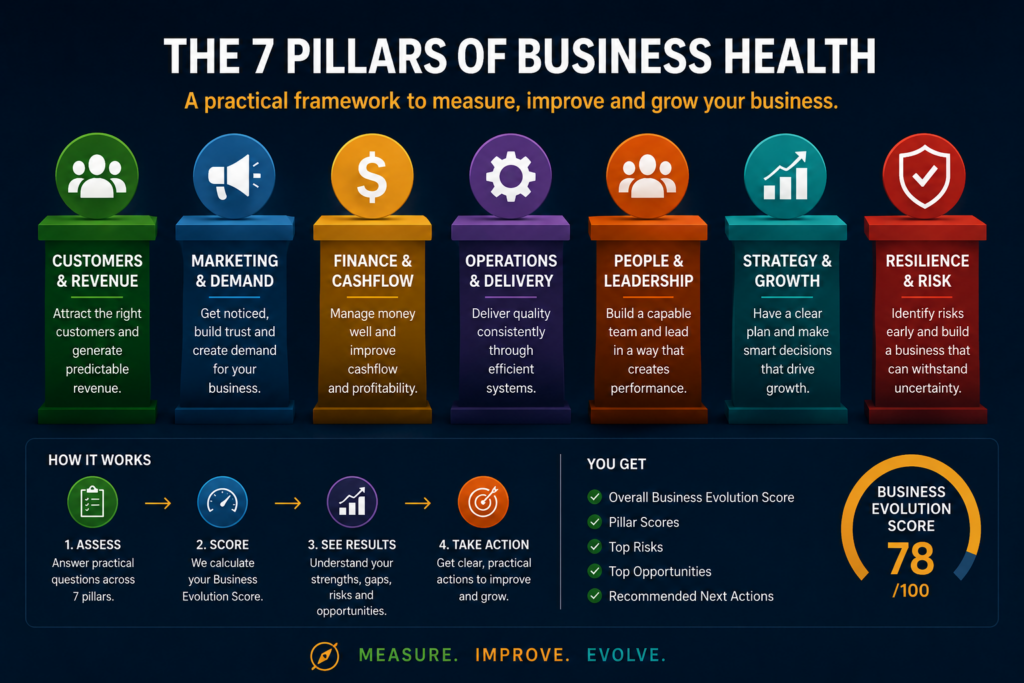
These seven areas form the Business Evolution Framework, a practical model for understanding how different parts of your business work together and where improvements will have the greatest impact.
Business Evolution Score measures these seven pillars:
Strategy & Growth – Knowing where the business is going and how to get there.
Resilience & Risk – Preparing for uncertainty and reducing unnecessary business risk.
These pillars don’t exist in isolation. Weakness in one area often creates pressure in another. Poor marketing eventually affects cash flow. Weak systems increase founder dependency. A lack of strategy often results in reactive decision-making.
That’s why it’s important to assess the business as a whole rather than focusing on individual problems as they arise.
Healthy Businesses Are Built, Not Found
One of the biggest misconceptions in business is that healthy businesses happen naturally.
They don’t.
Healthy businesses are built through hundreds of small decisions made consistently over time.
They are built by understanding the numbers rather than avoiding them. By documenting processes instead of relying on memory. By developing future leaders instead of trying to do everything yourself. By regularly reviewing where the business is heading instead of simply responding to today’s problems.
None of these actions is particularly exciting on its own, but together they create businesses that are more resilient, more profitable and, perhaps most importantly, more enjoyable to own.
Why Blind Spots Matter
One of the challenges of running a business is that you’re often too close to it.
When you’re dealing with customers, managing staff, solving problems and keeping cash flowing, it’s difficult to step back and see the bigger picture. Small issues become part of everyday life. You adapt to them without realising they’re slowly limiting the business.
I’ve seen businesses where the owner accepted working every weekend because “that’s just part of running a business.” Others assumed inconsistent sales were normal because they’d never built a structured marketing process. Some believed cash flow stress was unavoidable when, in reality, it stemmed from poor forecasting and weak debtor management.
These aren’t failures.
They’re blind spots.
And every business has them.
The value of a Business Health Score isn’t that it gives you a number. The real value is that it helps you identify those blind spots before they become bigger problems.
Progress Over Perfection
One thing I’ve learned over the years is that there is no such thing as the perfect business.
Every business has weaknesses. Every owner has areas they could improve. Even well-established companies continue refining their systems, developing their people and adapting to changing markets.
The goal isn’t to score 100%.
The goal is to understand where you are today, identify the areas that will make the biggest difference, and keep improving over time. Business is an ongoing journey of evolution, not a destination where everything is finally “finished.”
Small improvements, applied consistently, often produce far greater results than dramatic changes made once every few years.
Why I Created Business Evolution Score
Business Evolution Score grew out of a simple belief: business owners deserve a practical way to understand the health of their business.
Not another personality test.
Not another generic online quiz.
And certainly not a report full of consultant jargon.
I wanted to create something that would help entrepreneurs step back from the daily demands of running a business, assess where they stand today and receive practical guidance on what to improve next.
The assessment doesn’t judge your business. It helps you understand it.
Because once you understand your business more clearly, you can make better decisions, reduce unnecessary risks and build something that is not only successful, but sustainable.
Find Out How Healthy Your Business Is
If you’ve never taken a step back to assess the overall health of your business, now is a good time to start.
The free Business Evolution Score assessment takes just a few minutes to complete. You’ll receive an overall Business Health Score, insights across each of the seven pillars, practical recommendations and a personalised 90-day action plan designed to help you focus on the improvements that matter most.
After all, building a better business doesn’t start by working harder.
It starts by understanding where your business stands today—and knowing where to focus next.
Related Reading
If you’d like to explore business health in more detail, you may also find these guides useful:
The free Business Evolution Score assessment evaluates your business across seven critical areas, helping you identify strengths, risks and the next actions that will have the biggest impact.
Whether you’re focused on growth, cashflow, marketing, leadership or resilience, you’ll receive a personalised Business Evolution Score along with practical recommendations to help your business evolve.
Michael Hamilton is an entrepreneur, author of The Purposeful Entrepreneur, and the founder of Business Evolution Score. Having built and worked with businesses across multiple industries, he created Business Evolution Score to give business owners a practical framework for understanding, measuring and improving the health of their business.
A Business Health Assessmentis a structured evaluation of how effectively a business is performing across the critical areas that determine its long-term success. Much like a medical health check identifies potential health risks before they become serious illnesses, a business health assessment helps owners identify strengths, weaknesses, risks, and opportunities before they become costly problems.
Rather than focusing on a single area of the business, a comprehensive Business Health Assessment evaluates the capabilities that enable a business to grow sustainably. These capabilities include attracting customers, generating demand, managing finances, delivering consistently, leading people, executing strategy, and building resilience. Together, they determine whether a business is truly healthy and prepared for long-term success.
The purpose of a business health assessment is not simply to produce a score. It is to provide business owners with practical insight into where the business is performing well, where risks exist, and which improvements will have the greatest impact.
Whether you are launching a new business, preparing for growth, experiencing operational challenges, or simply wanting to build a stronger company, a regular business health assessment provides an objective view of your business and helps you make better decisions based on evidence rather than assumptions.
The healthiest businesses are not necessarily the largest or the most profitable. They are the businesses that understand their strengths, address their weaknesses early, and continuously improve across every part of the organisation.
Table of Contents
Why Looking at One Part of Your Business Isn’t Enough
One of the biggest mistakes business owners make is trying to solve individual business problems in isolation.
Sales are down, so they invest in marketing.
Cash flow is tight, so they cut costs.
Customer complaints increase, so they hire more support staff.
Staff leave, so they recruit more employees.
While each of these actions may seem logical, they often address the symptom rather than the underlying cause.
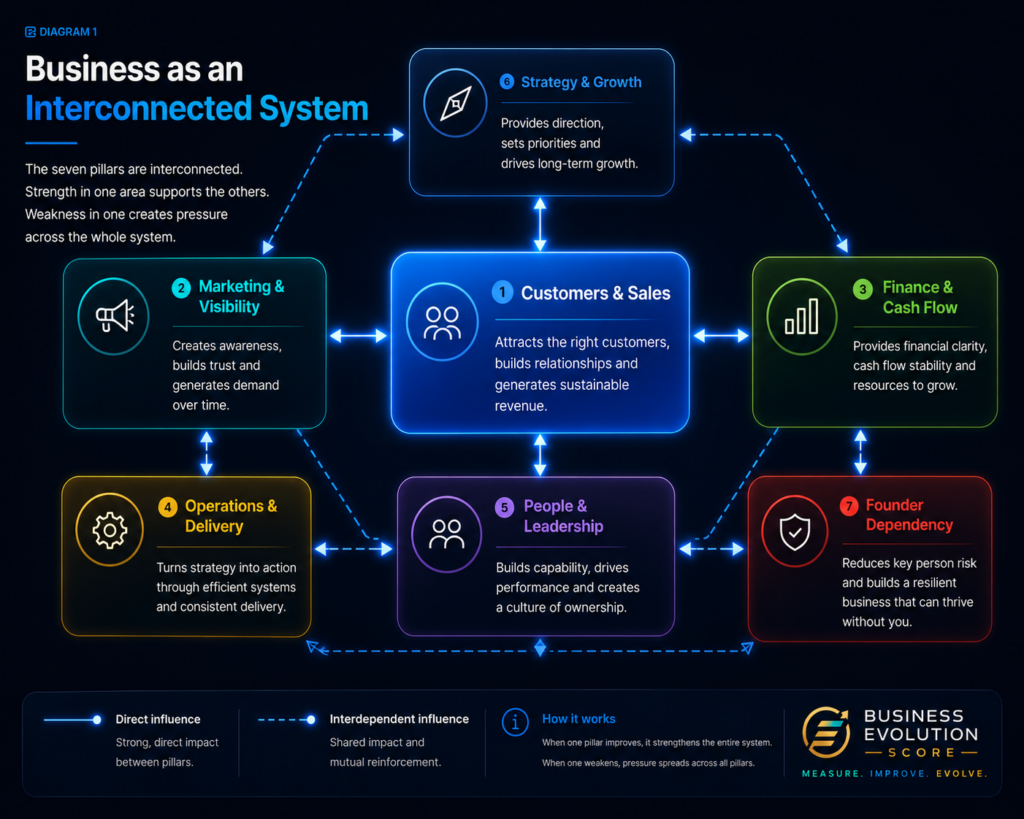
A business is not a collection of independent departments. It is an interconnected system where every capability influences another. Marketing generates awareness and demand. Sales converts opportunities into customers. Operations delivers on promises. Finance provides the resources to invest and grow. People execute the work, Leadership sets the direction, and Strategy ensures every part of the business is moving towards the same long-term goals.
When one area changes, every other area feels the impact.
A successful marketing campaign creates more leads, but if Operations cannot deliver the increased workload, customer satisfaction falls. Strong sales growth without sufficient cash flow can create financial pressure instead of sustainable growth. Hiring more people without effective leadership or documented processes often increases complexity rather than improving performance.
The healthiest businesses are not those with one exceptional department or one outstanding capability. They are businesses where every critical capability develops together, creating balance across the entire organisation.
This is why a truly effective Business Health Assessment should evaluate the business as an interconnected system rather than a collection of independent functions. It should identify how strengths and weaknesses influence one another, allowing business owners to focus on the root causes of problems instead of simply reacting to the symptoms.
Business Evolution Insight
Businesses rarely fail because one area is weak. They struggle because one part of the business evolves faster than the rest.
Think about some common examples:
Sales outpace Operations, resulting in missed deadlines and unhappy customers.
Marketing generates more demand than the business can fulfil, damaging its reputation.
Revenue grows faster than Cash Flow, leaving the business profitable on paper but struggling to pay its bills.
The team expands faster than Leadership develops, creating confusion, inconsistency and poor accountability.
Strategy changes, but the rest of the business continues operating as if nothing has changed.
These are not isolated problems.
They are signs that the business has become unbalanced.
A truly healthy business is not measured by the strength of one department or one impressive financial result. It is measured by how effectively every critical part of the business evolves together.
A comprehensive Business Health Assessment should identify these imbalances early, helping business owners strengthen the entire business rather than continuously fixing the same symptoms.
The Business Evolution Framework
Most Business Health Assessments evaluate different parts of a business separately. They measure financial performance, operational efficiency, leadership, marketing, customer satisfaction or strategy independently, producing individual scores and recommendations for each area.
While this approach provides useful information, it often overlooks the way businesses actually operate.
A business is not a collection of disconnected departments. It is a living system where every capability both influences and depends upon the others.
A successful marketing campaign creates demand, but without the operational capacity to deliver, customer satisfaction declines. An increase in sales may improve revenue, but without disciplined financial management, cash flow can quickly become strained. A clear strategy provides direction, but without capable leaders and engaged people, execution will always fall short.
Every decision creates a ripple effect across the business.
Businesses do not grow through isolated improvements. They grow when every critical capability evolves together.
Rather than assessing individual functions in isolation, the framework evaluates the capabilities that enable a business to grow sustainably and remain healthy over time. Each capability contributes to the overall strength of the business while simultaneously influencing the performance of every other capability.
The objective is not to achieve a perfect score in one area. It is to create balance across the business so that growth in one capability strengthens, rather than weakens, the others.
Businesses that grow sustainably do not simply improve individual functions. They continuously evolve every critical capability together.
That is the difference between improving a business and building a healthy business.
The Seven Pillars of Business Evolution
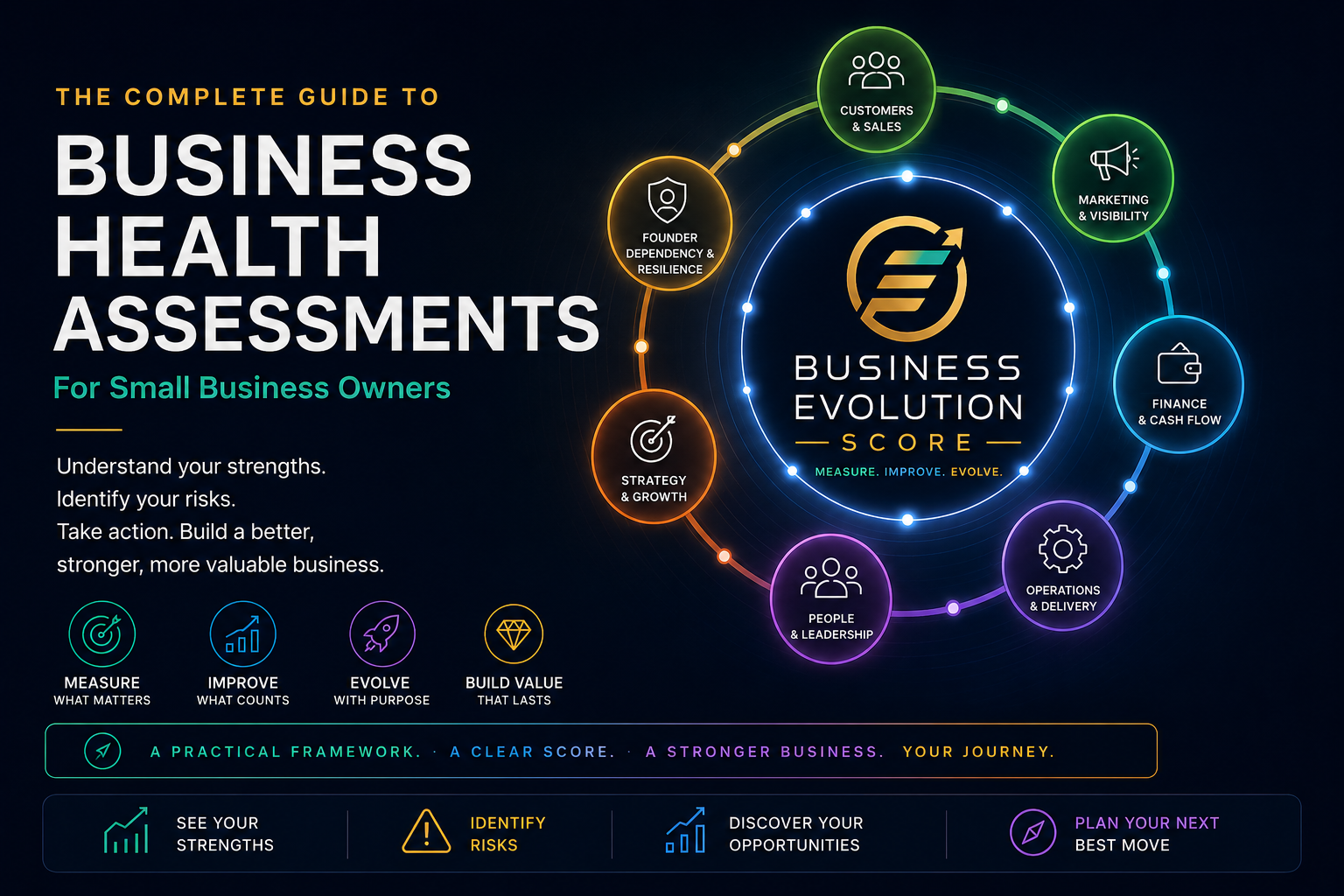
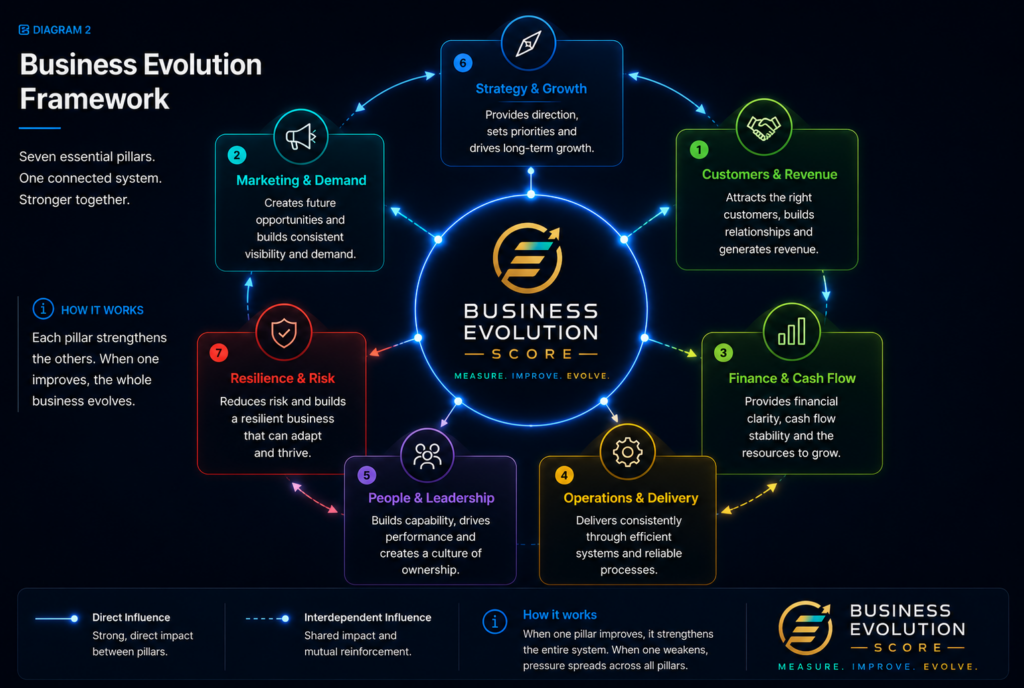
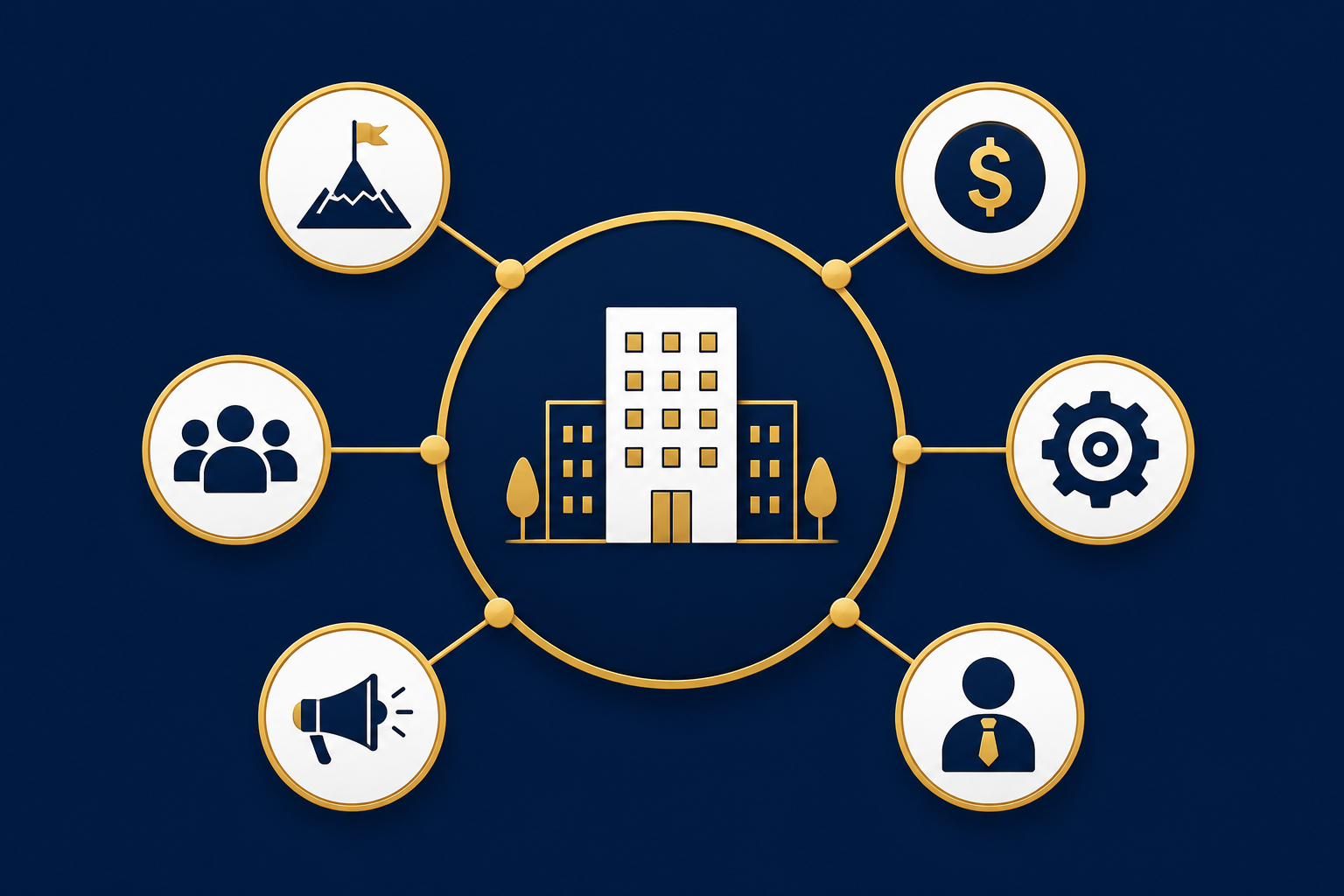
The Business Evolution Framework evaluates seven interconnected business capabilities that together determine the long-term health, resilience and sustainability of a business.
1. Customers & Sales
Measures how effectively the business attracts, converts and retains profitable customers while reducing reliance on a small number of key clients.
2. Marketing & Visibility
Evaluates how consistently the business generates awareness, builds its reputation and creates a predictable flow of qualified opportunities.
3. Finance & Cash Flow
Assesses profitability, cash flow management, pricing, financial controls and the organisation’s ability to fund sustainable growth.
4. Operations & Delivery
Measures the efficiency, consistency and scalability of the systems and processes used to deliver products and services.
5. People & Leadership
Evaluates leadership capability, team performance, accountability, culture and the degree to which the business depends on the founder.
6. Strategy & Growth
Assesses whether the business has a clear direction, measurable objectives and a practical plan for sustainable growth.
7. Business Resilience & Risk
Measures the organisation’s ability to manage risk, adapt to change, reduce dependencies and remain sustainable through uncertainty.
Together, these seven business capabilities provide a holistic view of business health, allowing owners to identify not only where weaknesses exist, but also how improvements in one area are likely to influence the performance of every other part of the business.
Business Evolution Insight
The goal of a Business Health Assessment is not to create seven strong pillars. It is to build one healthy business.
A healthy business is more than the sum of its individual parts.
You can have exceptional sales and still experience serious cash flow problems.
You can employ talented people but struggle because of ineffective leadership.
You can have a brilliant strategy but poor execution.
You can generate significant marketing activity but disappoint customers because Operations cannot keep pace.
Business health is not measured by excellence in a single capability.
It is measured by the ability of every capability to work together in support of the whole business.
Healthy businesses don’t optimise departments.
They strengthen the connections between them.
This is the principle behind the Business Evolution Framework.
Business Evolution is the continuous process of strengthening every critical capability of a business so that sustainable growth becomes possible.
Caption
The Business Evolution Framework visualises business health as a connected system rather than a collection of independent functions. Each capability strengthens the others. Sustainable growth occurs when the entire business evolves together.
Signs Your Business May Be Less Healthy Than You Think
One of the biggest misconceptions about business health is that problems appear suddenly.
In reality, businesses rarely become unhealthy overnight.
More often, the warning signs develop gradually. A late invoice becomes a cash flow problem. A delayed delivery becomes an unhappy customer. One employee leaving places extra pressure on the rest of the team. A founder takes on just one more responsibility until they become the biggest bottleneck in the business.
By the time these symptoms become obvious, the underlying cause has often existed for months—or even years.
Many business owners become so focused on solving today’s problems that they never have the opportunity to step back and ask a much more important question:
“What is causing these problems in the first place?”
This is where a Business Health Assessment becomes invaluable. Rather than focusing on individual symptoms, it provides an objective view of the business, helping owners identify underlying weaknesses before they begin affecting every other part of the organisation.
Common Warning Signs of an Unhealthy Business
Every business experiences challenges from time to time. However, when the following issues become recurring patterns rather than occasional events, they often indicate deeper weaknesses within the business.
Cash Flow Always Feels Tight
Revenue may be increasing, yet there never seems to be enough cash available to comfortably pay suppliers, salaries or invest in growth.
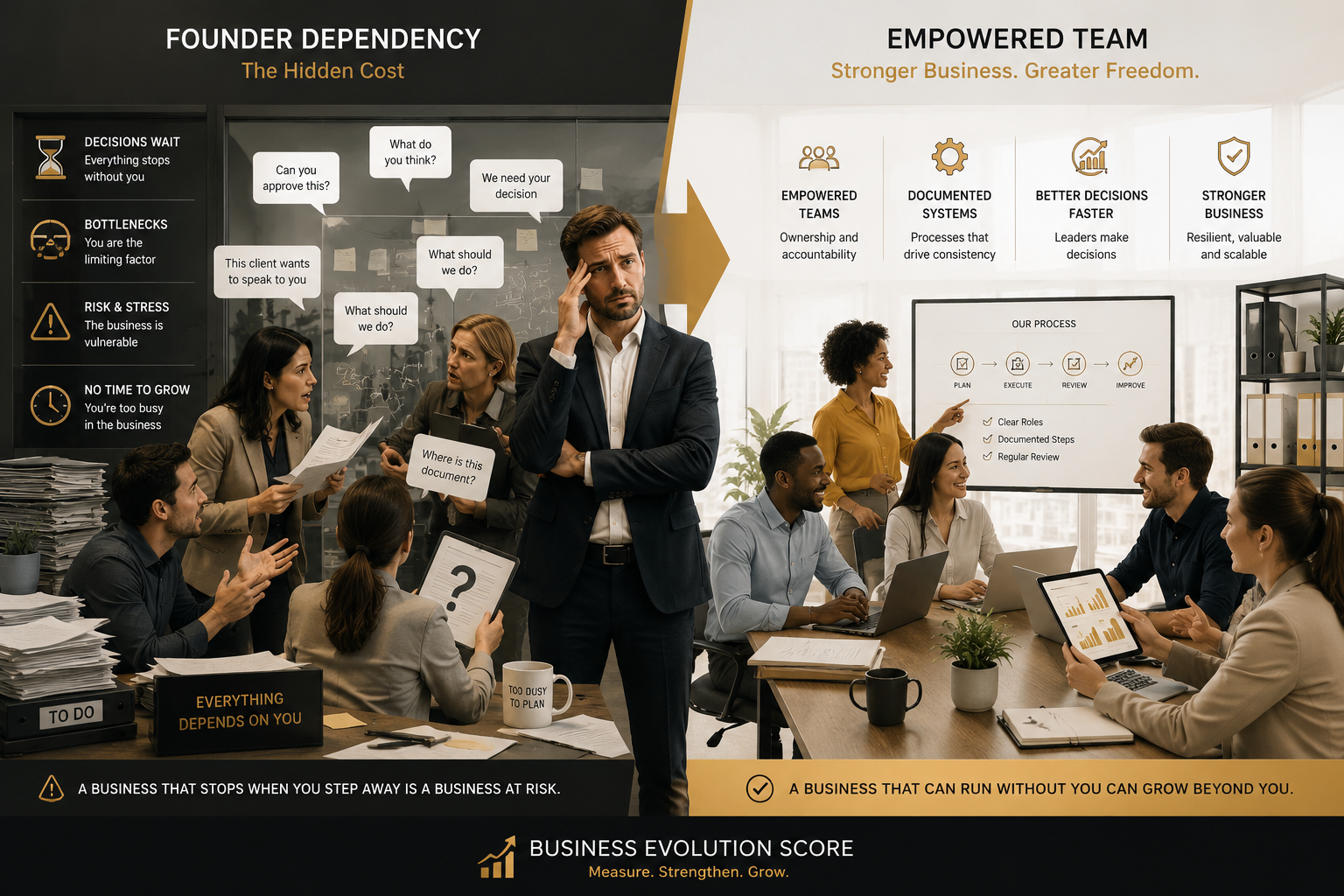
The Business Depends Too Much on the Founder
The business slows down whenever the owner is unavailable. Decisions wait. Customers expect to speak directly to the founder. The business cannot operate effectively without them.
Sales Are Unpredictable
Some months are excellent while others are concerning. New business depends on referrals, luck or a handful of key customers rather than a consistent marketing and sales process.
Customers Are Waiting Longer
Projects take longer to complete. Customer complaints increase. Quality becomes inconsistent because Operations are struggling to keep pace with demand.
Everyone Is Busy, But Progress Feels Slow
The team works hard, yet the same issues continue to appear. Meetings replace action, processes become inconsistent and productivity begins to decline.
Growth Creates More Stress Than Opportunity
Winning new customers should be exciting. Instead, every new project feels like another operational challenge waiting to happen.
You Spend More Time Reacting Than Leading
Instead of working on the future of the business, most days are spent solving urgent problems, putting out fires and responding to issues that should never have happened in the first place.
Symptoms vs. Root Causes
One of the greatest dangers in business is treating symptoms instead of solving root causes.
A business owner may believe they have a sales problem, when the real issue is an unclear strategy or weak marketing.
Cash flow problems are often blamed on slow-paying customers, when the underlying cause is poor pricing, weak financial controls or overdependence on a small number of clients.
High staff turnover may appear to be a recruitment issue, when the real problem lies in leadership, culture or poorly designed operational processes.
Without understanding the relationship between these issues, businesses often spend time and money fixing the wrong problem.
The purpose of a Business Health Assessment is to uncover the cause, not simply measure the symptom.
Symptoms vs. Possible Root Causes
Business Symptom
Possible Root Cause
Sales are declining
Weak strategy, inconsistent marketing or poor customer positioning
Cash flow is constantly under pressure
Pricing issues, weak financial controls, slow collections or customer concentration
Customers complain more frequently
Operational bottlenecks, inconsistent delivery or unclear processes
High employee turnover
Leadership challenges, culture, workload or lack of development
Founder burnout
Founder dependency, poor delegation or limited systems
Growth has stalled
One or more business capabilities have stopped evolving alongside the business
Business Evolution Insight
Every business has problems. Healthy businesses identify the cause before the symptoms become a crisis.
Many of the challenges business owners experience are interconnected.
A decline in customer satisfaction may begin with operational inefficiencies.
Poor profitability may be caused by pricing decisions made months earlier.
Staff frustration may be the result of unclear leadership rather than poor performance.
Business owners often experience the symptom long before they discover the real cause.
The Business Evolution Framework encourages a different way of thinking. Instead of asking:
“What problem am I trying to fix?”
It asks:
“Which business capability is preventing the entire business from performing at its best?”
That shift in thinking transforms a Business Health Assessment from a simple checklist into a practical decision-making tool.
Business Evolution Principle
Healthy businesses don’t spend their time fixing symptoms. They continuously strengthen the capabilities that prevent those symptoms from occurring in the first place.
What Should a Business Health Assessment Measure?
One of the most common misconceptions about Business Health Assessments is that they are simply a checklist or questionnaire.
They are not.
A meaningful assessment is not about answering a series of questions or calculating a score. Its real value lies in understanding what those questions are measuring and, more importantly, what they reveal about the health of your business.
Every business owner can recognise when sales are slowing down, cash flow is becoming tight or customers are becoming dissatisfied. These are important indicators, but they are only symptoms.
A truly effective Business Health Assessment goes much deeper.
It measures whether the business has the capabilities required to grow sustainably, adapt to change and consistently deliver value to its customers.
Rather than asking, “How is the business performing today?”, it asks a far more important question:
“Is the business capable of performing even better tomorrow?”
That difference shifts the assessment from measuring past performance to evaluating future readiness.
A Modern Business Health Assessment Measures Capability, Not Activity
Many traditional business assessments ask questions such as:
Do you have a business plan?
Do you have documented processes?
Do you use a CRM system?
Do you prepare monthly financial reports?
These questions are useful, but they only confirm whether something exists.
They do not tell you whether it is effective.
Owning a CRM system does not mean your sales process is working.
Having documented procedures does not guarantee consistent operations.
Creating a business plan does not mean your team understands or executes the strategy.
The Business Evolution Framework takes a different approach.
Rather than measuring activity, it measures capability.
Capability reflects how effectively the business performs, regardless of the tools it owns, the software it uses or the number of people it employs.
A healthy business is not defined by what it has.
It is defined by what it can consistently achieve.
Assessing the Business as a Connected System
The most valuable Business Health Assessments recognise that no business capability exists in isolation.
Marketing generates awareness and demand.
Sales converts opportunities into customers.
Operations fulfils the promises made during the sales process.
Finance provides the resources required to support growth.
People execute the work, while Leadership provides direction and accountability.
Strategy aligns every capability towards a common purpose.
When one capability improves, every other capability feels the impact.
Likewise, when one capability begins to weaken, the effects are rarely contained to that single area.
A marketing campaign that generates more leads than Operations can deliver creates dissatisfied customers.
Rapid sales growth without strong financial management places unnecessary pressure on cash flow.
Poor leadership eventually affects employee engagement, customer experience and long-term profitability.
This is why the Business Evolution Score evaluates the business as an interconnected system rather than a collection of independent functions.
The result is not simply seven scores.
It is a clearer understanding of how the business works as a whole, where risks exist, and which improvements are likely to create the greatest overall impact.
From Assessment to Action
The value of a Business Health Assessment is not found in the final score.
It is found in the conversations, decisions and improvements that follow.
An effective assessment should help business owners answer questions such as:
Which capabilities are already supporting growth?
Where are the greatest risks hiding?
Which weaknesses are limiting the performance of the rest of the business?
What should be improved first?
Which improvements will create the greatest overall impact?
These questions transform an assessment from a reporting exercise into a practical decision-making tool.
Rather than reacting to problems as they appear, business owners can begin strengthening the capabilities that will have the greatest influence on the long-term health of the business.
Business Evolution Insight
A Business Health Assessment should never become a report that sits in a drawer. It should become part of the way a business learns, improves and evolves.
Healthy businesses do not assess themselves once.
They develop the discipline of continuously measuring their capabilities, strengthening their weakest constraints and adapting as the business grows.
Business Evolution is not a once-off event.
It is a continuous journey of learning, improvement and intentional growth.
The goal is not to achieve a perfect score.
The goal is to build a business that becomes stronger, more resilient and better prepared with every assessment.
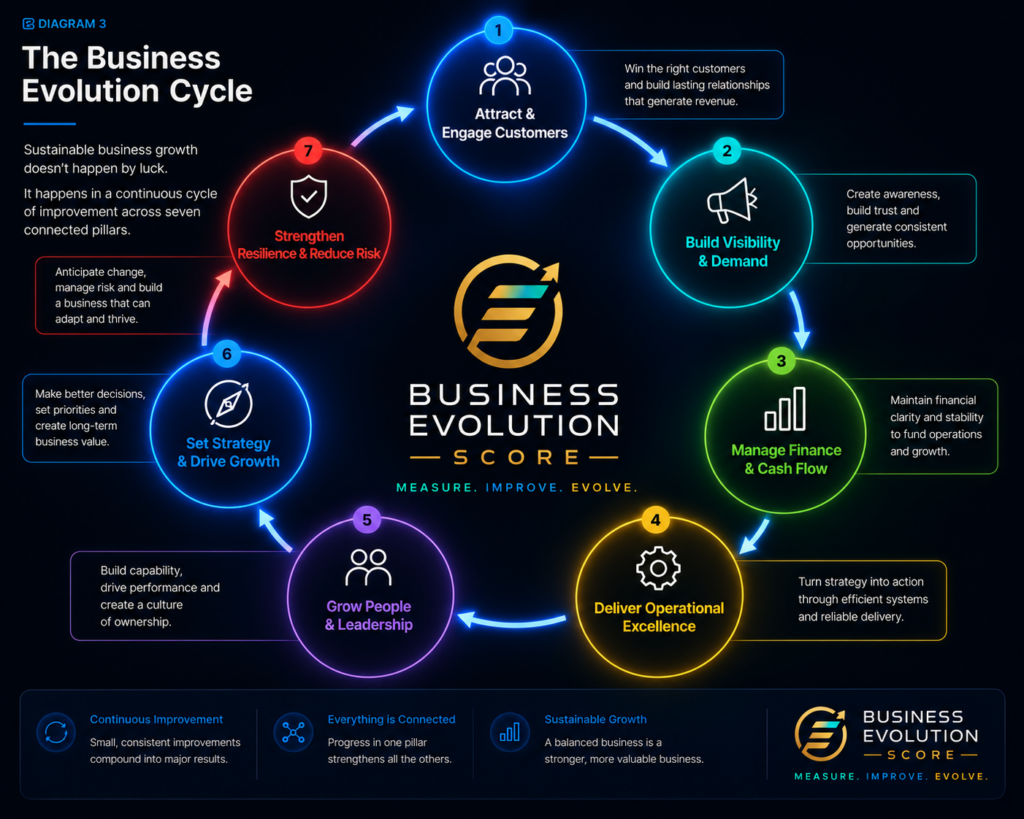
The Business Evolution Cycle
Caption
Business health is not measured once. The strongest businesses continuously assess, improve and evolve. The Business Evolution Cycle provides a practical framework for ongoing business improvement.
The Seven Pillars of Business Evolution
Customers & Sales
Every successful business begins with one simple principle:
Create value for customers.
Without customers there is no revenue, and without revenue there is no business.
It sounds obvious, yet many business owners spend far more time chasing new sales than building a healthy customer base.
The result is often unpredictable revenue, customer concentration, inconsistent growth and constant pressure to “find the next deal.”
A healthy business approaches Customers & Sales differently.
Rather than relying on luck, referrals or the founder’s personal network, it develops repeatable processes for attracting the right customers, converting opportunities into long-term relationships and consistently delivering value.
Healthy businesses understand exactly who their ideal customers are.
They know why customers choose them instead of competitors.
They actively nurture relationships, measure customer satisfaction and continually improve the experience they provide.
Most importantly, they avoid becoming overly dependent on a small number of customers.
When one customer represents a significant percentage of total revenue, the business becomes vulnerable. Losing a single client can immediately create cash flow pressure, disrupt operations and force difficult decisions throughout the organisation.
A diverse and loyal customer base provides stability, resilience and the confidence to invest in future growth.
Customers are not simply the result of a healthy business.
They are one of the foundations upon which a healthy business is built.
What a Healthy Business Looks Like
Businesses with strong Customers & Sales capabilities typically demonstrate several common characteristics.
They have a clearly defined target market and understand the problems they solve for their customers.
Their sales pipeline is consistent rather than unpredictable, and new business is generated through repeatable processes instead of last-minute effort.
Existing customers continue to buy because they receive consistent value, while new customers arrive through a combination of referrals, marketing and deliberate business development.
No single customer has the power to threaten the future of the business.
Warning Signs
Your business may need to strengthen this pillar if:
One or two customers generate most of your revenue.
Sales fluctuate dramatically from month to month.
New business depends almost entirely on referrals.
Customers leave without anyone understanding why.
The founder personally closes every significant sale.
There is no predictable sales pipeline.
How This Pillar Influences the Rest of the Business
Every pillar within the Business Evolution Framework is connected.
Weak customer acquisition eventually affects cash flow.
Poor customer retention increases the pressure on Marketing to constantly generate new leads.
Unpredictable sales make financial planning difficult and often delay investment in people, systems and future growth.
Customer concentration increases business risk, while inconsistent demand creates operational challenges that affect delivery, staff workload and customer experience.
Conversely, a healthy customer base creates confidence throughout the business.
Predictable revenue allows leaders to invest strategically, improve systems, develop people and focus on long-term growth rather than short-term survival.
This is why Customers & Sales is not simply about generating revenue.
It influences the health of every other pillar.
Business Evolution Insight
Customers don’t build healthy businesses. Healthy businesses consistently earn and keep the right customers.
Sustainable growth is rarely achieved by chasing every opportunity.
It is achieved by building a business that consistently attracts, serves and retains customers who value what you do.
When customer relationships become predictable, every other part of the business becomes easier to manage.
Business Evolution Principle
Revenue is an outcome. Strong customer relationships are the capability that produces it.
Caption
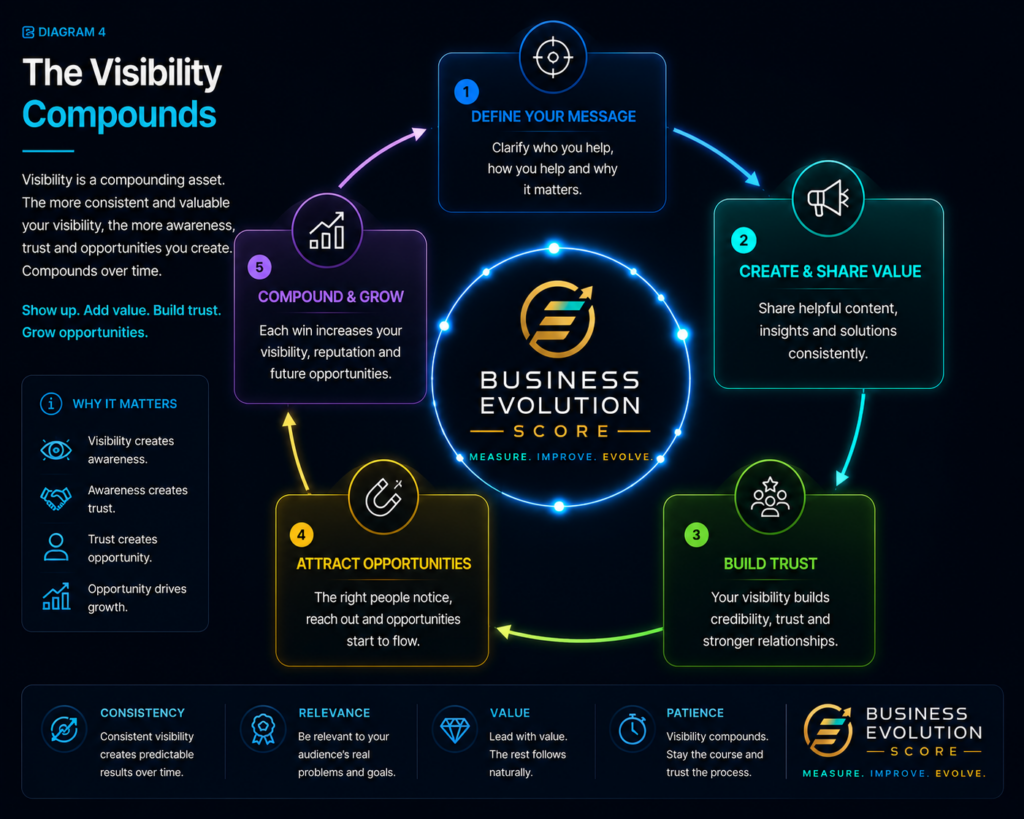
Healthy businesses don’t rely on one marketing campaign to generate growth. They continuously build visibility, trust and authority, creating a self-reinforcing cycle that generates qualified opportunities over time.
Marketing & Visibility
Many business owners think marketing is something they do. Healthy businesses understand that marketing is a capability they build.
It isn’t.
Marketing is the capability that consistently positions your business in front of the right people, builds trust over time, and creates a predictable flow of opportunities for your sales process.
Healthy businesses rarely depend on a single marketing activity. Instead, they develop multiple ways for potential customers to discover them, understand the value they offer and build enough confidence to take the next step.
For some businesses that might include search engines, educational content and industry referrals. Others may rely on networking, strategic partnerships, LinkedIn, events or repeat business from satisfied customers.
The channel is rarely the competitive advantage. The capability behind it is.
What matters is whether the business can consistently generate awareness and qualified opportunities without relying on luck or last-minute effort.
One of the biggest mistakes small businesses make is treating marketing as something they only do when sales slow down.
Marketing should not be an emergency response.
It should be a continuous business capability that creates future demand long before it is needed.
Businesses that invest consistently in visibility build momentum.
Every article published, every customer success story shared, every referral earned and every search engine ranking achieved becomes another asset working on behalf of the business.
Unlike advertising, these assets continue creating value long after they have been created.
Healthy businesses understand that visibility compounds over time.
A healthy marketing capability creates confidence throughout the organisation.
It allows sales teams to focus on converting qualified opportunities rather than searching for prospects. It gives Finance greater confidence when forecasting future revenue. It enables Operations to plan capacity more effectively because demand becomes more predictable.
Marketing is not simply about attracting attention.
It is about creating confidence in the future of the business.
What a Healthy Business Looks Like
Businesses with strong Marketing & Visibility capabilities share several common characteristics.
They have a clearly defined value proposition and understand exactly why customers choose them over competing alternatives. Their messaging is consistent across every customer touchpoint, making it easy for prospective customers to understand the problems they solve.
Rather than relying on a single source of enquiries, they generate opportunities through multiple channels, creating resilience if one source slows down.
They invest in building long-term visibility rather than chasing short-term spikes in activity. Educational content, customer success stories, search engine visibility, referrals and professional networks all work together to strengthen the business’s reputation over time.
Importantly, healthy businesses measure the quality of their opportunities rather than simply the quantity.
A hundred poor-quality leads rarely outperform ten highly qualified prospects.
The goal of marketing is not to generate more enquiries.
It is to generate the right enquiries.
Warning Signs
Your business may need to strengthen this pillar if:
New enquiries are inconsistent from month to month.
Most new business comes from referrals alone.
Customers struggle to explain what makes your business different.
Marketing activities stop whenever the business becomes busy.
You rely heavily on paid advertising with little long-term visibility.
Your website attracts very little organic traffic.
There is no consistent flow of qualified opportunities into your sales pipeline.
You cannot easily measure where your best customers come from.
How This Pillar Influences the Rest of the Business
Marketing is often viewed as the beginning of the customer journey, but its influence extends far beyond generating leads.
Strong marketing creates predictable demand, allowing Sales to focus on building relationships rather than prospecting continuously. Consistent demand gives Finance greater confidence when forecasting revenue and making investment decisions.
Operations also benefits from predictable marketing. A steady flow of new business allows workloads to be planned more effectively, reducing the operational stress caused by sudden spikes or unexpected quiet periods.
Leadership can make better strategic decisions because future demand becomes easier to anticipate.
Conversely, weak marketing creates uncertainty across the entire business.
Sales teams become desperate for opportunities. Cash flow becomes less predictable. Operational planning becomes reactive, and strategic decisions are often delayed because future revenue is uncertain.
Marketing is therefore not simply about promotion.
It provides the visibility that allows every other business capability to operate with greater confidence.
Business Evolution Insight
The strongest businesses don’t constantly search for customers. They become easier for customers to find.
Marketing is not about making the phone ring today.
It is about ensuring the phone keeps ringing six months from now.
Healthy businesses understand that visibility compounds over time.
Every helpful article, every satisfied customer, every referral, every LinkedIn post, every search engine ranking and every valuable conversation contributes to the reputation of the business.
Eventually, marketing stops feeling like a campaign.
It becomes part of the way the business grows.
Business Evolution Principle
Marketing is not an expense that generates sales. It is a business capability that creates future opportunities.
Caption
Healthy businesses don’t rely on one marketing campaign to generate growth. They continuously build visibility, trust and authority, creating a self-reinforcing cycle that generates qualified opportunities over time.
Business Evolution Connection
Marketing creates awareness.
Customers & Sales convert that awareness into revenue.
Without effective marketing, even the best sales process eventually runs out of opportunities. Without an effective sales process, even outstanding marketing fails to generate sustainable growth.
Neither capability succeeds in isolation.
Together, they create the engine that fuels the rest of the business.
Finance & Cash Flow
Revenue may attract attention, but cash flow determines whether a business survives.
Many profitable businesses have failed, not because they lacked customers or generated too little revenue, but because they ran out of cash.
This is why financial health is about far more than preparing accounts or submitting tax returns. It is about understanding how money flows through the business, ensuring sufficient resources are available to meet today’s obligations while creating the capacity to invest in tomorrow’s opportunities.
Healthy businesses treat financial management as an ongoing capability rather than an administrative task. They understand where their money comes from, where it goes and how their financial decisions influence every other part of the business.
They monitor profitability, manage cash flow carefully, price their products and services appropriately, and maintain financial controls that support sustainable growth.
Most importantly, they use financial information to make better decisions.
Rather than relying on instinct alone, they understand the financial consequences of hiring another employee, investing in new equipment, launching a new product or expanding into a new market.
Finance is not simply about recording what has already happened.
It is about providing the clarity needed to decide what should happen next.
A healthy business does not wait for financial problems to appear before paying attention to its numbers.
It builds financial discipline into the way it operates every day.
What a Healthy Business Looks Like
Businesses with strong Finance & Cash Flow capabilities understand their financial position at all times. They regularly review key financial information, maintain healthy cash reserves where possible and monitor the indicators that influence long-term sustainability.
Pricing decisions are based on value, costs and profitability rather than simply matching competitors. Cash flow is forecast rather than guessed, allowing the business to prepare for seasonal fluctuations, planned investments and unexpected challenges.
Healthy businesses also recognise that revenue alone is not a reliable measure of success.
They understand the relationship between revenue, profit and cash flow, ensuring growth strengthens the business instead of placing it under unnecessary financial pressure.
Financial conversations become part of regular business decision-making rather than something reserved for month-end meetings or discussions with the accountant.
Warning Signs
Your business may need to strengthen this pillar if:
Cash flow is regularly under pressure despite increasing revenue.
You struggle to explain where the business’s money is being spent.
Pricing decisions are based primarily on competitors rather than profitability.
Financial reports are produced but rarely used to guide decisions.
The business has little or no cash reserve for unexpected events.
Late customer payments regularly create operational pressure.
Important decisions are made without understanding their financial impact.
How This Pillar Influences the Rest of the Business
Finance provides every other capability with the resources required to grow.
Strong financial management enables investment in marketing, new systems, better equipment, additional staff and product development. It allows leaders to make strategic decisions confidently because they understand the financial implications before committing valuable resources.
Weak financial management creates the opposite effect.
Marketing budgets are reduced. Recruitment is delayed. Operational improvements are postponed. Strategic opportunities are missed because uncertainty makes every decision feel risky.
Cash flow problems also place unnecessary pressure on the founder, who often becomes consumed by short-term survival rather than long-term leadership.
Healthy financial management does not guarantee business success.
However, without it, almost every other capability becomes more difficult to strengthen.
Business Evolution Insight
Money does more than pay the bills.
It buys options.
Healthy businesses understand that strong cash flow creates freedom.
The freedom to invest.
The freedom to hire.
The freedom to innovate.
The freedom to withstand uncertainty.
Businesses with weak financial discipline often lose these choices long before they become unprofitable.
Financial health is not simply measured by how much money a business earns.
It is measured by how many good decisions that money makes possible.
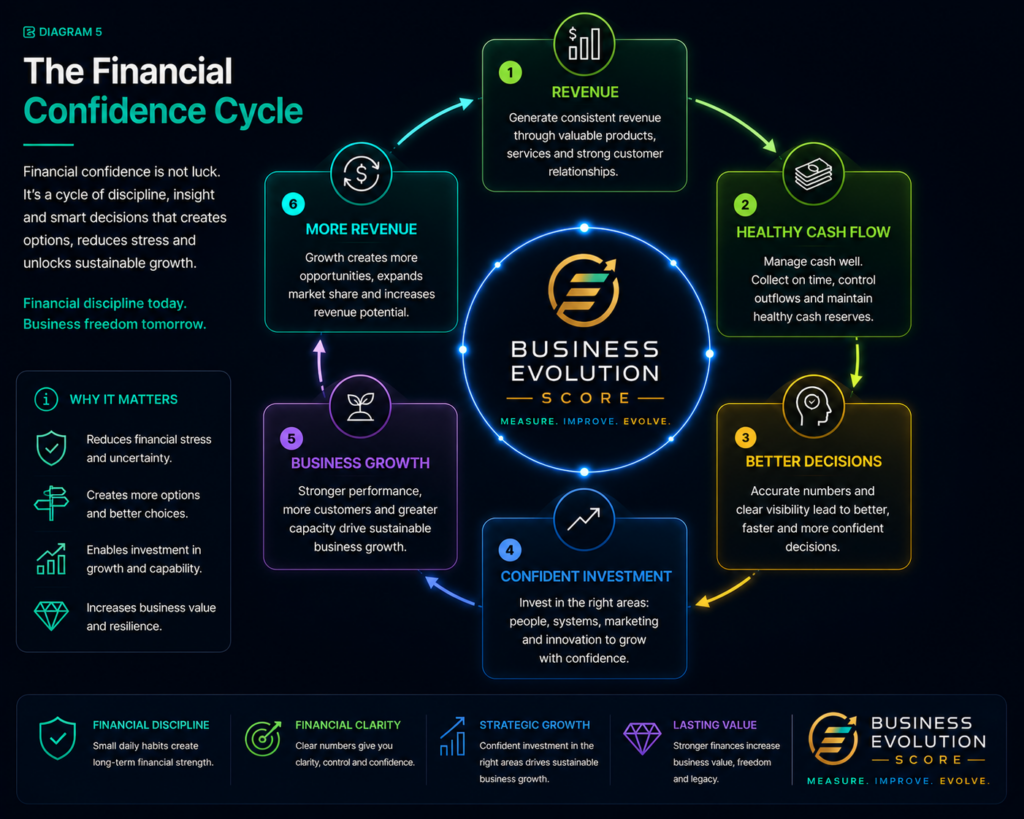
Healthy businesses don’t simply generate revenue. They convert revenue into profit, profit into cash flow, and cash flow into better business decisions that support sustainable growth.
Business Evolution Connection
Finance is the capability that enables every other pillar to improve.
Marketing requires investment.
Operations require systems.
People require development.
Strategy requires resources.
Even the best ideas remain ambitions if the business lacks the financial capacity to execute them.
This is why Finance & Cash Flow is more than an accounting function.
It is the capability that transforms business ambition into practical action.
Operations & Delivery
Every business makes promises.
Operations determines whether those promises are consistently kept.
While marketing attracts attention and sales secure new customers, Operations is responsible for delivering the products, services and experiences that customers actually receive. It is where strategy becomes reality and reputation is either strengthened or damaged.
Many business owners think Operations is about efficiency alone.
It isn’t.
Operations is the capability that enables a business to deliver consistent quality, manage increasing demand and scale without creating unnecessary complexity.
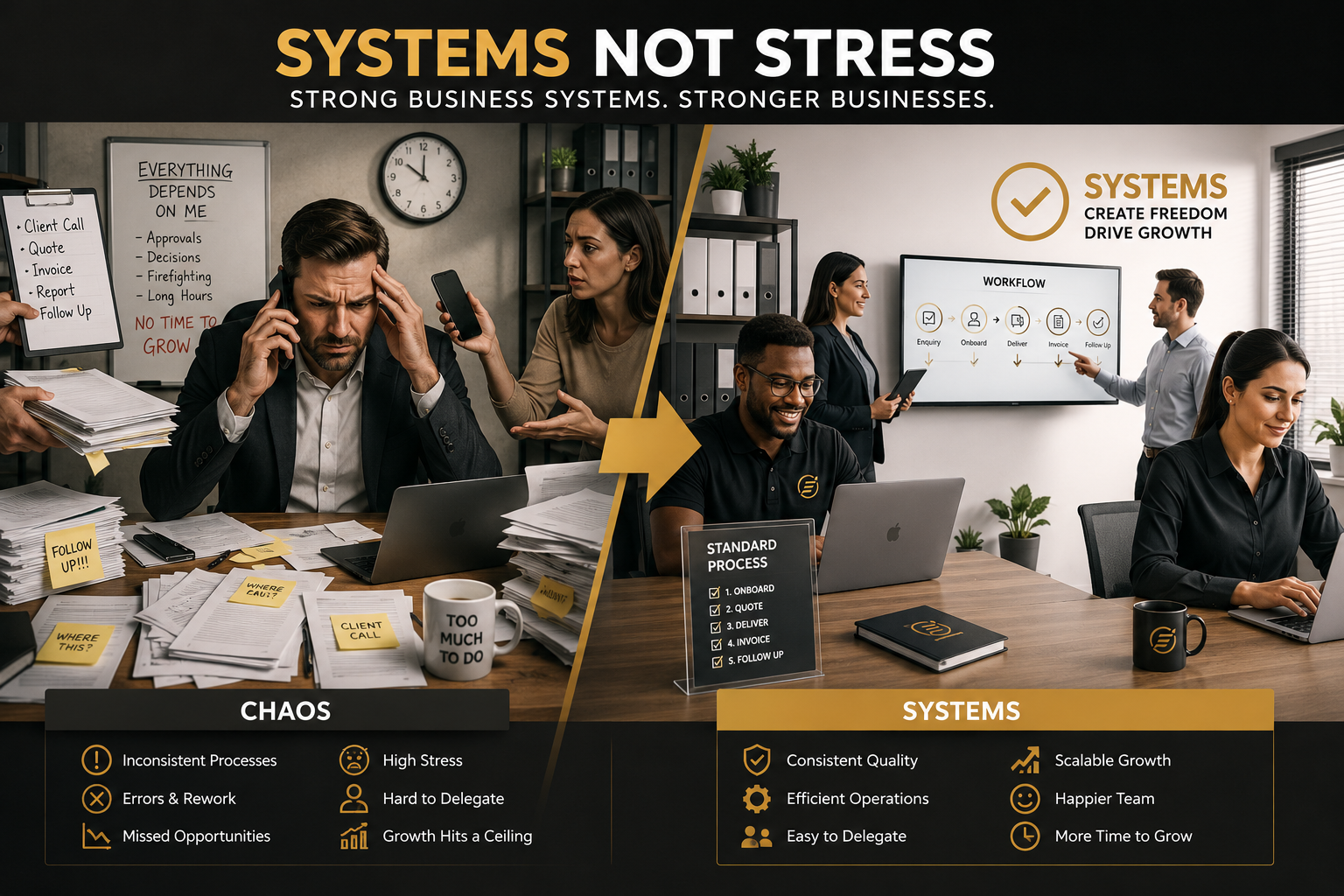
Healthy businesses do not rely on individuals remembering what to do or solving the same problems repeatedly. They build systems, processes and ways of working that allow the business to perform consistently, regardless of who is involved.
This does not mean creating unnecessary bureaucracy or documenting every task.
It means making the important things repeatable.
When work is delivered consistently, customers gain confidence, employees become more productive and leaders spend less time solving avoidable problems.
Strong operations also create capacity.
Instead of constantly reacting to mistakes, delays or confusion, the business can focus on improving, innovating and growing.
Operations is not simply about doing work efficiently.
It is about creating a business that delivers on its promises every single day.
What a Healthy Business Looks Like
Businesses with strong Operations & Delivery capabilities perform consistently, even as they grow.
Key processes are clearly understood and continuously improved. Team members know what is expected of them, work flows efficiently between departments and quality remains high regardless of who performs the task.
Healthy businesses actively identify bottlenecks before they become major problems. They use systems to reduce unnecessary manual work, monitor performance and learn from mistakes instead of repeatedly correcting the same issues.
Customers experience reliable service because delivery is based on well-designed processes rather than individual heroics.
Growth becomes more manageable because the business has built the operational capability to support it.
Warning Signs
Your business may need to strengthen this pillar if:
The same operational problems occur repeatedly.
Customers regularly experience delays or inconsistent quality.
Team members perform the same task in different ways.
Important knowledge exists only in people’s heads.
Small mistakes frequently become larger customer issues.
Growth creates operational stress rather than improved performance.
Employees spend significant time fixing avoidable problems.
Day-to-day operations depend on constant intervention from the founder.
How This Pillar Influences the Rest of the Business
Operations connects every promise made by the business with every experience received by the customer.
Strong operations improve customer satisfaction, strengthen the organisation’s reputation and increase customer retention. They also reduce waste, improve profitability and give leaders greater confidence when planning for growth.
Poor operations create ripple effects throughout the business.
Marketing attracts customers who become disappointed.
Sales teams spend time managing complaints instead of building new relationships.
Finance absorbs the cost of rework, delays and inefficiencies.
Employees become frustrated because they are continually solving problems that should never have occurred.
Eventually, even the strongest strategy begins to fail because the business cannot consistently execute it.
Healthy operations provide the stability that allows every other capability to perform at its best.
Business Evolution Insight
Growth does not expose operational weaknesses.
It amplifies them.
A process that works for ten customers may fail with one hundred.
A system that supports a small team may create confusion as the business expands.
Many businesses believe they have a growth problem when, in reality, they have an operational capability problem.
Healthy businesses understand that every improvement made to their operations today creates capacity for tomorrow’s growth.
Business Evolution Principle
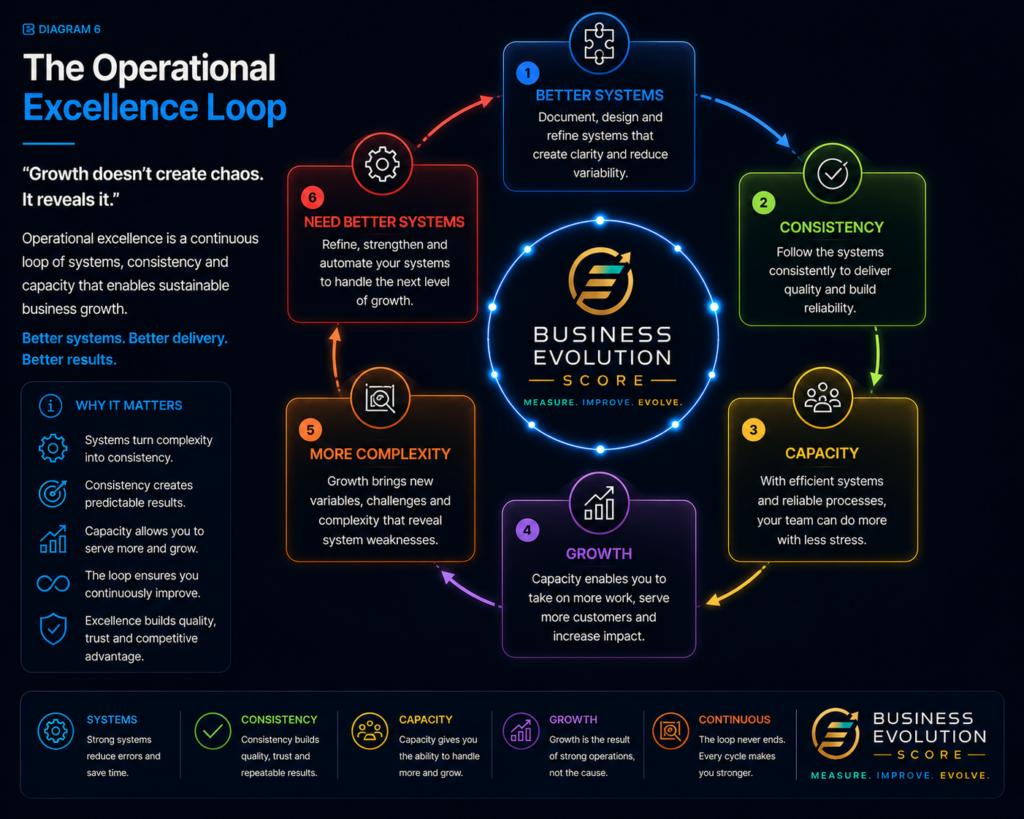
Operational excellence is not about working harder. It is about making consistent performance repeatable.
Healthy operations create a continuous cycle of consistency and improvement. Every delivery provides an opportunity to strengthen the systems, processes and capabilities that support future growth.
Business Evolution Connection
Operations is the bridge between customer expectations and business performance.
Marketing creates awareness.
Sales make promises.
Finance provides resources.
People perform the work.
Strategy sets the direction.
Operations brings them together by turning intention into execution.
Without strong operations, growth becomes increasingly difficult because every new customer places additional strain on the business.
With strong operations, growth becomes sustainable because the business has built the capability to deliver consistently at scale.
People & Leadership
Businesses do not grow because one person works harder.
They grow because people work together effectively.
Many business owners think People & Leadership is primarily about recruitment, employment contracts or managing staff.
It isn’t.
People & Leadership is the capability to build a team that understands the business, takes ownership of its responsibilities and consistently performs without constant supervision.
Every successful business eventually reaches a point where the founder can no longer do everything.
Customers increase.
Work becomes more complex.
Decisions multiply.
Without capable people and effective leadership, growth begins to slow because the business remains dependent on a handful of individuals.
Healthy businesses recognise that leadership is not about having all the answers.
It is about creating clarity, building trust and enabling other people to succeed.
This means recruiting carefully, setting clear expectations, developing people’s skills and creating an environment where accountability becomes part of the culture rather than something enforced through constant oversight.
Strong leadership also creates resilience.
When employees understand the purpose of the business, know what success looks like and feel trusted to make good decisions, the organisation becomes stronger than the sum of its individual parts.
People do not simply carry out work.
They carry the capability of the business.
What a Healthy Business Looks Like
Businesses with strong People & Leadership capabilities develop teams that are confident, accountable and aligned around common goals.
Roles and responsibilities are clearly defined, communication is open and regular feedback helps individuals continue improving. Leaders focus on developing people rather than solving every problem themselves.
Healthy businesses invest in knowledge sharing so that expertise is distributed across the organisation rather than concentrated in a few individuals. Decisions are made at the appropriate level, allowing leaders to focus on strategic priorities instead of becoming involved in every operational detail.
Employees understand how their work contributes to the success of the business, creating greater engagement, consistency and collaboration.
Warning Signs
Your business may need to strengthen this pillar if:
The founder is involved in nearly every important decision.
Employees wait for instructions instead of taking ownership.
Performance varies significantly between team members.
Staff turnover regularly disrupts the business.
Important knowledge is concentrated in a few individuals.
Difficult conversations are avoided until they become major problems.
Managers spend more time firefighting than leading.
Growth increases pressure on leaders rather than building leadership capacity.
How This Pillar Influences the Rest of the Business
People bring every other capability to life.
Marketing campaigns are created by people.
Sales relationships are built by people.
Operations are delivered by people.
Financial decisions are made by people.
Strategy is executed by people.
Even the best systems cannot compensate for unclear leadership, poor communication or a lack of accountability.
At the same time, strong leadership enables every other capability to improve.
Leaders create the environment where learning, innovation and continuous improvement become part of the culture.
As businesses grow, leadership becomes less about directing work and more about enabling others to perform at their best.
Healthy businesses understand that developing people is not separate from building the business.
It is how the business is built.
Business Evolution Insight
Businesses don’t scale because they hire more people.
They scale because more people become capable of making good decisions.
Adding employees without developing leadership simply increases complexity.
Developing capable leaders multiplies the effectiveness of the entire organisation.
Healthy businesses understand that leadership is not measured by how many people report to you.
It is measured by how many people can succeed without relying on you.
Business Evolution Principle
Strong businesses are not built by indispensable people. They are built by capable people who make each other stronger.
Caption
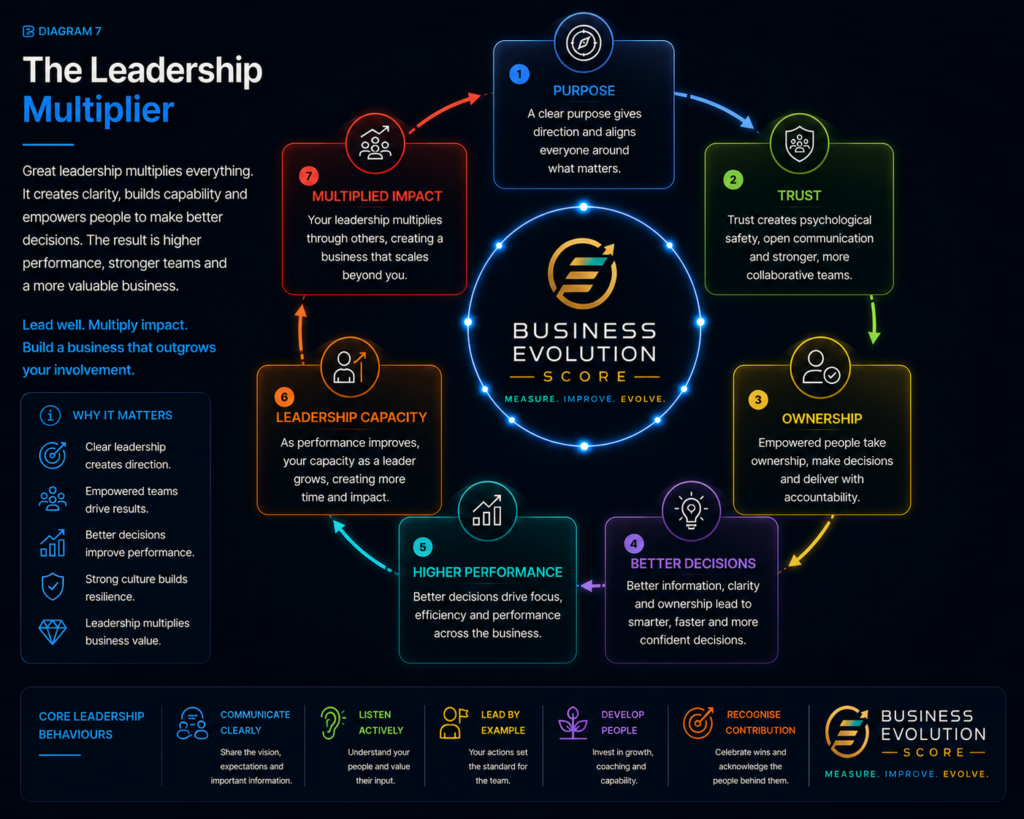
Effective leadership creates a reinforcing cycle. Clear direction builds trust, trust encourages ownership, ownership improves decision-making, and better decisions strengthen the performance and leadership capacity of the business.
Business Evolution Connection
People transform business capability into business performance.
Strategy provides direction.
Finance provides resources.
Operations create consistency.
Marketing creates opportunities.
Sales create customers.
But it is people who make each of these capabilities work together.
Without effective leadership, even strong systems eventually lose momentum because nobody is guiding, improving and strengthening them.
Healthy businesses understand that sustainable growth depends on building leaders at every level, not simply adding more employees.
Strategy & Growth
Every business is heading somewhere.
The question is whether it is getting there by design or by default.
Many business owners think strategy is a document, a planning session or a set of ambitious goals.
It isn’t.
Strategy is the capability to make deliberate choices about where the business is going, how it will get there and what it will deliberately choose not to do.
Healthy businesses understand that growth does not happen by accident.
It is the result of consistent decisions that align people, resources and effort around a clear direction.
Without strategy, businesses often become reactive.
Opportunities are pursued because they appear attractive rather than because they support a long-term objective. Priorities change constantly, resources become stretched and progress feels slower despite everyone working harder.
Strong strategy provides clarity.
It helps leaders decide which customers to serve, which opportunities to pursue, where to invest and when to say no.
Just as importantly, it ensures that every other capability in the business is working towards the same destination.
Strategy is not about predicting the future.
It is about making better decisions today while remaining adaptable as circumstances change.
Healthy businesses review their direction regularly, learn from experience and adjust when necessary without losing sight of their purpose.
Growth is not simply becoming bigger.
It is becoming stronger, more capable and more valuable over time.
What a Healthy Business Looks Like
Businesses with strong Strategy & Growth capabilities have a clear understanding of where they are going and why.
Their goals are translated into practical priorities that guide decision-making throughout the organisation. Investments, new opportunities and day-to-day activities are evaluated against long-term objectives rather than short-term distractions.
Healthy businesses monitor progress regularly and are willing to adjust their approach when circumstances change, but they avoid constantly changing direction.
They understand that sustainable growth comes from improving the capabilities of the business rather than chasing every new opportunity.
Everyone in the organisation understands what success looks like and how their work contributes to achieving it.
Warning Signs
Your business may need to strengthen this pillar if:
New opportunities regularly distract the business from its priorities.
Growth feels reactive rather than intentional.
Teams are unclear about the business’s direction.
Major decisions are made without clear criteria.
Too many initiatives compete for the same resources.
The business frequently changes priorities before previous initiatives are completed.
Success is measured by activity rather than meaningful progress.
How This Pillar Influences the Rest of the Business
Strategy gives purpose to every other capability.
Marketing knows who it is trying to reach.
Sales understands which customers are the right fit.
Finance allocates resources with intention.
Operations improve the processes that matter most.
People develop the capabilities needed for the future rather than simply solving today’s problems.
Without strategy, every department may perform well individually while the business as a whole drifts without clear direction.
Strong strategy aligns decisions across the organisation, ensuring that every improvement strengthens the same long-term objective.
Business Evolution Insight
Businesses rarely fail because they have too few opportunities.
They struggle because they pursue too many.
Every new product.
Every new market.
Every new partnership.
Every new idea.
Each one competes for the same time, money and attention.
Healthy businesses understand that strategy is as much about choosing what not to do as deciding what to pursue.
Focus is not a limitation.
It is a competitive advantage.
Business Evolution Principle
Strategy is not about having more options. It is about making better choices.
Caption
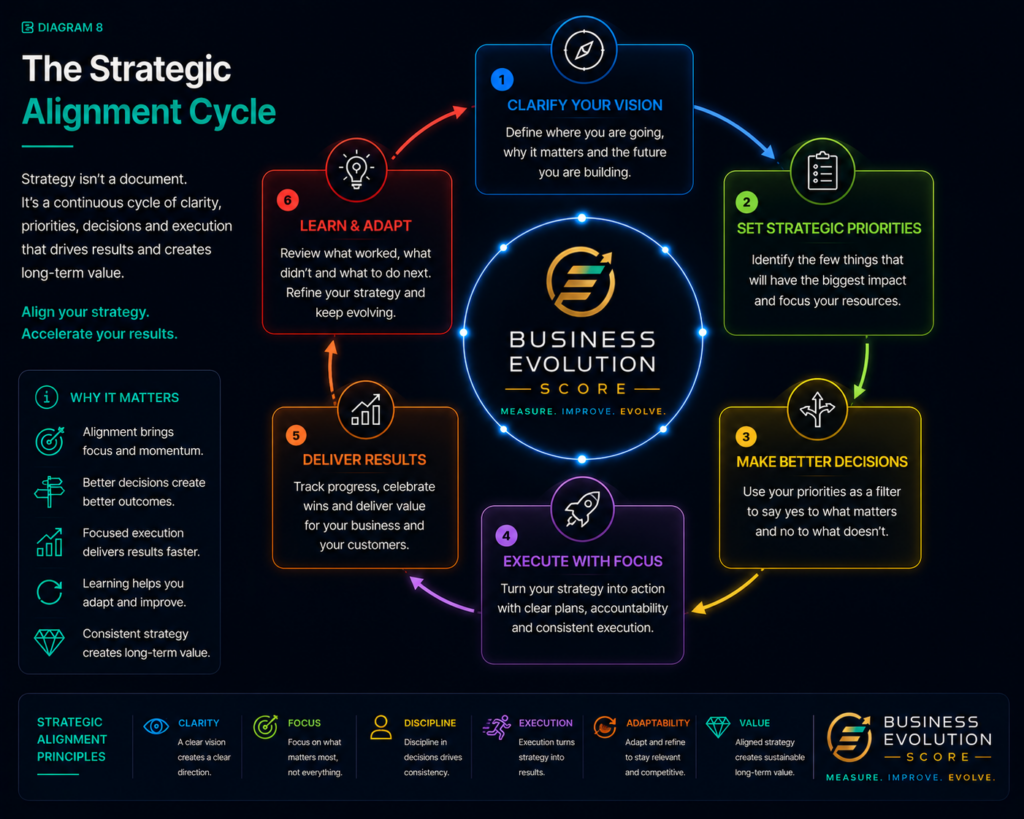
Healthy businesses continually align their decisions with their direction. Progress creates learning, learning refines strategy, and refined strategy leads to even better decisions.
Business Evolution Connection
Strategy is the capability that aligns every other pillar.
Customers & Sales generate revenue from the right markets.
Marketing builds visibility with the right audience.
Finance funds the right investments.
Operations improve the right processes.
People develop the right capabilities.
Founder Dependency reduces the risks that threaten long-term sustainability.
Without strategy, these capabilities can improve independently without moving the business forward together.
Healthy businesses understand that growth is not created by improving one capability in isolation.
It is created by aligning them all towards a common purpose.
Founder Dependency & Business Resilience
Every business begins with dependence.
In the early stages, the founder often makes the sales, manages the customers, solves the problems, controls the finances and keeps the entire operation moving.
That is normal.
The risk appears when the business grows, but the dependency does not change.
Many founders believe their business is successful because it is busy, profitable or growing.
But if the business cannot operate effectively without their constant involvement, it may be performing well without yet being truly resilient.
Founder Dependency & Business Resilience is the capability to build a business that can continue operating, making decisions and serving customers without relying excessively on one person.
This does not mean the founder becomes irrelevant.
It means the founder’s role evolves.
Instead of being the person who holds everything together, the founder becomes the person who builds the capabilities, people and systems that allow the business to hold itself together.
Healthy businesses reduce unnecessary dependency over time.
Knowledge is shared.
Responsibilities are distributed.
Decision-making is delegated appropriately.
Customer relationships belong to the business, not only to the founder.
Critical processes are understood by more than one person.
The business can absorb disruption without immediately losing control.
Resilience is not created by predicting every possible problem.
It is created by ensuring the business is not critically exposed when problems occur.
A resilient business can survive the founder taking a holiday, becoming unavailable, stepping back temporarily or eventually choosing to exit.
The true test of business health is not how well the business performs when the founder is present.
It is how well it continues to perform when the founder is not.
What a Healthy Business Looks Like
Businesses with strong Founder Dependency & Business Resilience capabilities do not rely on one person to make every important decision or maintain every key relationship.
Leadership responsibility is shared across capable people. Essential knowledge is documented, discussed and transferred so that the business is not vulnerable when an employee or founder becomes unavailable.
Customers trust the organisation rather than depending exclusively on one individual.
Key processes continue without constant intervention.
Important financial, operational and commercial information is accessible to the people who need it.
The founder can step away from day-to-day activity without the business immediately slowing down, losing direction or creating unnecessary risk.
Healthy businesses also prepare for disruption.
They understand their critical dependencies, maintain appropriate contingency plans and regularly consider what would happen if a key person, supplier, customer or system were suddenly unavailable.
Resilience does not mean removing every risk.
It means ensuring no single weakness can unnecessarily threaten the entire business.
Warning Signs
Your business may need to strengthen this pillar if:
Most important decisions still require the founder’s approval.
Customers insist on dealing directly with the founder.
Critical knowledge exists only in one person’s head.
The business slows down when the founder is unavailable.
Team members avoid taking responsibility for fear of making the wrong decision.
The founder cannot take meaningful time away without remaining constantly connected.
One customer, employee, supplier or system represents a major point of failure.
There is no clear succession, continuity or emergency plan.
The founder spends most of their time solving operational problems.
The value of the business depends heavily on the founder’s personal relationships and reputation.
How This Pillar Influences the Rest of the Business
Founder dependency places pressure on every other capability.
Sales become constrained because the founder remains the primary rainmaker.
Marketing struggles to build a brand that exists beyond one personality.
Financial decisions are delayed because authority is concentrated.
Operations become fragile because too much knowledge remains undocumented.
People fail to develop because the founder continues making decisions on their behalf.
Strategy becomes difficult because the founder is trapped in daily execution.
The business may continue growing, but each new customer, employee and responsibility increases the founder’s workload.
Eventually, the founder becomes both the greatest strength of the business and its greatest limitation.
Reducing founder dependency releases capacity across the organisation.
Customers build confidence in the team.
Employees take greater ownership.
Decisions happen faster.
Knowledge becomes more widely available.
The founder gains the time and perspective required to focus on leadership, growth and long-term value.
Business resilience is therefore not a separate activity.
It is the outcome of every capability becoming strong enough to function without constant rescue.
Business Evolution Insight
A founder can be essential to the vision without being essential to every decision.
Many business owners fear that reducing dependency means losing control.
In reality, the opposite is often true.
When everything depends on the founder, control is fragile.
One illness.
One emergency.
One period of exhaustion.
One unexpected departure.
Any of these can expose how little control the business truly has.
Healthy businesses replace personal control with organisational capability.
The founder does not lose influence.
They gain leverage.
Their knowledge becomes embedded in systems.
Their standards become reflected in the team.
Their relationships become part of the organisation.
Their vision can continue without requiring their presence in every moment.
The goal is not to build a business that no longer needs its founder.
It is to build one that is no longer endangered by them being unavailable.
Business Evolution Principle
A resilient business does not depend on the founder being everywhere. It depends on the founder building capability everywhere.
Caption
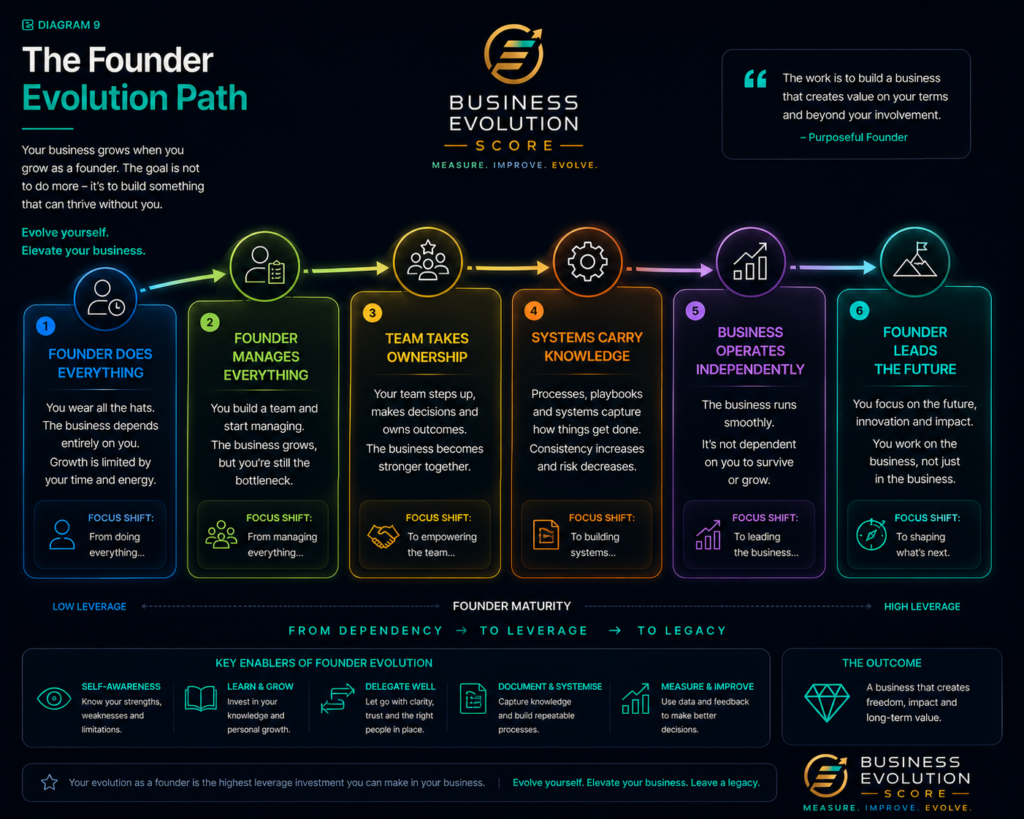
As a business evolves, the founder’s role should evolve with it. The goal is not withdrawal, but progression: from doing the work, to directing the work, to building the capability that allows the business to perform without constant intervention.
Business Evolution Connection
Founder Dependency & Business Resilience is where the strength of every other pillar is tested.
Customers & Sales are healthier when relationships belong to the business.
Marketing & Visibility are stronger when the brand is bigger than one individual.
Finance & Cash Flow are more secure when financial understanding and authority are shared.
Operations & Delivery are more reliable when knowledge is embedded in processes.
People & Leadership become stronger when others are trusted to decide and lead.
Strategy & Growth become possible when the founder has the space to think beyond daily survival.
A business becomes resilient when its capabilities are distributed across the organisation rather than concentrated in one person.
That is the final stage of business evolution.
Not a business without a founder.
A business that has grown beyond depending on the founder for everything.
The Final Business Evolution Insight
The founder is often the reason the business exists.
But the business only becomes truly valuable when it can exist beyond the founder’s constant involvement.
That is not a loss of importance.
It is the clearest evidence that the founder has succeeded.
The ultimate achievement is not building a business that needs you. It is building one that carries your vision without requiring your presence.
That is the difference between owning a job and building a business.
A healthy business does not become independent of its founder overnight.
It evolves.
One decision.
One system.
One leader.
One capability at a time.
Every improvement made across the seven pillars strengthens the business’s ability to perform, adapt and grow.
The result is not simply a business that is larger.
It is a business that is healthier.
Business Evolution Connection
Founder Dependency & Business Resilience is the point where every other capability is proven.
A business cannot become resilient through systems alone.
Or through better marketing.
Or stronger finances.
Or clearer strategy.
Resilience emerges when every capability works together.
When customers trust the organisation.
When marketing creates consistent opportunities.
When finances provide confidence.
When operations deliver reliably.
When people take ownership.
When strategy provides direction.
The founder is no longer carrying the business.
The business has learned to carry itself.
That is the destination of Business Evolution.
Bringing It All Together
For most business owners, improving a business feels overwhelming.
There are always more ideas to pursue, more problems to solve and more opportunities competing for attention.
The Business Evolution Framework is built on a different belief.
Healthy businesses are not created by fixing everything at once.
They are built by strengthening the capabilities that matter most, one step at a time.
Every business has strengths.
Every business has weaknesses.
Every business has opportunities to improve.
The goal is not perfection.
The goal is progress.
By understanding how the seven pillars work together, business owners can move beyond reacting to today’s problems and begin building a business that is stronger, more resilient and better prepared for tomorrow.
Because healthy businesses do not happen by chance.
They evolve.
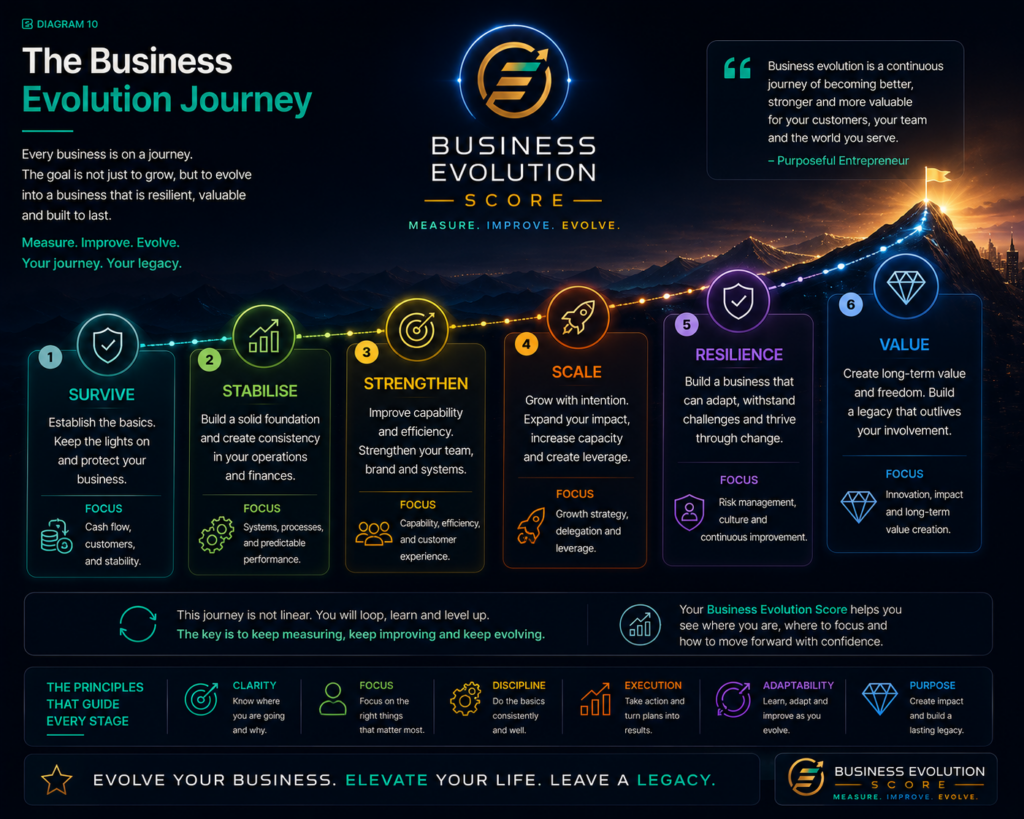
The Business Evolution Journey
Caption
Every business begins somewhere. Healthy businesses don’t become resilient overnight—they evolve by continuously strengthening the capabilities that matter most. The Business Evolution Journey illustrates the progression from survival to long-term value.
Ready to Discover Your Business Evolution Score?
Reading about business health is valuable.
Understanding the health of your business is even more valuable.
The Business Evolution Score assessment evaluates your business across all seven pillars, identifies your strengths, highlights your greatest risks and provides practical recommendations to help you build a stronger, healthier and more resilient business.
Whether you’re just starting out or leading an established company, your next stage of growth begins with understanding where you are today.
Take the Free Business Evolution Score Assessment
Measure your business across the seven pillars and receive your personalised Business Evolution Score with practical recommendations to help you build a stronger business.
Building a healthy business requires more than just understanding the principles discussed in this guide. Depending on where your business operates, you may also benefit from trusted government agencies and international organisations that provide guidance on business regulations, funding opportunities, exporting, taxation, compliance and entrepreneurship.
The following organisations are recognised internationally as authoritative sources of information and support for entrepreneurs and small business owners.
🌍 OECD – SMEs and Entrepreneurship
The Organisation for Economic Co-operation and Development (OECD) publishes research, policy insights and practical resources focused on entrepreneurship, innovation, productivity, resilience and the long-term growth of small and medium-sized businesses around the world.
🌍 World Trade Organization (WTO) – MSME Business Handbook
The World Trade Organization (WTO) provides practical guidance for micro, small and medium-sized enterprises looking to expand into international markets, understand global trade requirements and navigate export opportunities.
🇺🇸 United States – U.S. Small Business Administration (SBA)
The U.S. Small Business Administration (SBA) offers comprehensive guidance on starting, managing, funding and growing a business within the United States, including free planning tools and educational resources.
🇬🇧 United Kingdom – GOV.UK Business and Self-Employed
The UK Government’s Business and Self-employed portal provides official guidance covering company registration, taxation, employment, legal compliance and support programmes for businesses operating in the United Kingdom.
While business regulations, funding programmes and support services vary from country to country, the fundamental principles of building a healthy business remain remarkably consistent.
The Business Evolution Framework was designed around these universal principles. Whether you operate in South Africa, the United States, the United Kingdom, Australia or anywhere else in the world, every successful business depends on healthy customers, effective marketing, sound financial management, efficient operations, strong leadership, clear strategy and reduced founder dependency.
Government agencies can help you navigate local requirements. The Business Evolution Framework helps you build a stronger, healthier and more resilient business—wherever you are in the world.
Frequently Asked Questions
What is a business health assessment?
A business health assessment is a structured evaluation of the key capabilities that determine how well a business performs. Rather than focusing on a single area such as finance or sales, it measures multiple aspects of the business to identify strengths, weaknesses, risks and opportunities for improvement.
What is the Business Evolution Score?
The Business Evolution Score is an assessment that measures your business across seven core pillars: Customers & Sales, Marketing & Visibility, Finance & Cash Flow, Operations & Delivery, People & Leadership, Strategy & Growth, and Founder Dependency & Resilience. Your results highlight where your business is performing well and where you should focus next.
Why is business health important?
Healthy businesses are more resilient, profitable and better prepared for growth. Understanding your business health helps you identify risks early, improve decision-making and build a stronger business over time.
How often should I complete a business health assessment?
Most businesses benefit from completing an assessment every three to six months. Regular assessments help you track progress, measure improvements and identify new priorities as your business evolves.
Is the Business Evolution Score suitable for small businesses?
Yes. The Business Evolution Framework was designed specifically for entrepreneurs, founders and small to medium-sized businesses. It focuses on practical capabilities rather than enterprise-level processes.
Does a business health assessment replace a business plan?
No. A business plan describes where you want to go, while a business health assessment measures how capable your business is of getting there. The two complement each other.
How long does the Business Evolution Score assessment take?
The assessment is designed to be completed in around 10 to 15 minutes. Once finished, you’ll receive your overall score, individual pillar scores and practical recommendations for improving your business.
Is the Business Evolution Score free?
Yes. The introductory Business Evolution Score assessment is free and provides an overview of your business health along with personalised recommendations to help you decide what to improve next.
Founders work long hours, solve problems quickly and do whatever it takes to keep customers happy. In the early stages of a business, this approach is often enough to create momentum and establish a loyal customer base.
As the business grows, however, hard work alone becomes less effective.
More customers, more employees and more complexity require a different way of operating. Businesses that continue to grow successfully usually do so because they replace reliance on memory and individual effort with well-designed business systems that create consistency, efficiency and accountability.
What Are Business Systems?
Business systems are the documented processes, procedures and workflows that guide how work is completed throughout the business.
They don’t need to be complicated.
A business system can be as simple as a customer onboarding checklist, a documented quoting process or a standard procedure for responding to customer enquiries.
The objective is not to create unnecessary administration.
The objective is to ensure that important activities are completed consistently, regardless of who performs them.
Strong business systems reduce uncertainty, improve communication and create a more reliable experience for both customers and employees.
Why Business Systems Matter
Businesses without documented systems often rely on individuals remembering how things should be done.
This may work while the team is small, but it becomes increasingly difficult as the business grows.
Staff begin performing the same task in different ways.
Important steps are forgotten.
Training takes longer because knowledge is transferred verbally rather than through documented processes.
Customers receive inconsistent service depending on who they deal with.
Strong Operations & Delivery helps businesses eliminate this inconsistency by creating repeatable ways of working that improve quality and efficiency.
Systems Improve Efficiency
One of the greatest benefits of business systems is improved efficiency.
Employees spend less time asking questions, searching for information or correcting mistakes because the correct process is already documented.
Routine tasks become easier to complete.
Managers spend less time supervising everyday activities.
Business owners are able to focus on improving the business instead of constantly solving operational problems.
Small improvements in efficiency made consistently across the business can have a significant impact on profitability, customer satisfaction and employee productivity.
Systems Make Delegation Easier
Many business owners find delegation difficult.
Often this is not because employees lack capability, but because expectations have never been documented.
When knowledge exists only in the founder’s head, every decision eventually returns to the owner.
Documented business systems create clarity.
Employees understand what is expected.
Managers are able to coach consistently.
New employees become productive more quickly because they follow established processes instead of learning everything through trial and error.
Delegation becomes far more effective when the business relies on systems rather than memory.
Systems Support Sustainable Growth
Growth places increasing pressure on every part of a business.
More customers generate more enquiries, more orders, more support requests and more operational complexity.
Without strong systems, growth often creates confusion instead of progress.
Businesses with documented processes are able to maintain quality standards while expanding their teams and customer base.
This creates confidence that growth can continue without reducing service quality or placing additional pressure on the founder.
Rather than simply asking whether systems exist, the assessment evaluates how consistently they support efficiency, quality, resilience and sustainable growth.
Strong businesses are not built on hard work alone.
They are built on repeatable systems that allow ordinary business activities to be performed consistently, efficiently and with confidence every day.
Ready to Measure Your Business Evolution?
The free Business Evolution Score assessment evaluates your business across seven critical areas, helping you identify strengths, risks and the next actions that will have the biggest impact.
Whether you’re focused on growth, cashflow, marketing, leadership or resilience, you’ll receive a personalised Business Evolution Score along with practical recommendations to help your business evolve.
Many business owners celebrate a profitable month.
Unfortunately, profit doesn’t always mean there’s money in the bank.
One of the most common reasons businesses experience financial pressure isn’t because they aren’t profitable—it’s because they have poor cash flow.
Understanding the difference between profit and cash flow can help business owners make better decisions, reduce stress and build a more resilient business.
Profit and Cash Flow Are Not the Same
Profit is what remains after your income exceeds your expenses.
Cash flow measures the movement of money into and out of your business.
A business can be profitable on paper while struggling to pay salaries, suppliers or rent because cash hasn’t yet been received.
Healthy businesses manage both profitability and cash flow effectively.
Why Cash Flow Is So Important
Poor cash flow affects every area of the business.
Paying Suppliers
Late customer payments often mean suppliers need to wait.
This can damage relationships and make it harder to negotiate favourable payment terms.
Paying Employees
Employees expect to be paid on time.
Strong Finance & Cashflow management ensures payroll remains predictable, even during slower months.
Investing in Growth
Growing businesses often need to invest before additional revenue arrives.
Without healthy cash flow, opportunities are often delayed or missed entirely.
Reducing Stress
One of the biggest causes of stress for business owners is uncertainty about whether there will be enough money available next month.
Good cash flow planning provides confidence and allows better decision-making.
Common Causes of Cash Flow Problems
Many cash flow challenges are avoidable.
Common causes include:
Customers paying late.
Poor invoicing processes.
Low profit margins.
Excess inventory.
Unplanned business expenses.
Rapid growth without adequate funding.
Recognising these issues early makes them much easier to address.
Cash Flow Is About Planning
Successful businesses don’t simply react to financial problems.
They plan ahead.
That includes:
Forecasting income.
Monitoring expenses.
Building cash reserves.
Reviewing payment terms.
Managing debtor collections.
These habits improve financial resilience and reduce unnecessary risk.
Warning Signs Your Cash Flow Needs Attention
Many cash flow problems don’t happen overnight. They develop gradually, often going unnoticed until the business starts feeling financial pressure.
Watch out for these common warning signs:
You regularly delay paying suppliers.
Customers take longer to pay than expected.
Payroll becomes stressful at the end of the month.
You rely on an overdraft or credit facility to cover normal operating expenses.
Growth opportunities have to be delayed because there isn’t enough cash available.
You constantly wonder whether there will be enough money in the bank next month.
Recognising these warning signs early allows you to take corrective action before they become major financial problems.
Healthy businesses don’t wait for a cash flow crisis—they monitor, plan and adjust continuously.
Cash Flow Is a Measure of Business Health
Cash flow is more than a financial metric.
It reflects how effectively your business converts sales into available working capital, manages expenses and prepares for future growth.
Businesses with healthy cash flow are generally more resilient during difficult economic conditions because they have greater flexibility to respond to unexpected challenges and opportunities.
Improving cash flow isn’t simply about collecting money faster. It’s about building stronger financial habits that support long-term business success.
It helps business owners understand how effectively they manage cash flow, financial planning and long-term sustainability.
If cash flow has ever kept you awake at night, it’s worth understanding where your business stands.
Understanding your cash flow is only one part of building a stronger business. Measuring every area of your business gives you a clearer picture of where to focus next.
Ready to Measure Your Business Evolution?
The free Business Evolution Score assessment evaluates your business across seven critical areas, helping you identify strengths, risks and the next actions that will have the biggest impact.
Whether you’re focused on growth, cashflow, marketing, leadership or resilience, you’ll receive a personalised Business Evolution Score along with practical recommendations to help your business evolve.
Many business owners wear their busyness as a badge of honour.
They’re involved in every important decision, approve every payment, solve every customer problem and answer every difficult question.
At first, this feels like good leadership.
Over time, however, it often becomes one of the biggest barriers to business growth.
This is known as founder dependency.
When a business depends on one person to keep everything moving, growth becomes slower, risk increases and the long-term value of the business declines.
What Is Founder Dependency?
Founder dependency occurs when the owner becomes central to almost every part of the business.
Examples include:
Clients only want to speak to the owner.
Staff wait for the owner to make decisions.
Sales stop when the owner isn’t involved.
Important knowledge exists only in the owner’s head.
The business struggles whenever the owner is away.
Many small businesses start this way.
The challenge is recognising when founder involvement becomes founder dependency.
The Hidden Cost of Founder Dependency
Founder dependency affects far more than the owner’s workload.
It influences almost every aspect of the business.
Growth Slows Down
Every decision eventually waits for one person.
As the business grows, this creates bottlenecks that limit capacity.
Teams Stop Taking Ownership
When employees believe every decision needs approval, initiative disappears.
Strong People & Leadership encourages accountability and empowers teams to solve problems confidently.
Customers Become Attached to One Person
Customers often build strong relationships with founders.
While this creates trust, it also creates risk.
If every important relationship depends on one individual, the business becomes vulnerable.
Business Value Declines
Businesses that rely heavily on their founders are generally more difficult to sell.
Potential buyers want systems, capable teams and predictable performance—not a business that depends on one person’s daily involvement.
Founder dependency is one of the biggest risks facing many growing businesses.
Illness, holidays or unexpected life events should not bring the business to a standstill.
Resilient businesses are designed to continue operating even when the founder steps away.
Reducing Founder Dependency
Reducing founder dependency doesn’t mean becoming less involved.
It means building a stronger business.
Practical steps include:
Document important processes.
Delegate decision-making.
Develop future leaders.
Build systems instead of relying on memory.
Encourage accountability across the team.
These improvements create a business that is stronger, healthier and easier to grow.
Building a Business Beyond Yourself
As I discuss in The Purposeful Entrepreneur, one of the greatest transitions for any entrepreneur is moving from being the business to building a business that can succeed without constant founder involvement.
That shift creates freedom for the owner while making the business more resilient and valuable over the long term.
Rather than relying on assumptions, you’ll receive practical insights into how dependent your business is on you and the steps you can take to strengthen it.
If you’re wondering whether your business could continue operating without you for two weeks, it’s worth finding out.
Take the free Business Evolution Score assessment and discover where your business stands.
Why your business isn’t growing is a question many business owners ask themselves, especially when sales are increasing.
The truth is that higher revenue doesn’t always mean a healthier business. Growth can expose weaknesses in operations, leadership, cashflow and strategy that eventually limit future success.
Understanding these hidden constraints is the first step towards building a stronger, more resilient business.
Why Your Business Isn’t Growing Despite Increasing Sales
Revenue is important.
Without customers, there is no business.
But revenue is only one part of the picture.
A business can increase sales while experiencing:
Declining profitability
Worsening cashflow
Operational bottlenecks
Founder burnout
Customer service issues
Increasing business risk
Growth only creates value when the business has the capability to support it.
The Customers & Revenue pillar measures how consistently your business turns opportunities into predictable income.
Five Hidden Reasons Businesses Stop Growing
Many growing businesses encounter the same challenges.
1. Everything Depends on the Founder
If every important decision comes through the owner, growth eventually slows.
The founder becomes the bottleneck.
Strong People & Leadership capability becomes essential as the business grows.
2. Marketing Outpaces Operations
Successful marketing creates demand.
But if Operations & Delivery can’t consistently deliver, customers become disappointed and staff become overwhelmed.
Sales and delivery need to evolve together.
3. Cashflow Doesn’t Keep Up
Growing businesses often require:
More inventory
More staff
Additional equipment
Larger facilities
Without strong Finance & Cashflow management, higher sales can actually increase financial pressure.
4. Systems Haven’t Matured
Many businesses operate successfully using spreadsheets, memory and informal processes.
As the business grows, these approaches become increasingly difficult to manage.
Documented systems improve consistency and reduce risk.
5. There Is No Clear Strategic Direction
Sometimes businesses become busy without becoming better.
Activity isn’t the same as progress.
Businesses that actively invest in Strategy & Growth are far better positioned to identify opportunities while avoiding unnecessary distractions.
Rather than focusing on a single number, the framework evaluates seven key business areas that influence long-term performance, resilience and growth.
The result is a more complete understanding of where your business is strong, where hidden risks exist and what improvements will have the greatest impact.
If you’ve been wondering why your business isn’t growing, the answer often lies in the capabilities that support long-term success rather than sales alone.
If your business feels busy but growth has stalled, the problem may not be sales at all.
It may be that another part of the business is limiting your ability to move forward.
Sustainable Growth Requires Balance
Businesses rarely stop growing because of a single problem.
More often, growth slows because several small weaknesses combine over time. A business may have strong sales but weak cashflow, or excellent marketing but poor operational capacity. Identifying these imbalances early allows business owners to focus on the improvements that will create the greatest long-term impact.
The strongest businesses continuously review and strengthen every area of the business rather than relying on revenue growth alone.
Measure More Than Revenue
Every business reaches a point where working harder stops producing better results.
Understanding the real constraints is the first step towards building a stronger, healthier and more valuable business.
Ready to discover why your business isn’t growing? Take your free Business Evolution Score assessment and receive personalised insights, practical recommendations and a clear roadmap to build a stronger, healthier business.
Ready to Measure Your Business Evolution?
The free Business Evolution Score assessment evaluates your business across seven critical areas, helping you identify strengths, risks and the next actions that will have the biggest impact.
Whether you’re focused on growth, cashflow, marketing, leadership or resilience, you’ll receive a personalised Business Evolution Score along with practical recommendations to help your business evolve.
Most business owners know they should delegate more.
They’ve read the books.
They’ve attended the seminars.
They’ve heard the advice countless times:
“Work on the business, not just in it.”
Yet every morning they find themselves approving invoices, answering routine questions, solving customer issues and making decisions their team could probably handle.
The problem isn’t that founders don’t understand delegation.
The problem is that delegation is far more difficult than it sounds.
For many entrepreneurs, their business exists because they cared more, worked harder and solved problems faster than anyone else.
Those same strengths that helped build the business can eventually become the biggest obstacle to its growth.
Learning to delegate isn’t about doing less.
It’s about building a business that can achieve more without depending on one person.
Why Delegation Feels So Difficult
Delegation isn’t just a management skill.
It’s a mindset shift.
Many business owners worry that if they hand work to someone else:
Quality will drop.
Customers won’t be looked after.
Mistakes will increase.
Problems will take longer to solve.
They’ll spend more time fixing work than doing it themselves.
These concerns are understandable.
But they often lead to a business where every important decision still depends on the owner.
That’s not leadership.
That’s dependency.
The People & Leadership pillar of the Business Evolution Framework explores how delegation, accountability and leadership capability influence long-term business success.
The Hidden Cost of Founder Dependency
When every decision depends on one person, growth slows.
The owner becomes the bottleneck.
Team members stop making decisions because they know everything eventually comes back to the founder.
Customers wait longer.
Projects take longer.
Opportunities are missed.
Ironically, the harder the owner works, the more dependent the business becomes.
The free Business Evolution Score assessment evaluates your business across seven critical areas, helping you identify strengths, risks and the next actions that will have the biggest impact.
Whether you’re focused on growth, cashflow, marketing, leadership or resilience, you’ll receive a personalised Business Evolution Score along with practical recommendations to help your business evolve.
Most business owners don’t wake up one morning and decide to create chaos.
It happens gradually.
The business wins more customers. The team grows. New products or services are added. Before long, everyone is busy, but nobody seems to know the best way to do things.
The owner answers the same questions every day.
Mistakes become more common.
Customer experiences become inconsistent.
Simple tasks take longer than they should.
Sound familiar?
The problem usually isn’t the people.
It’s the lack of systems.
Business systems are what allow a business to deliver consistent results, regardless of who is doing the work. They reduce confusion, improve quality and create the foundations for sustainable growth.
Without systems, growth often creates complexity.
With the right systems, growth becomes far more manageable.
What Are Business Systems?
Business systems are the documented processes, workflows and ways of working that enable a business to operate consistently.
They’re not software.
They’re not expensive technology.
They’re simply agreed ways of doing important work.
A good system answers questions like:
How do we onboard a new customer?
How do we prepare a quote?
How do we invoice clients?
How do we handle complaints?
How do we deliver a project?
The Operations & Delivery pillar of the Business Evolution Framework explores how well your business delivers consistently through documented processes and operational excellence.
Why Small Businesses Resist Systems
Many founders believe systems are something only large companies need.
In reality, the opposite is true.
Small businesses have fewer people, less time and less margin for error.
Without systems, the owner becomes the system.
Every decision flows through one person.
Every exception lands on the owner’s desk.
Every new employee requires constant supervision.
That isn’t sustainable.
Good systems create freedom, not bureaucracy.
Five Benefits of Strong Business Systems
1. Consistency
Customers expect a consistent experience every time they deal with your business.
Systems ensure that quality doesn’t depend on who’s working that day.
Consistency builds trust.
2. Better Efficiency
When everyone follows the same process, work gets done faster.
There’s less duplication.
Less confusion.
Less rework.
Efficiency improves naturally because the team spends less time figuring out what to do.
3. Easier Delegation
One of the biggest reasons founders struggle to delegate is that nothing has been documented.
People can’t follow a process that only exists in the owner’s head.
Documented systems make delegation far easier.
The People & Leadership pillar explores how delegation reduces founder dependency and creates stronger teams.
4. Better Customer Experience
Reliable systems create reliable service.
Customers receive consistent communication.
Projects are delivered on time.
Problems are resolved more quickly.
Over time, this consistency becomes a competitive advantage.
The Customers & Revenue pillar explains how delivering consistently helps improve customer retention and long-term revenue.
5. Businesses That Can Scale
Growth places pressure on every business.
Without systems, pressure creates chaos.
With systems, pressure becomes manageable because the business already knows how work should flow.
That’s one of the reasons operational maturity plays such an important role in long-term growth.
Systems Don’t Need To Be Complicated
Many business owners imagine thick operations manuals that nobody reads.
That’s not what we’re talking about.
A good business system can be:
A simple checklist
A one-page process
A documented workflow
A standard operating procedure
A shared template
The goal isn’t perfection.
The goal is consistency.
Start with the activities your business performs every day.
Improve one system at a time.
Signs Your Business Needs Better Systems
Ask yourself a few questions.
Do people regularly ask how to do routine tasks?
Does work get completed differently depending on who does it?
Are mistakes becoming more common?
Does the owner answer the same questions every day?
Is onboarding new staff difficult?
Does quality vary between projects?
If you answered “yes” to several of these questions, improving your business systems could have one of the biggest impacts on your business.
Systems Support Strategic Growth
Many businesses focus on sales while overlooking operations.
But growth without systems often creates stress rather than success.
Strong businesses improve both.
The Strategy & Growth pillar looks at how planning, decision-making and operational readiness support sustainable business growth.
Likewise, resilient businesses rely on strong systems to maintain quality and adapt when circumstances change. Learn more in the Resilience & Riskpillar.
Build Systems Before You Need Them
The best time to improve your systems isn’t after your business becomes overwhelmed.
It’s before.
Every documented process, checklist and workflow reduces complexity and creates a stronger foundation for growth.
You don’t need hundreds of systems.
You simply need the right systems for the stage your business is in today.
Over time, those small improvements compound into a business that’s easier to manage, easier to grow and more valuable.
The free Business Evolution Score assessment evaluates your business across seven critical areas, helping you identify strengths, risks and the next actions that will have the biggest impact.
Whether you’re focused on growth, cashflow, marketing, leadership or resilience, you’ll receive a personalised Business Evolution Score along with practical recommendations to help your business evolve.
But here’s the reality: not all growth is good growth.
Many businesses increase their sales only to discover they’re working longer hours, carrying more stress and making less profit than before. Others grow so quickly that their systems, cashflow and people simply can’t keep up.
Growing a business and building a better business are not always the same thing.
That’s where strategic growth comes in.
Strategic growth isn’t about growing as quickly as possible. It’s about growing in a way that makes your business stronger, healthier and more resilient over time.
This philosophy sits at the heart of the Business Evolution Framework, which measures the key capabilities every business needs to grow sustainably.
If you’re a founder or small business owner, understanding this difference could save you years of frustration.
What Is Strategic Growth?
Strategic growth is the deliberate process of improving your business while it grows.
Rather than focusing only on increasing revenue, strategic growth considers every part of the business.
It asks questions like:
Can we consistently deliver what we promise?
Do we have enough cashflow to support growth?
Are our systems ready for more customers?
Are we too dependent on the founder?
Can the business continue growing without becoming chaotic?
A business that grows strategically becomes stronger with every stage of growth.
A business that grows without a strategy often becomes more complicated, more stressful and more vulnerable.
Growth Doesn’t Solve Business Problems
One of the biggest misconceptions among entrepreneurs is that growth will solve existing problems.
In reality, growth often magnifies them.
If your sales process is inconsistent today, more leads simply create more confusion.
If your operations are already under pressure, more customers create more delays.
If your cashflow is tight, faster growth usually requires more working capital, making the situation even more difficult.
Growth acts like a magnifying glass.
Strong businesses become stronger.
Weak businesses become exposed.
That’s why many businesses struggle during periods of rapid growth—not because growth is bad, but because they weren’t ready for it.
The Five Pillars of Strategic Growth
Although every business is different, sustainable growth usually depends on five key areas.
1. Clear Direction
Businesses that grow strategically know where they’re going.
They have clear goals, understand their target market and make decisions that support their long-term vision rather than chasing every opportunity that comes along.
Without direction, growth becomes reactive.
The Strategy & Growthpillar of the Business Evolution Framework explores how vision, planning and decision-making influence long-term business success.
2. Healthy Financial Foundations
Growth costs money.
Hiring people, purchasing equipment, increasing inventory or expanding into new markets all require cash.
Strategic growth means understanding your numbers, forecasting cashflow and ensuring that growth strengthens profitability instead of creating financial pressure.
Revenue is important.
Cashflow keeps the doors open.
If finances are holding your business back, our Finance & Cashflow pillar explains the capabilities needed to build a stronger financial foundation.
3. Systems That Can Scale
Every business eventually reaches the point where informal processes stop working.
What worked with five customers won’t necessarily work with fifty.
Documented systems, repeatable processes and consistent ways of working allow businesses to grow without constantly reinventing how things are done.
Good systems reduce stress, improve quality and make growth far more manageable.
Businesses that rely entirely on the founder eventually reach a ceiling.
Strategic growth requires leaders who can delegate, develop their teams and build a business that doesn’t depend on one person making every decision.
The goal isn’t to become less important.
It’s to build a business that’s capable of succeeding because of the team—not despite them.
Our People & Leadership pillar looks at founder dependency, delegation and leadership capability in more detail.
5. Continuous Improvement
Successful businesses don’t stand still.
They regularly evaluate what’s working, identify weaknesses and make steady improvements over time.
Small improvements made consistently often produce far better long-term results than dramatic changes made occasionally.
Strategic growth is a journey, not a destination.
The Business Evolution Framework encourages business owners to regularly assess, improve and measure progress over time.
Strategic Growth vs Business Growth
It’s easy to assume these terms mean the same thing, but they don’t.
Business growth is usually measured by size.
Strategic growth is measured by strength.
A business can double its revenue while becoming less profitable, more stressful to manage and increasingly dependent on the owner.
On the other hand, a strategically growing business improves its systems, leadership, customer relationships and financial health while increasing revenue.
The difference isn’t how fast the business grows.
It’s how well prepared the business is for growth.
Is Your Business Ready to Grow?
Before focusing on more customers or bigger opportunities, ask yourself a few simple questions.
Do we have a clear direction?
Can we consistently generate new business?
Are our finances under control?
Can our operations handle more work?
Does the business rely too heavily on me?
Have we identified our biggest business risks?
If several of these questions make you hesitate, the priority may not be faster growth.
It may be building a stronger foundation first.
Strategic Growth Starts with Understanding Your Business
One of the biggest challenges for business owners is objectivity.
When you’re dealing with customers, staff and day-to-day decisions, it’s difficult to step back and honestly evaluate the overall health of your business.
That’s why frameworks and assessments can be so valuable.
They provide a structured way to measure where your business is strong, where risks exist and what improvements will have the greatest impact.
Growth decisions become much easier when they’re based on evidence rather than assumptions.
Build a Better Business Before You Build a Bigger One
Every entrepreneur wants their business to grow.
The question is whether that growth will create more freedom—or more pressure.
Strategic growth isn’t about chasing size.
It’s about creating a business that’s profitable, resilient and capable of succeeding for years to come.
By strengthening the foundations of your business before accelerating growth, you’ll be in a far better position to take advantage of future opportunities with confidence.
The free Business Evolution Score assessment evaluates your business across seven critical areas, helping you identify strengths, risks and the next actions that will have the biggest impact.
Whether you’re focused on growth, cashflow, marketing, leadership or resilience, you’ll receive a personalised Business Evolution Score along with practical recommendations to help your business evolve.
Running a business is demanding. Between serving customers, managing cashflow, leading your team and planning for the future, it’s easy to spend every day working in the business instead of stepping back to work on it.
That’s why many business owners don’t realise there’s a problem until it becomes impossible to ignore.
Sales begin to slow.
Cashflow becomes unpredictable.
The business depends too heavily on the owner.
Growth starts creating more stress than opportunity.
A Business Health Framework helps you identify these issues before they become serious problems.
What Is a Business Health Framework?
A Business Health Framework is a structured way of measuring the overall health of a business.
Rather than focusing on a single metric such as revenue or profit, it evaluates the core areas that determine whether a business is stable, resilient and capable of sustainable growth.
Just as a doctor looks at more than one vital sign to assess a person’s health, a business health framework considers multiple aspects of a business to provide a complete picture.
The goal isn’t to judge a business. It’s to help business owners understand where they stand today and identify what they should improve next.
Why Business Health Matters
Many businesses appear successful from the outside while quietly carrying significant risks.
A business may have:
Growing sales but poor cashflow.
Loyal customers but no consistent marketing.
Strong profits but heavy founder dependency.
Great products but inefficient systems.
A capable team but no clear strategy.
These weaknesses often remain hidden until growth, economic uncertainty or unexpected events expose them.
Measuring business health helps identify these issues early, giving owners the opportunity to improve before they become costly.
Why Financial Reports Aren’t Enough
Financial reports are essential, but they only tell part of the story.
They show what has already happened.
They don’t tell you:
Whether customers will continue buying.
Whether your marketing consistently generates leads.
Whether your team can operate without constant supervision.
Whether one major client represents too much of your revenue.
Whether your business could continue operating during unexpected disruption.
Healthy businesses are built on more than financial performance.
They rely on strong systems, capable leadership, effective marketing and sound decision-making.
The Seven Pillars of Business Health
The Business Evolution Score framework measures business health across seven pillars, helping entrepreneurs and small business owners understand where they stand and what to improve next.
The Business Evolution Score framework measures business health across seven practical areas.
1. Customers & Revenue
Can your business consistently attract customers and convert opportunities into predictable revenue?
This pillar focuses on sales processes, customer retention and revenue consistency.
Learn more about Customers & Revenue.
2. Marketing & Demand
Can the right customers find and trust your business?
This pillar evaluates visibility, lead generation, brand positioning and marketing consistency.
Learn more about Marketing & Demand.
3. Finance & Cashflow
Do you have control over your finances?
This pillar measures cashflow management, profitability, forecasting and financial planning.
Learn more about Finance & Cashflow.
4. Operations & Delivery
Can your business deliver consistently as it grows?
This area focuses on systems, documentation, quality and operational efficiency.
Learn more about Operations & Delivery.
5. People & Leadership
Can your business continue operating without depending on you for every decision?
This pillar assesses delegation, accountability, leadership and team capability.
Learn more about People & Leadership.
6. Strategy & Growth
Do you have a clear direction for your business?
This pillar evaluates planning, priorities, innovation and long-term growth readiness.
Learn more about Strategy & Growth.
7. Resilience & Risk
How well prepared is your business for uncertainty?
This pillar considers founder dependency, client concentration, business continuity and overall resilience.
Learn more about Resilience & Risk.
Business Health vs Business Maturity
Business health and business maturity are closely related, but they are not the same thing.
Many maturity models assume every business should operate like a large corporate organisation.
That isn’t realistic for most entrepreneurs and small businesses.
A healthy business doesn’t need complex processes or large teams.
It needs the right capabilities for its stage of growth.
The goal is not to become more corporate.
The goal is to become more capable, more resilient and better prepared for the future.
How Often Should You Measure Business Health?
Business health isn’t something you measure once.
As your business grows, your strengths, challenges and priorities will change.
For most small businesses, reviewing business health every 90 days provides enough time to implement improvements while still measuring meaningful progress.
This creates a simple improvement cycle:
Assess → Improve → Measure Progress
Over time, these regular assessments help business owners make better decisions, reduce risk and build stronger businesses.
Understanding Your Business Through Business Evolution Score
The Business Evolution Score (BES) was created to give entrepreneurs and small business owners a practical way to measure business health.
In around 10 minutes, the assessment evaluates your business across seven key areas and provides a personalised report including:
Your overall Business Evolution Score.
Individual scores for each business area.
Your strongest capabilities.
Improvement priorities.
Business risks.
Growth opportunities.
Practical recommendations for what to focus on next.
The assessment is practical, founder-friendly and designed specifically for small businesses—not large corporations.
Final Thoughts
Every business has strengths.
Every business has weaknesses.
The most successful business owners are not those with perfect businesses, but those who regularly measure, improve and adapt.
Understanding the health of your business is the first step towards building a stronger, more resilient and more valuable business.
If you’d like to see where your business stands today, take the free Business Evolution Score assessment and receive your personalised Business Evolution Report in less than 10 minutes.
Many small business owners believe they have a sales problem.
In reality, they often have a lead generation problem.
Sales can only happen when there are opportunities to convert. Without a consistent flow of potential customers entering the pipeline, revenue becomes unpredictable, cashflow becomes harder to manage, and growth becomes increasingly difficult to sustain.
Unfortunately, lead generation is often one of the first activities to be neglected when business gets busy.
When customer demand is high, marketing is paused. When projects are completed and the pipeline begins to dry up, marketing activity resumes. This creates a cycle of feast and famine that many small businesses experience for years.
The hidden cost of inconsistent lead generation is not simply fewer sales. It affects planning, confidence, decision-making and long-term business growth.
Why Lead Generation Matters
Lead generation is the process of attracting and creating opportunities with potential customers who may eventually purchase your products or services.
For most businesses, revenue begins with a lead.
Without leads there are no sales conversations.
Without sales conversations there are no customers.
Without customers there is no revenue.
While this may seem obvious, many businesses spend far more time focusing on delivery than on maintaining a predictable flow of opportunities into the business.
A healthy sales pipeline is often the result of consistent marketing and business development activities performed over time.
The Feast And Famine Cycle
One of the most common patterns in small business is the feast and famine cycle.
The cycle usually looks something like this:
Marketing generates leads.
New customers are acquired.
The business becomes busy delivering work.
Marketing activity slows down or stops.
The pipeline gradually empties.
Revenue begins to decline.
Panic sets in.
Marketing starts again.
The cycle then repeats.
This creates unnecessary pressure and makes it difficult to build momentum.
Businesses that generate leads consistently tend to experience more stable growth because demand is being created continuously rather than only when problems appear.
Common Signs Of Inconsistent Lead Generation
Many business owners do not realise lead generation has become a weakness until revenue begins to decline.
Common warning signs include:
Leads arrive unpredictably.
Most business comes from referrals.
Marketing activity happens sporadically.
There is little visibility into future opportunities.
Sales fluctuate significantly month to month.
The business depends heavily on one lead source.
Business development only happens when work slows down.
If several of these signs sound familiar, lead generation consistency may be limiting growth.
Why Inconsistent Lead Generation Creates Risk
Revenue Becomes Unpredictable
Without a steady pipeline, future revenue becomes difficult to forecast.
Business owners may struggle to make confident decisions because they cannot accurately predict future demand.
Cashflow Pressure Increases
Revenue gaps often become cashflow problems.
Periods of low demand can place pressure on payroll, suppliers and operating expenses.
Many businesses incorrectly assume they have a cashflow problem when the underlying issue is an inconsistent flow of new opportunities.
Decision-Making Becomes Reactive
When sales are strong, decisions tend to be proactive.
When the pipeline is empty, decisions often become reactive.
Businesses may reduce prices, chase unsuitable opportunities or invest in marketing tactics without a clear strategy.
Growth Becomes Difficult To Sustain
Growth requires a reliable flow of opportunities.
Without consistency, scaling becomes challenging because future demand cannot be predicted with confidence.
Building A More Consistent Lead Generation System
The goal is not necessarily to generate more leads.
The goal is to generate leads more consistently.
Understand Your Ideal Customer
Businesses that clearly understand their target audience tend to market more effectively.
Understanding customer needs, challenges and buying behaviour allows marketing efforts to become more focused and relevant.
Commit To Consistent Marketing Activity
Consistency usually outperforms intensity.
Publishing one piece of content every week for a year is often more effective than publishing ten pieces in one month and then disappearing.
Marketing should become a business habit rather than an emergency response.
Diversify Lead Sources
Relying on a single source of leads creates unnecessary risk.
Businesses should ideally generate opportunities through multiple channels such as:
Referrals
Search engines
Social media
Networking
Partnerships
Email marketing
Content marketing
Diversification creates resilience.
Measure What Works
Marketing without measurement becomes guesswork.
Businesses should understand:
Where leads originate.
Which channels generate customers.
Cost per lead.
Conversion rates.
Return on marketing investment.
Measurement allows resources to be directed toward activities that produce results.
Build A Sales Pipeline
Lead generation and sales are closely connected.
A structured pipeline helps businesses track opportunities, prioritise follow-up and understand future revenue potential.
Without visibility into the pipeline, opportunities can easily be lost.
Quick Self-Assessment: Is Lead Generation A Risk?
Ask yourself the following questions:
Do new leads arrive consistently every month?
Do you know where most of your leads come from?
Are marketing activities planned in advance?
Would lead flow continue if one channel stopped working?
Can you predict future sales opportunities with reasonable confidence?
If you answered “No” to most of these questions, lead generation consistency may be limiting business growth.
Related Business Evolution Pillars
Lead generation affects several areas of business performance and forms part of the broader Business Evolution Framework.
Marketing visibility, lead generation, content marketing, marketing consistency and performance measurement all contribute to creating a predictable flow of opportunities.
Long-term growth depends on the ability to create demand consistently rather than relying on luck or short-term activity.
Businesses that plan for growth typically invest in repeatable lead generation systems.
Final Thoughts
Many businesses believe they need more sales.
What they often need is a more reliable way of creating opportunities.
Consistent lead generation provides stability, improves forecasting, supports cashflow and creates a stronger foundation for growth.
The businesses that grow sustainably are rarely the ones that market only when they need customers.
They are the ones that build systems capable of generating opportunities continuously.
Ready to Measure Your Business Evolution?
The free Business Evolution Score assessment evaluates your business across seven critical areas, helping you identify strengths, risks and the next actions that will have the biggest impact.
Whether you’re focused on growth, cashflow, marketing, leadership or resilience, you’ll receive a personalised Business Evolution Score along with practical recommendations to help your business evolve.
Many small businesses start with a founder who does everything.
They generate sales, solve problems, manage customers, oversee delivery, handle finances and make most of the important decisions.
In the early stages this level of involvement is often necessary.
The problem is that what helps a business survive can eventually prevent it from growing.
This is known as founder dependency.
When too much knowledge, responsibility and decision-making sits with one person, the business becomes difficult to scale and vulnerable to disruption.
What Is Founder Dependency?
Founder dependency exists when the business relies heavily on the owner for day-to-day operations and key decisions.
Common signs include:
Customers always ask for the owner
Team members cannot make decisions independently
Key processes exist only in the founder’s head
The business slows down when the owner is away
Growth creates stress rather than opportunity
The owner becomes the bottleneck.
Why Founder Dependency Is Risky
Growth Becomes Limited
A founder only has so many hours available.
Eventually growth reaches a point where the owner cannot personally manage everything.
Decision-Making Slows Down
When every decision requires founder approval, work becomes delayed and opportunities can be missed.
Team Development Suffers
Employees may avoid taking ownership if they know the owner will ultimately make every decision.
Business Value Decreases
A business that depends entirely on its founder is often less attractive to investors or potential buyers.
Quick Self-Assessment: Is Your Business Too Dependent On You?
Ask yourself the following questions:
Can the business operate effectively for two weeks without you?
Can team members make routine decisions without your approval?
Are key processes documented and repeatable?
Do customers have relationships with the business, or only with you?
Would important work continue if you were unavailable tomorrow?
If you answered “No” to most of these questions, founder dependency may be limiting your growth and increasing business risk.
How To Reduce Founder Dependency
Document Key Processes
Create simple documentation for recurring activities.
The goal is not complexity.
The goal is consistency.
Delegate Outcomes, Not Tasks
Give team members ownership of results rather than isolated tasks.
Develop Leaders
Identify people who can take responsibility for specific areas of the business.
Build Accountability
Ensure responsibilities are clearly defined and measured.
Make Knowledge Transfer A Priority
Critical information should not live in one person’s head.
The Goal Is Not To Become Invisible
Reducing founder dependency does not mean removing the owner from the business.
It means creating a business that can function effectively without requiring the founder to be involved in every decision and activity.
The owner should be able to focus on strategy, growth and leadership rather than constantly solving operational problems.
Related Business Evolution Pillars
Founder dependency affects more than leadership. It can influence growth, operational performance and business resilience.
The People & Leadership pillar measures how effectively responsibility is shared across the business. Areas such as delegation, accountability, communication and leadership development all contribute to reducing dependence on the owner.
Founder dependency is also a business risk. If critical decisions, customer relationships or operational knowledge sit with one person, the business becomes vulnerable when that person is unavailable. The Resilience & Risk pillar evaluates founder dependence, key person risk, knowledge documentation and succession readiness.
Many businesses struggle to scale because the owner becomes the bottleneck. Strong growth often requires systems, delegation and leadership capability that allow the business to grow beyond the founder’s direct involvement.
Final Thoughts
Many business owners believe growth requires working harder.
In reality, sustainable growth often requires building systems, developing people and reducing dependency on the founder.
A healthy business should be able to continue operating even when the owner is not directly involved in every activity.
Ready to Measure Your Business Evolution?
The free Business Evolution Score assessment evaluates your business across seven critical areas, helping you identify strengths, risks and the next actions that will have the biggest impact.
Whether you’re focused on growth, cashflow, marketing, leadership or resilience, you’ll receive a personalised Business Evolution Score along with practical recommendations to help your business evolve.