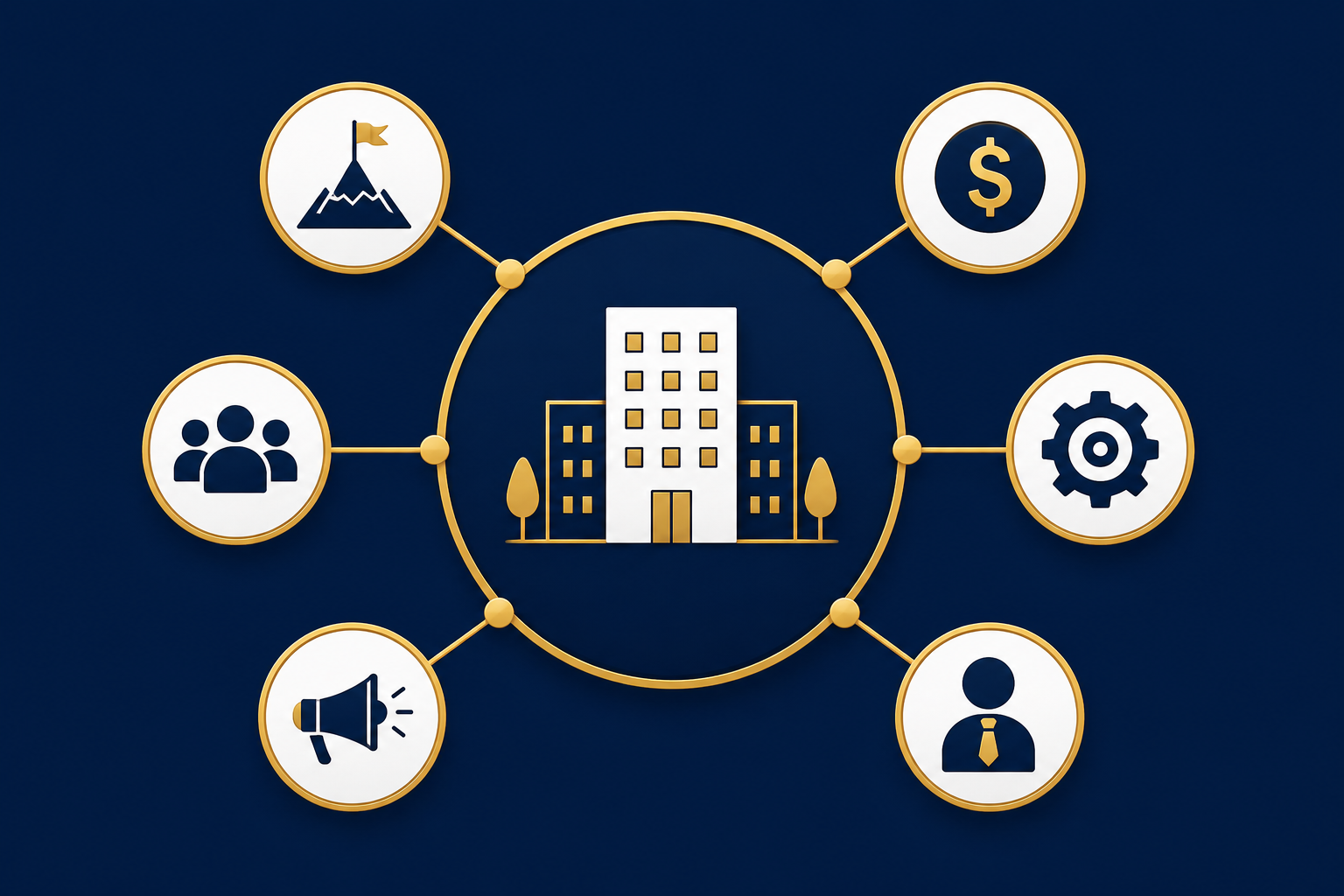
Most business owners dream about growth.
- More customers.
- More revenue.
- More staff.
- A bigger office.
- A stronger brand.
Growth feels like success.
But here’s the reality: not all growth is good growth.
Many businesses increase their sales only to discover they’re working longer hours, carrying more stress and making less profit than before. Others grow so quickly that their systems, cashflow and people simply can’t keep up.
Growing a business and building a better business are not always the same thing.
That’s where strategic growth comes in.
Strategic growth isn’t about growing as quickly as possible. It’s about growing in a way that makes your business stronger, healthier and more resilient over time.
This philosophy sits at the heart of the Business Evolution Framework, which measures the key capabilities every business needs to grow sustainably.
If you’re a founder or small business owner, understanding this difference could save you years of frustration.
What Is Strategic Growth?
Strategic growth is the deliberate process of improving your business while it grows.
Rather than focusing only on increasing revenue, strategic growth considers every part of the business.
It asks questions like:
- Can we consistently deliver what we promise?
- Do we have enough cashflow to support growth?
- Are our systems ready for more customers?
- Are we too dependent on the founder?
- Can the business continue growing without becoming chaotic?
A business that grows strategically becomes stronger with every stage of growth.
A business that grows without a strategy often becomes more complicated, more stressful and more vulnerable.
Growth Doesn’t Solve Business Problems
One of the biggest misconceptions among entrepreneurs is that growth will solve existing problems.
In reality, growth often magnifies them.
If your sales process is inconsistent today, more leads simply create more confusion.
If your operations are already under pressure, more customers create more delays.
If your cashflow is tight, faster growth usually requires more working capital, making the situation even more difficult.
Growth acts like a magnifying glass.
Strong businesses become stronger.
Weak businesses become exposed.
That’s why many businesses struggle during periods of rapid growth—not because growth is bad, but because they weren’t ready for it.
The Five Pillars of Strategic Growth
Although every business is different, sustainable growth usually depends on five key areas.
1. Clear Direction
Businesses that grow strategically know where they’re going.
They have clear goals, understand their target market and make decisions that support their long-term vision rather than chasing every opportunity that comes along.
Without direction, growth becomes reactive.
The Strategy & Growth pillar of the Business Evolution Framework explores how vision, planning and decision-making influence long-term business success.
2. Healthy Financial Foundations
Growth costs money.
Hiring people, purchasing equipment, increasing inventory or expanding into new markets all require cash.
Strategic growth means understanding your numbers, forecasting cashflow and ensuring that growth strengthens profitability instead of creating financial pressure.
Revenue is important.
Cashflow keeps the doors open.
If finances are holding your business back, our Finance & Cashflow pillar explains the capabilities needed to build a stronger financial foundation.
3. Systems That Can Scale
Every business eventually reaches the point where informal processes stop working.
What worked with five customers won’t necessarily work with fifty.
Documented systems, repeatable processes and consistent ways of working allow businesses to grow without constantly reinventing how things are done.
Good systems reduce stress, improve quality and make growth far more manageable.
Strong operational systems are explored in the Operations & Delivery pillar.
4. Strong Leadership
Businesses that rely entirely on the founder eventually reach a ceiling.
Strategic growth requires leaders who can delegate, develop their teams and build a business that doesn’t depend on one person making every decision.
The goal isn’t to become less important.
It’s to build a business that’s capable of succeeding because of the team—not despite them.
Our People & Leadership pillar looks at founder dependency, delegation and leadership capability in more detail.
5. Continuous Improvement
Successful businesses don’t stand still.
They regularly evaluate what’s working, identify weaknesses and make steady improvements over time.
Small improvements made consistently often produce far better long-term results than dramatic changes made occasionally.
Strategic growth is a journey, not a destination.
The Business Evolution Framework encourages business owners to regularly assess, improve and measure progress over time.
Strategic Growth vs Business Growth
It’s easy to assume these terms mean the same thing, but they don’t.
Business growth is usually measured by size.
Strategic growth is measured by strength.
A business can double its revenue while becoming less profitable, more stressful to manage and increasingly dependent on the owner.
On the other hand, a strategically growing business improves its systems, leadership, customer relationships and financial health while increasing revenue.
The difference isn’t how fast the business grows.
It’s how well prepared the business is for growth.
Is Your Business Ready to Grow?
Before focusing on more customers or bigger opportunities, ask yourself a few simple questions.
- Do we have a clear direction?
- Can we consistently generate new business?
- Are our finances under control?
- Can our operations handle more work?
- Does the business rely too heavily on me?
- Have we identified our biggest business risks?
If several of these questions make you hesitate, the priority may not be faster growth.
It may be building a stronger foundation first.
Strategic Growth Starts with Understanding Your Business
One of the biggest challenges for business owners is objectivity.
When you’re dealing with customers, staff and day-to-day decisions, it’s difficult to step back and honestly evaluate the overall health of your business.
That’s why frameworks and assessments can be so valuable.
They provide a structured way to measure where your business is strong, where risks exist and what improvements will have the greatest impact.
Growth decisions become much easier when they’re based on evidence rather than assumptions.
Learn more about how the Business Evolution Framework evaluates business health across seven critical areas.
Build a Better Business Before You Build a Bigger One
Every entrepreneur wants their business to grow.
The question is whether that growth will create more freedom—or more pressure.
Strategic growth isn’t about chasing size.
It’s about creating a business that’s profitable, resilient and capable of succeeding for years to come.
By strengthening the foundations of your business before accelerating growth, you’ll be in a far better position to take advantage of future opportunities with confidence.
Continue Exploring
Ready to Measure Your Business Evolution?
The free Business Evolution Score assessment evaluates your business across seven critical areas, helping you identify strengths, risks and the next actions that will have the biggest impact.
Whether you’re focused on growth, cashflow, marketing, leadership or resilience, you’ll receive a personalised Business Evolution Score along with practical recommendations to help your business evolve.