Growth is one of those words we use constantly in business without always stopping to ask what we mean by it. Ask most business owners whether they want their business to grow and the answer will probably be yes. More customers, more revenue, perhaps a bigger team and better profits are all perfectly reasonable ambitions.
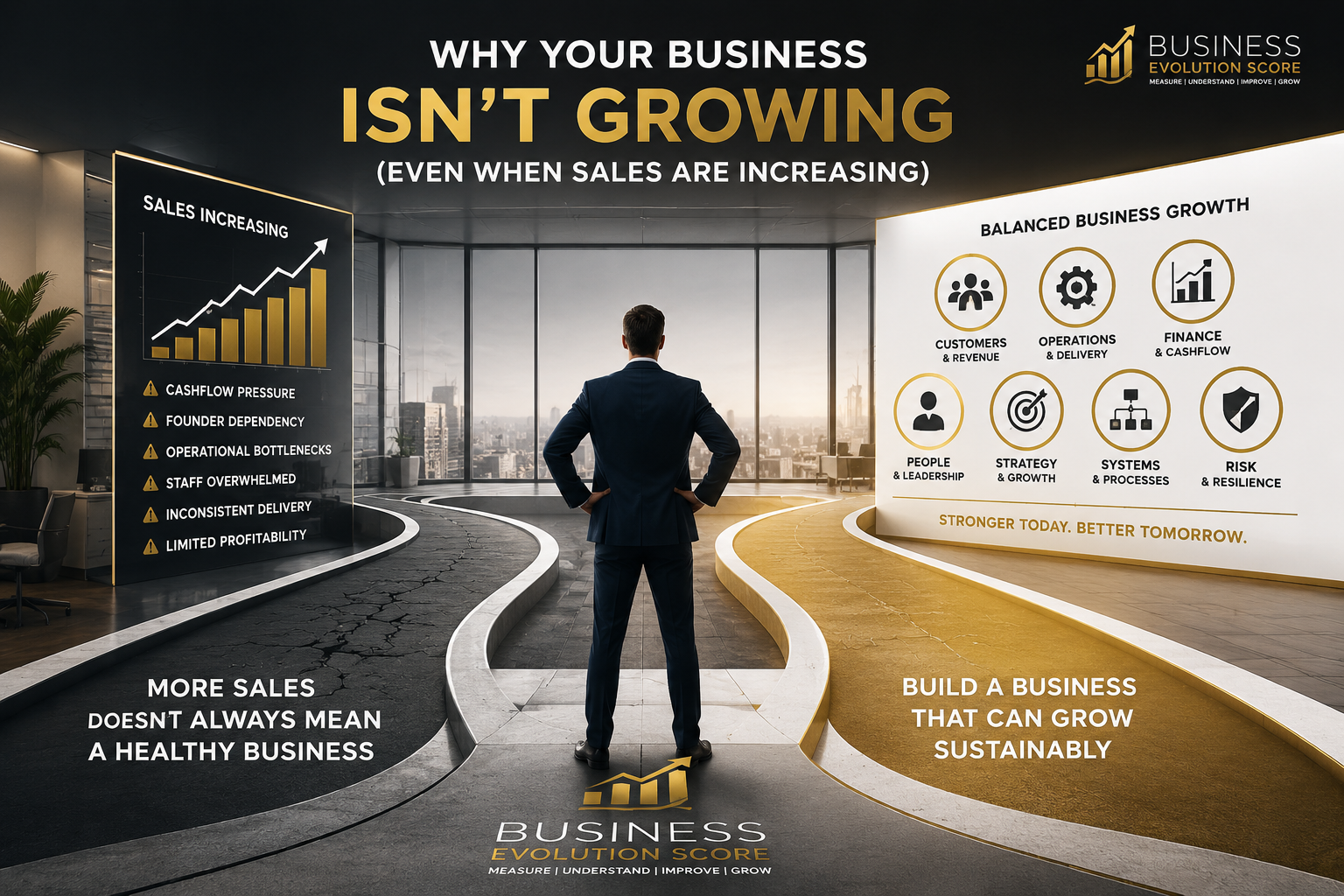
Over the years, though, I’ve seen businesses grow in ways that actually make them harder to run. Revenue increases, but cash becomes tighter. More customers arrive, but service starts slipping. The team gets bigger, yet the owner somehow becomes more involved in everything. Sales increase, but margins quietly deteriorate.
This raises an important question: is a growing business always becoming a better business?
I don’t think it is. There is a difference between business growth and strategic growth, and understanding that difference can change the way you think about building your business.
What Do We Mean by Business Growth?
At its simplest, business growth usually means that something is getting bigger. Revenue increases, you acquire more customers, employ more people, sell more products, enter another market or perhaps open another location. These are the numbers we naturally notice because they are relatively easy to measure.
If revenue increased from R5 million to R7 million, the business grew. If you went from 10 employees to 15, the team grew. If you added 100 new customers, the customer base grew. There is nothing wrong with measuring growth this way because these numbers matter.
The problem comes when we assume that because these numbers are increasing, the underlying business must also be improving. A business can grow revenue while becoming less profitable. It can add customers while becoming dangerously dependent on one or two large accounts. It can employ more people without improving accountability or productivity, or generate more demand than its operations can comfortably handle.
Growth tells us that something is getting bigger. It doesn’t necessarily tell us whether the business is getting better.
So What Is Strategic Growth?
I think about strategic growth differently. It isn’t simply about increasing the size of the business; it is about deliberately strengthening the capabilities that allow the business to grow sustainably.
That might mean improving your sales process so revenue becomes more predictable, reducing your dependence on one large customer, or developing managers who can make decisions without everything coming back to you. It could mean improving cashflow forecasting so growth can be funded without constantly creating financial pressure, or documenting important operational processes so the business can deliver consistently as the team expands.
These improvements might not immediately produce a dramatic increase in revenue, but they make future growth safer, more predictable and easier to manage. That is the important distinction: business growth increases the size of the business, while strategic growth increases its capability.
Ideally, you want both.
Growth Often Exposes Problems That Were Already There
One of the strange things about growth is that it often exposes weaknesses that have been sitting quietly in the business for years. When a company is small, the owner and a few capable people can compensate for weak systems simply by working harder, communicating constantly and solving problems as they arise.
Perhaps the owner personally checks every important piece of work before it reaches the customer. With five customers that might be manageable, but with fifty it becomes a bottleneck. Perhaps cashflow is managed by checking the bank balance every morning. At a small scale the owner may be able to keep most of the numbers in their head, but as transactions, staff and financial commitments increase, that becomes increasingly risky.
The same happens with sales. A founder may have handled every important sales conversation personally for years, so there was never much need for a defined sales process. The problem only becomes obvious when the business needs other people to sell and discovers that much of the sales knowledge exists only in the founder’s head.
Growth hasn’t necessarily created these weaknesses; it has made them visible. This is why a business can feel surprisingly comfortable at one level of revenue and suddenly chaotic at the next. The systems, processes and management capability that got you here may simply not be enough to get you there.
Revenue Growth Can Put Pressure on Cash
Cashflow is one of the clearest examples of why growth and business health are not the same thing.
Imagine a business wins several substantial contracts and revenue begins climbing rapidly. On paper everything looks fantastic, but those customers might only pay in 30, 60 or even 90 days. Meanwhile, the business has to hire people, purchase stock, pay suppliers, cover salaries and fund delivery before the customer money arrives.
The faster the company grows, the more working capital it may need. Suddenly a profitable, growing business is under enormous cash pressure.
This can feel counterintuitive because we naturally associate increasing sales with increasing financial strength. In reality, sales, profit and cash are three different things, and rapid growth can put enormous pressure on the last of them.
Strategic growth therefore asks more than, “How do we sell more?” It also asks whether the business can financially support the growth it is trying to create. That leads to very different decisions about forecasting, payment terms, margins, financing and the pace at which the business should expand.
More Customers Can Create More Risk
Winning a large customer can transform a small business. One substantial contract can create new revenue, justify hiring more people and give the company credibility in the market. It can also create dependence.
Imagine that customer gradually grows until it represents 40% or 50% of your revenue. Your turnover might look healthier than ever and the business might even be posting record sales, but it is worth asking whether the business has actually become stronger.
If that customer leaves, delays payment, changes suppliers or negotiates aggressively on price, the consequences could be severe. From a pure growth perspective, the large customer looks like success. From a business health perspective, it represents both an opportunity and a risk.
Strategic growth means recognising both sides of that equation. The answer isn’t necessarily to walk away from good customers; it is to deliberately build enough diversity around them that no single relationship has disproportionate power over the future of the business.
A Bigger Team Doesn’t Automatically Mean More Capacity
Hiring is another good example. When business owners become overwhelmed, the natural response is often to employ more people, and sometimes that’s exactly what is needed. The difficulty is that adding people to unclear processes can simply create a larger version of the same problem.
If responsibilities aren’t clear, accountability is weak and decisions still have to go through the founder, every new employee can actually create additional management work. The owner starts spending more time answering questions, resolving problems and coordinating people. The business has grown, but the founder’s workload has grown with it.
Strategic growth asks whether the organisation is becoming more capable as the team expands. Are responsibilities becoming clearer? Can decisions happen without the owner? Are people accountable for outcomes rather than simply completing tasks? Is important knowledge being transferred from individuals into the business?
A healthy team should eventually increase the organisation’s capacity without creating an equal increase in dependency on the founder. That’s very different from simply increasing headcount.
The Founder Dependency Problem
Many businesses naturally grow around the abilities of the person who started them. The founder knows the customers, understands the product, solves difficult problems, approves pricing and manages important relationships. They often carry years of knowledge that has never been documented because, in the early stages, there was little reason to document it.
That can be a tremendous advantage while the business is small. It can become a serious constraint later because if every important decision still requires the founder, there is a practical limit to how large the business can become. There are only so many hours in the day. Founder dependency is a real thing.
This is where strategic growth can feel uncomfortable. The next stage of growth isn’t necessarily about the founder doing more; it may require them to deliberately become less important to the day-to-day running of the business.
That means delegating decisions, developing people, documenting knowledge and accepting that other people may occasionally do things differently. The objective isn’t to remove the founder from the business. It is to remove the requirement that they be involved in everything.
Would Your Business Cope If Sales Doubled?
There is a question I think every business owner should ask before aggressively chasing the next stage of growth: what would happen if sales doubled over the next twelve months?
It sounds like a wonderful problem to have, but think through what it would actually mean. Could your current team handle the work while maintaining quality? Could you invoice accurately and on time? Would your suppliers support the additional volume? Would your cashflow survive the increase in working capital? Would customer service cope with twice as much activity?
Most importantly, what would happen to you as the owner? Would the business absorb the additional activity through its people and systems, or would you spend every waking hour putting out fires?
Sometimes the most valuable growth work a business can do is preparing itself for growth before pursuing more of it. That may mean improving processes, removing bottlenecks, investing in the team or improving financial visibility. None of these things are as exciting as announcing a new customer or celebrating record revenue, but they are often what make sustained growth possible.
Strategic Growth Is About Building a Healthier Business
This is also why I don’t believe business health can be measured by a single number such as revenue. Businesses are interconnected systems, and what happens in one part eventually affects the others.
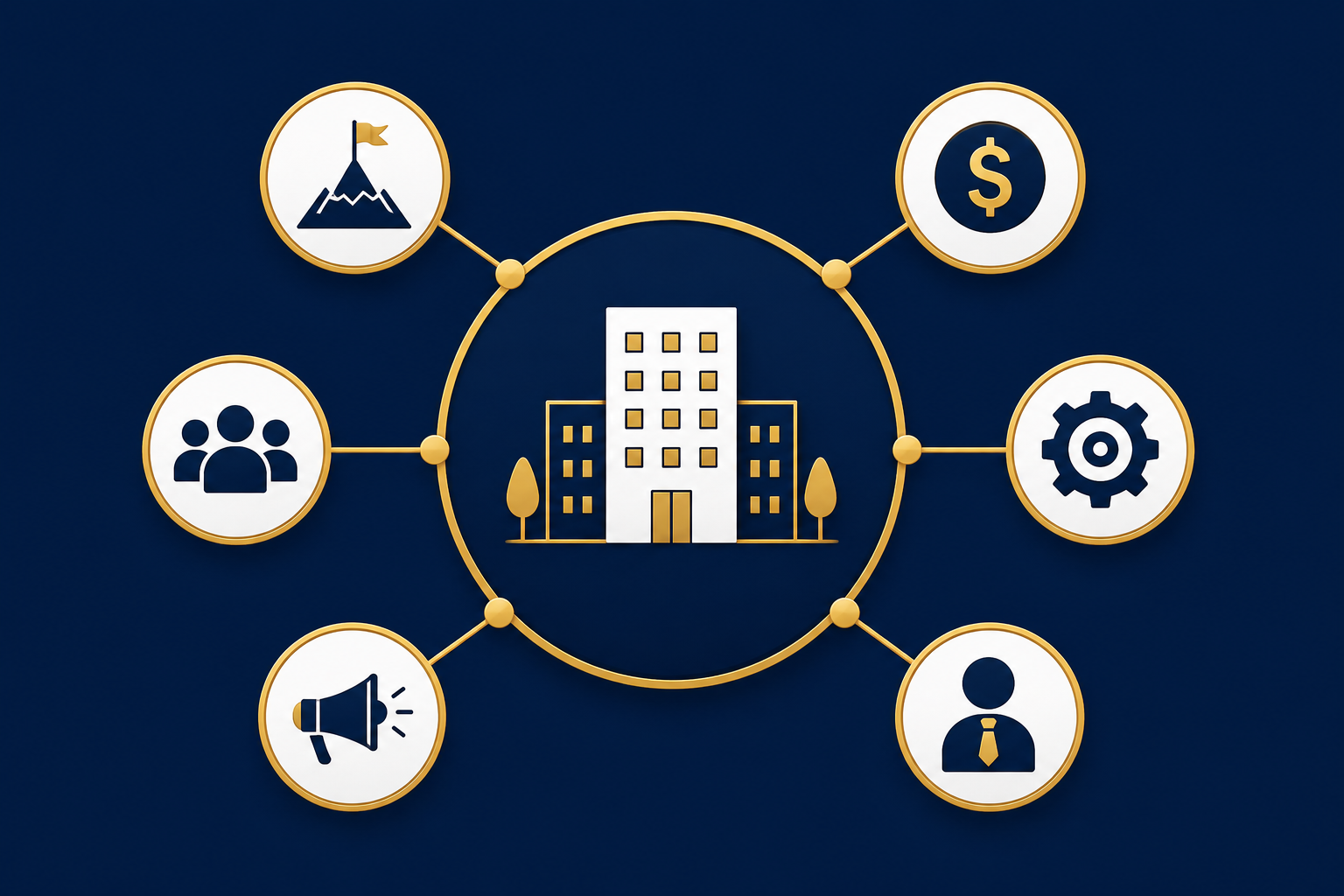
Marketing creates demand, sales converts that demand into customers, and operations delivers what was promised. Finance ensures the business can fund that activity and remain profitable, while people provide the capability to deliver it. Strategy determines where the organisation is heading, and resilience determines how well it can absorb setbacks when things don’t go according to plan.
Weakness in one area eventually creates pressure somewhere else. A brilliant sales team can overwhelm weak operations. Rapid hiring can damage cashflow. Strong marketing cannot compensate forever for poor customer retention, and a talented founder cannot personally compensate for weak systems indefinitely.
Strategic growth therefore means strengthening the business as a whole rather than maximising one number at the expense of everything else. That doesn’t mean every part of the business needs to be perfect. It means understanding where the constraints are and deliberately working on the capabilities that matter most at your current stage.
Not Every Business Needs to Become Huge
There is another assumption about growth that deserves challenging. Not every business owner wants to build a massive company, and there is nothing wrong with that.
Some want to build a highly profitable specialist business with a small team. Others want independence and flexibility. Some want to build something they can eventually sell, while others want to create employment or build a company that can support their family for decades.
Strategic growth isn’t about forcing every business towards some imaginary corporate destination. It is about building a business that is increasingly capable of achieving what its owner wants it to achieve.
For one company that might mean doubling revenue. For another it could mean improving margins while keeping revenue roughly the same. Another owner might want to reduce their involvement from 60 hours a week to 30, while someone else may be building management capability so they can eventually step away completely.
Growth should serve the purpose of the business. The business shouldn’t exist merely to serve growth.
How Do You Know Whether Your Growth Is Healthy?
This is where I would look beyond the headline numbers. Revenue is important, but what is happening to profitability and cashflow as revenue increases? Customer numbers matter, but are you becoming more or less dependent on a handful of them? A growing team might be positive, but is accountability improving with it?
The same thinking applies across the business. More leads sound good, but are you getting better at converting them? More work can increase turnover, but are your operational systems becoming stronger? As the business grows, is it becoming more capable of operating without constant intervention from the owner?
These questions tell you much more about the quality of your growth. You don’t need every answer to be perfect. What matters is knowing where the weaknesses are before growth turns them into bigger problems.
Build a Stronger Business, Not Just a Bigger One
There is nothing wrong with wanting more revenue, customers or market share. Growth creates opportunities. It allows businesses to invest, employ people, develop new products and reward the people who helped build them.
But size alone isn’t a particularly good measure of business health. A strategically growing business should gradually become more predictable, more capable and more resilient. Its finances should become clearer, its systems stronger, its customer base healthier and its people more capable. Over time, the organisation should also become less dependent on individual heroics to keep everything moving.
That kind of progress isn’t always visible from the outside. As a business owner, though, you can usually feel the difference.
And perhaps the most useful question isn’t simply “How fast are we growing?”
It is:
“Are we building a business capable of handling the growth we want?”
Measure More Than Growth
The Business Evolution Score was built around this idea. Rather than looking at revenue alone, it assesses seven areas of your business: Customers & Revenue, Marketing & Demand, Finance & Cashflow, Delivery & Operations, Team & Leadership, Strategy & Growth, and Resilience & Risk.
The aim isn’t to give you another number to chase. It’s to help you understand where your business is already strong, where risks may be building and which capabilities deserve your attention next.
If your business is growing, or you’re preparing for its next stage of growth, it may be worth finding out whether the rest of the business is ready for it.
Ready to Measure Your Business Evolution?
The free Business Evolution Score assessment evaluates your business across seven critical areas, helping you identify strengths, risks and the next actions that will have the biggest impact.
Whether you’re focused on growth, cashflow, marketing, leadership or resilience, you’ll receive a personalised Business Evolution Score along with practical recommendations to help your business evolve.