Many business owners believe growth simply means increasing sales.
If revenue is rising, more customers are arriving and the team is getting busier, the business must be moving in the right direction.
Unfortunately, increased activity does not always create a stronger business.
A company can grow revenue while becoming less profitable, more difficult to manage and increasingly dependent on the owner. More customers can place pressure on cashflow, expose weak processes and overwhelm a team that is already operating at capacity.
Strategic growth is different.
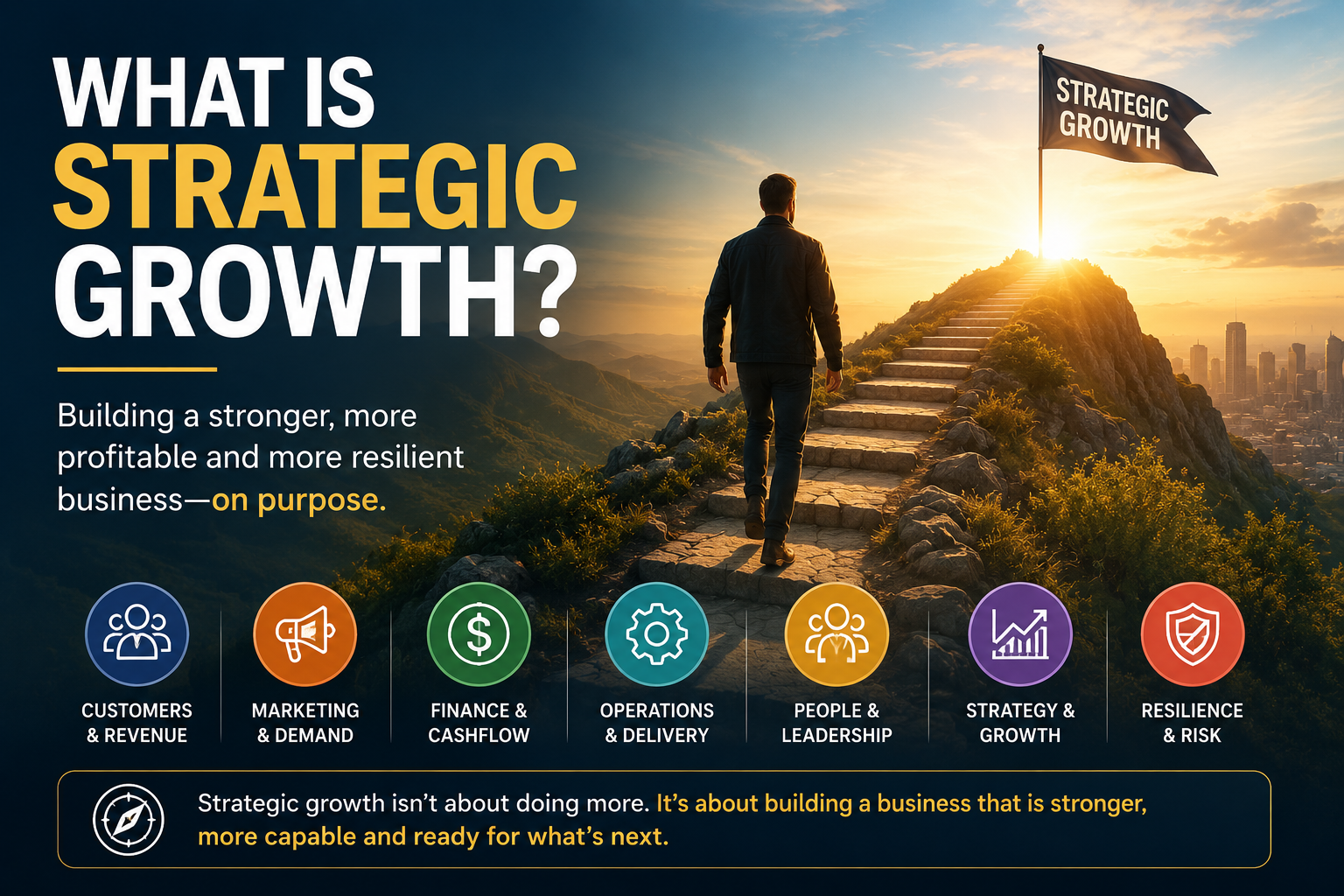
Strategic growth means building the business deliberately so that revenue, profitability, operations, leadership and resilience improve together. It is not simply about becoming larger. It is about becoming stronger, more predictable and better equipped to manage the next stage of development.
What Is Strategic Growth?
Strategic growth is the process of growing a business in a deliberate, sustainable and profitable way.
Rather than focusing only on increasing sales, strategic growth ensures that the capabilities supporting the business develop at the same time. As revenue grows, operations should become more reliable, cashflow should remain manageable, employees should become more capable and the business should become less dependent on the founder.
Many businesses experience rapid growth without being ready for it.
A large new customer may increase revenue but create capacity problems. A successful marketing campaign may generate more leads than the sales or delivery team can handle. Hiring additional employees may increase costs without solving weak management or unclear processes.
Strategic growth attempts to avoid these problems by asking a broader question:
Is the business becoming more capable as it grows?
The Strategy & Growth pillar of the Business Evolution Framework examines whether the business has a clear direction, practical priorities and the capabilities needed to grow sustainably.
Growth Is Not the Same as Being Busy
One of the most common mistakes in business is confusing activity with progress.
A company may have more customers, more employees, more meetings and more work than ever before, yet still struggle to improve profitability or reduce pressure on the owner.
Busy businesses often experience:
- Constant firefighting
- Unclear priorities
- Increasing staff costs
- Declining service quality
- Cashflow pressure
- Repeated operational problems
- Greater dependence on the founder
The business may look successful from the outside while becoming increasingly difficult to manage internally.
Strategic growth creates a different outcome.
As the business grows, decision-making becomes clearer, processes become more reliable and the team becomes more capable. The owner spends less time resolving routine problems and more time guiding the future direction of the business.
True growth should improve the quality of the business, not simply increase its workload.
The Characteristics of Strategic Growth
Strategic growth is rarely created by one major decision.
It usually comes from steady improvement across several connected areas.
Revenue becomes more predictable
Healthy growth does not rely entirely on one large customer, one salesperson or occasional referrals.
The business develops a reliable way to attract prospects, convert opportunities and retain customers.
Predictable revenue makes it easier to plan staffing, manage cashflow and invest with confidence.
The Customers & Revenue pillar measures whether the business can consistently turn opportunities into sustainable income.
Profitability improves alongside sales
Higher revenue does not automatically create higher profit.
Growth can increase wages, inventory, supplier costs, marketing expenses and working-capital requirements. If margins are not understood and managed, the business may become busier without becoming more valuable.
Strategic growth considers the quality of revenue, not only the quantity.
The goal is to build sales that contribute healthy margins, support cashflow and strengthen the long-term financial position of the business.
For more on this relationship, see Why Cash Flow Matters More Than Profit.
Systems become stronger
Small businesses often begin with informal processes.
The owner remembers what needs to happen, employees learn by watching others and important information is shared through conversations, messages or spreadsheets.
This can work while the business is small.
As the business grows, however, informal processes become unreliable. Work is completed differently by different people, important steps are missed and the owner becomes the person everyone depends on for answers.
Strategic growth requires repeatable systems that improve consistency and reduce unnecessary reliance on individual knowledge.
The article Why Business Systems Matter More Than Hard Work explains why stronger systems are essential for sustainable expansion.
The team becomes more capable
A growing business cannot depend on the founder for every decision.
Employees need clear responsibilities, managers need authority and the organisation needs enough leadership capacity to operate effectively without constant supervision.
This does not mean the founder becomes uninvolved.
It means their involvement becomes more strategic.
Instead of approving every small decision, the owner focuses on direction, priorities, culture and future opportunities.
Reducing founder dependency is therefore one of the most important parts of strategic growth.
Risk becomes more manageable
Growth creates opportunity, but it also creates exposure.
The business may become more dependent on key customers, suppliers, employees, systems or funding arrangements. Rapid expansion may also place pressure on service quality, cybersecurity, compliance and cash reserves.
Strategic growth does not ignore these risks.
It identifies them early and builds safeguards into the business.
The Resilience & Risk pillar helps business owners understand how well prepared the business is for uncertainty and disruption.
Why Small Businesses Stop Growing
Many businesses eventually reach a growth ceiling.
The owner may work harder, increase marketing activity or hire more people, yet the business struggles to move forward.
This is rarely caused by a lack of effort.
More often, internal constraints are limiting the next stage of growth.
Common constraints include:
- Sales depending heavily on the founder
- Inconsistent marketing and lead generation
- Weak conversion processes
- Poor cashflow forecasting
- Undocumented operational processes
- Unclear accountability
- Limited management capability
- Excessive customer concentration
- No clear strategic priorities
These weaknesses may remain hidden while the business is small.
As demand increases, they become more visible.
For example, weak processes may not cause serious problems when the company has ten customers. With one hundred customers, the same weakness can create delays, mistakes and complaints.
Strategic growth therefore begins by identifying the constraint that is most likely to limit progress.
Trying to improve everything at once usually creates distraction. Focusing on the right capability first creates momentum.
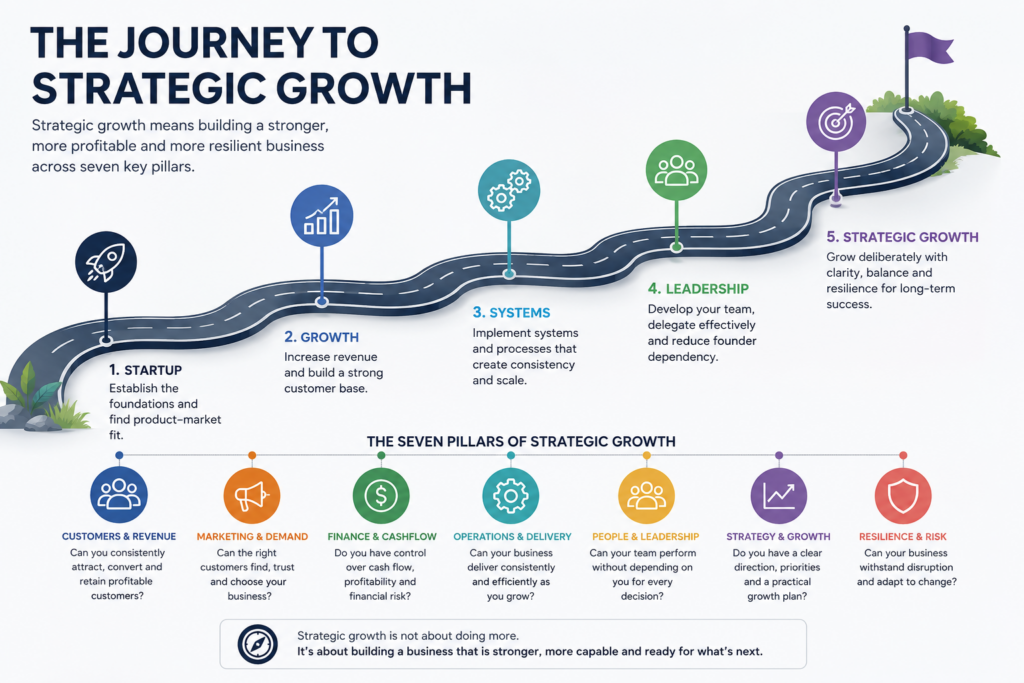
The Seven Pillars of Strategic Growth
The Business Evolution Framework measures strategic growth across seven connected business areas.
Customers & Revenue
Can the business consistently attract, convert and retain profitable customers?
Marketing & Demand
Can the right customers find, trust and choose the business?
Finance & Cashflow
Does the business understand profitability, cashflow and financial risk well enough to support growth?
Operations & Delivery
Can the business maintain quality and consistency as demand increases?
People & Leadership
Can employees and managers perform effectively without everything depending on the founder?
Strategy & Growth
Does the business have a clear direction, priorities and practical growth plan?
Resilience & Risk
Can the business withstand disruption, uncertainty and unexpected challenges?
These pillars do not operate independently.
Weak marketing affects sales. Weak operations affect customer retention. Poor cashflow limits investment. Founder dependency slows decision-making. Weak strategy creates conflicting priorities.
Strategic growth requires enough balance across the business for each pillar to support the others.
How to Build a Strategic Growth Plan
A strategic growth plan does not need to become a large corporate document.
For most small businesses, a practical plan can begin with five questions.
Where is the business today?
Start with an honest assessment of current performance and capability.
Identify what is working well, what feels unstable and where the owner or team spends the most time resolving recurring problems.
What is limiting the next stage of growth?
The answer may not be sales.
It may be cashflow, delivery capacity, founder dependency, weak management or poor customer retention.
The most visible problem is not always the real constraint.
What should improve first?
Choose one or two priorities that will have the greatest impact over the next 90 days.
A focused improvement plan is more likely to succeed than a long list of unrelated goals.
How will progress be measured?
Every priority should have a simple measure.
Examples include:
- Reducing overdue debtors
- Improving lead conversion
- Documenting key processes
- Increasing recurring revenue
- Delegating defined decisions
- Reducing dependence on one customer
Measurement turns intention into accountability.
What should the business look like in twelve months?
A useful growth plan describes more than financial targets.
It should also consider:
- How the team will operate
- Which decisions will be delegated
- Which systems need strengthening
- Which risks need reducing
- Which customers and markets the business will prioritise
This creates a clearer picture of the business being built, not only the revenue being pursued.
Strategic Growth Requires Regular Review
Business conditions change.
Customers change, competitors respond, employees leave, costs increase and new opportunities emerge.
A strategic growth plan should therefore be reviewed regularly rather than written once and forgotten.
A practical rhythm may include:
- Monthly operational reviews
- Quarterly strategic reviews
- Annual direction and planning sessions
- Reassessment after major changes
Regular review helps the business recognise when a previous priority has been resolved or when a new constraint has appeared.
It also prevents the business from continuing with plans that no longer reflect current reality.
Measure Before You Improve
Many owners understand their business through experience and instinct.
That knowledge is valuable, but it can be difficult to step back and evaluate the organisation objectively while managing daily demands.
A structured assessment creates distance.
It helps identify patterns across the business, compare different capabilities and focus attention on areas that may otherwise remain hidden.
The Business Evolution Score measures the business across all seven pillars and produces:
- An overall Business Evolution Score
- Pillar-level results
- Key strengths
- Growth constraints
- Business risks
- Recommended priorities
- A practical improvement plan
The purpose is not to judge the business or force it toward unnecessary complexity.
It is to provide clarity about where the business stands and what should improve next.
Strategic Growth Is About Building a Better Business
Strategic growth is not about becoming the largest company in the market.
It is about becoming a stronger, more capable and more valuable business.
A strategically growing business develops reliable revenue, healthy finances, effective systems, capable leaders and greater resilience. It becomes easier to manage, less dependent on individuals and better prepared for future opportunities.
Revenue remains important.
But sustainable success depends on the business behind that revenue.
Understanding which capabilities are already strong and which ones are limiting progress is the first step toward building growth that lasts.
Ready to Measure Your Business Evolution?
The free Business Evolution Score assessment evaluates your business across seven critical areas, helping you identify strengths, risks and the next actions that will have the biggest impact.
Whether you’re focused on growth, cashflow, marketing, leadership or resilience, you’ll receive a personalised Business Evolution Score along with practical recommendations to help your business evolve.