Category: Business Growth

Cross-pillar insights covering business health, strategy, growth, continuous improvement and the Business Evolution Score framework.

  • Why Business Systems Matter More Than Hard Work

    Why Business Systems Matter More Than Hard Work

    Many businesses are built on hard work.

    Founders work long hours, solve problems quickly and do whatever it takes to keep customers happy. In the early stages of a business, this approach is often enough to create momentum and establish a loyal customer base.

    As the business grows, however, hard work alone becomes less effective.

    More customers, more employees and more complexity require a different way of operating. Businesses that continue to grow successfully usually do so because they replace reliance on memory and individual effort with well-designed business systems that create consistency, efficiency and accountability.


    What Are Business Systems?

    Business systems are the documented processes, procedures and workflows that guide how work is completed throughout the business.

    They don’t need to be complicated.

    A business system can be as simple as a customer onboarding checklist, a documented quoting process or a standard procedure for responding to customer enquiries.

    The objective is not to create unnecessary administration.

    The objective is to ensure that important activities are completed consistently, regardless of who performs them.

    Strong business systems reduce uncertainty, improve communication and create a more reliable experience for both customers and employees.


    Why Business Systems Matter

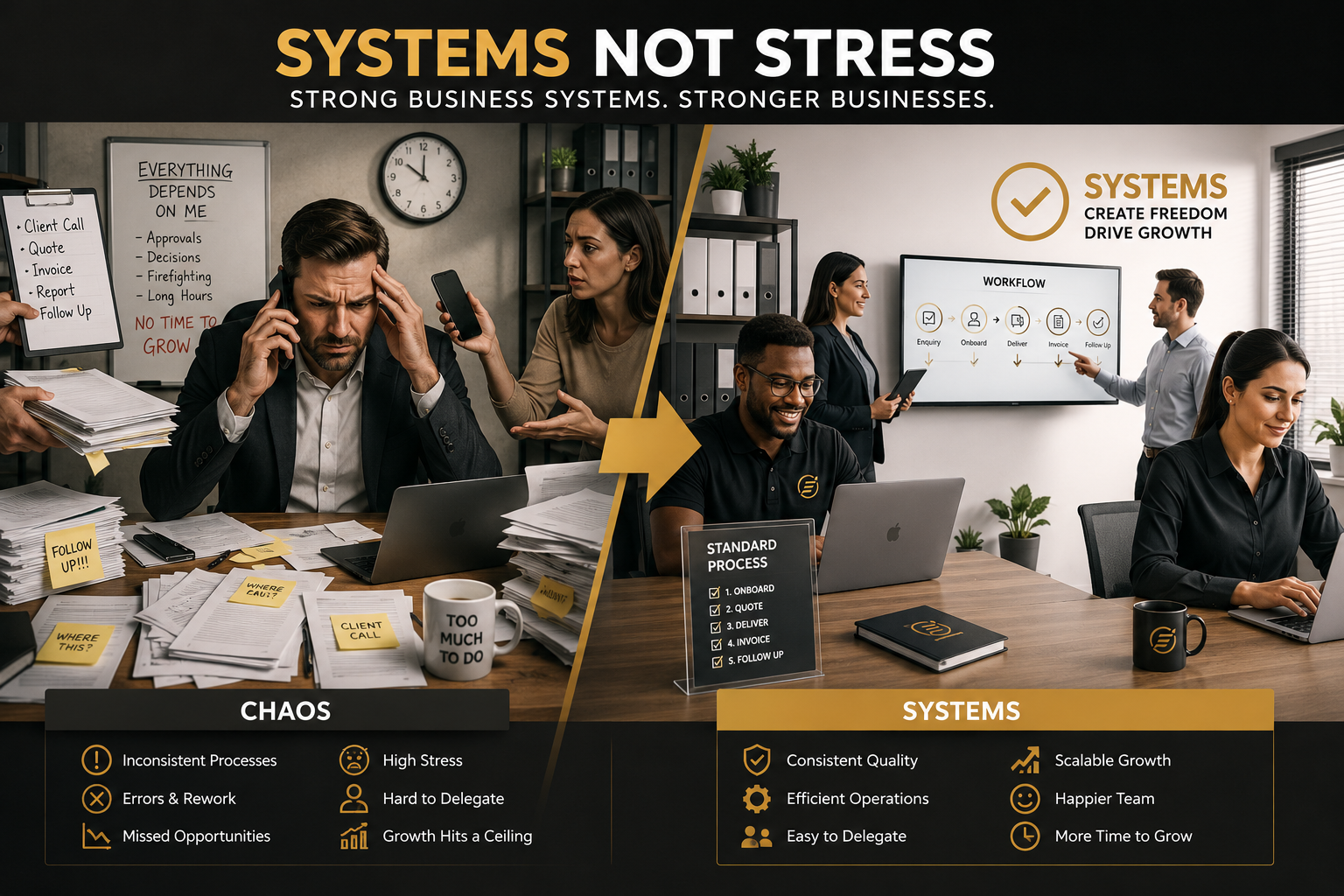
    Businesses without documented systems often rely on individuals remembering how things should be done.

    This may work while the team is small, but it becomes increasingly difficult as the business grows.

    Staff begin performing the same task in different ways.

    Important steps are forgotten.

    Training takes longer because knowledge is transferred verbally rather than through documented processes.

    Customers receive inconsistent service depending on who they deal with.

    Strong Operations & Delivery helps businesses eliminate this inconsistency by creating repeatable ways of working that improve quality and efficiency.


    Systems Improve Efficiency

    One of the greatest benefits of business systems is improved efficiency.

    Employees spend less time asking questions, searching for information or correcting mistakes because the correct process is already documented.

    Routine tasks become easier to complete.

    Managers spend less time supervising everyday activities.

    Business owners are able to focus on improving the business instead of constantly solving operational problems.

    Small improvements in efficiency made consistently across the business can have a significant impact on profitability, customer satisfaction and employee productivity.


    Systems Make Delegation Easier

    Many business owners find delegation difficult.

    Often this is not because employees lack capability, but because expectations have never been documented.

    When knowledge exists only in the founder’s head, every decision eventually returns to the owner.

    Documented business systems create clarity.

    Employees understand what is expected.

    Managers are able to coach consistently.

    New employees become productive more quickly because they follow established processes instead of learning everything through trial and error.

    Delegation becomes far more effective when the business relies on systems rather than memory.


    Systems Support Sustainable Growth

    Growth places increasing pressure on every part of a business.

    More customers generate more enquiries, more orders, more support requests and more operational complexity.

    Without strong systems, growth often creates confusion instead of progress.

    Businesses with documented processes are able to maintain quality standards while expanding their teams and customer base.

    This creates confidence that growth can continue without reducing service quality or placing additional pressure on the founder.


    Systems Reduce Business Risk

    One of the seven pillars of the Business Evolution Framework is Resilience & Risk .

    Business systems play an important role in reducing operational risk.

    When critical knowledge is documented, the business is less vulnerable to staff turnover, unexpected absences or changes within the organisation.

    Knowledge becomes part of the business rather than remaining with individual employees.

    This creates a more resilient organisation that is better prepared for future growth and change.


    Signs Your Business Needs Better Systems

    Many businesses don’t realise they have a systems problem until the symptoms become obvious.

    Common warning signs include:

    • Staff regularly asking the same operational questions.
    • Customers receiving inconsistent service.
    • Important tasks being forgotten.
    • New employees taking a long time to become productive.
    • The owner becoming involved in every decision.
    • Mistakes being repeated because there is no documented process.

    These challenges are often indicators that stronger business systems are needed rather than additional staff or longer working hours.


    Building Better Business Systems

    Developing business systems doesn’t require expensive software or complex documentation.

    Most businesses achieve significant improvements by documenting their most important recurring activities first.

    Examples include:

    • Customer onboarding.
    • Sales and quotation processes.
    • Invoice and payment procedures.
    • Customer service workflows.
    • Employee induction.
    • Operational checklists.

    As each process becomes more consistent, the business becomes easier to manage, easier to scale and less dependent on individual people.


    Measure Your Operational Capability

    The Business Evolution Score measures how effectively a business performs across several operational capabilities, including Operations & Delivery .

    Rather than simply asking whether systems exist, the assessment evaluates how consistently they support efficiency, quality, resilience and sustainable growth.

    Strong businesses are not built on hard work alone.

    They are built on repeatable systems that allow ordinary business activities to be performed consistently, efficiently and with confidence every day.


    Ready to Measure Your Business Evolution?

    The free Business Evolution Score assessment evaluates your business across seven critical areas, helping you identify strengths, risks and the next actions that will have the biggest impact.

    Whether you’re focused on growth, cashflow, marketing, leadership or resilience, you’ll receive a personalised Business Evolution Score along with practical recommendations to help your business evolve.

  • Why Cash Flow Matters More Than Profit

    Why Cash Flow Matters More Than Profit

    Many business owners celebrate a profitable month.

    Unfortunately, profit doesn’t always mean there’s money in the bank.

    One of the most common reasons businesses experience financial pressure isn’t because they aren’t profitable—it’s because they have poor cash flow.

    Understanding the difference between profit and cash flow can help business owners make better decisions, reduce stress and build a more resilient business.


    Profit and Cash Flow Are Not the Same

    Profit is what remains after your income exceeds your expenses.

    Cash flow measures the movement of money into and out of your business.

    A business can be profitable on paper while struggling to pay salaries, suppliers or rent because cash hasn’t yet been received.

    Healthy businesses manage both profitability and cash flow effectively.


    Why Cash Flow Is So Important

    Poor cash flow affects every area of the business.

    Paying Suppliers

    Late customer payments often mean suppliers need to wait.

    This can damage relationships and make it harder to negotiate favourable payment terms.

    Paying Employees

    Employees expect to be paid on time.

    Strong Finance & Cashflow management ensures payroll remains predictable, even during slower months.

    Investing in Growth

    Growing businesses often need to invest before additional revenue arrives.

    Without healthy cash flow, opportunities are often delayed or missed entirely.

    Reducing Stress

    One of the biggest causes of stress for business owners is uncertainty about whether there will be enough money available next month.

    Good cash flow planning provides confidence and allows better decision-making.


    Common Causes of Cash Flow Problems

    Many cash flow challenges are avoidable.

    Common causes include:

    • Customers paying late.
    • Poor invoicing processes.
    • Low profit margins.
    • Excess inventory.
    • Unplanned business expenses.
    • Rapid growth without adequate funding.

    Recognising these issues early makes them much easier to address.


    Cash Flow Is About Planning

    Successful businesses don’t simply react to financial problems.

    They plan ahead.

    That includes:

    • Forecasting income.
    • Monitoring expenses.
    • Building cash reserves.
    • Reviewing payment terms.
    • Managing debtor collections.

    These habits improve financial resilience and reduce unnecessary risk.


    Warning Signs Your Cash Flow Needs Attention

    Many cash flow problems don’t happen overnight. They develop gradually, often going unnoticed until the business starts feeling financial pressure.

    Watch out for these common warning signs:

    • You regularly delay paying suppliers.
    • Customers take longer to pay than expected.
    • Payroll becomes stressful at the end of the month.
    • You rely on an overdraft or credit facility to cover normal operating expenses.
    • Growth opportunities have to be delayed because there isn’t enough cash available.
    • You constantly wonder whether there will be enough money in the bank next month.

    Recognising these warning signs early allows you to take corrective action before they become major financial problems.

    Healthy businesses don’t wait for a cash flow crisis—they monitor, plan and adjust continuously.


    Cash Flow Is a Measure of Business Health

    Cash flow is more than a financial metric.

    It reflects how effectively your business converts sales into available working capital, manages expenses and prepares for future growth.

    Businesses with healthy cash flow are generally more resilient during difficult economic conditions because they have greater flexibility to respond to unexpected challenges and opportunities.

    Improving cash flow isn’t simply about collecting money faster. It’s about building stronger financial habits that support long-term business success.


    Cash Flow Supports Business Growth

    One of the pillars of the Business Evolution Framework is Finance & Cashflow.

    Strong financial management gives businesses the confidence to hire, invest and grow sustainably.

    Without healthy cash flow, even profitable businesses can struggle to survive.


    Measure Your Financial Health

    The Business Evolution Score evaluates more than just profitability.

    It helps business owners understand how effectively they manage cash flow, financial planning and long-term sustainability.

    If cash flow has ever kept you awake at night, it’s worth understanding where your business stands.

    Understanding your cash flow is only one part of building a stronger business. Measuring every area of your business gives you a clearer picture of where to focus next.


    Ready to Measure Your Business Evolution?

    The free Business Evolution Score assessment evaluates your business across seven critical areas, helping you identify strengths, risks and the next actions that will have the biggest impact.

    Whether you’re focused on growth, cashflow, marketing, leadership or resilience, you’ll receive a personalised Business Evolution Score along with practical recommendations to help your business evolve.
  • The Hidden Cost of Founder Dependency

    The Hidden Cost of Founder Dependency

    Many business owners wear their busyness as a badge of honour.

    They’re involved in every important decision, approve every payment, solve every customer problem and answer every difficult question.

    At first, this feels like good leadership.

    Over time, however, it often becomes one of the biggest barriers to business growth.

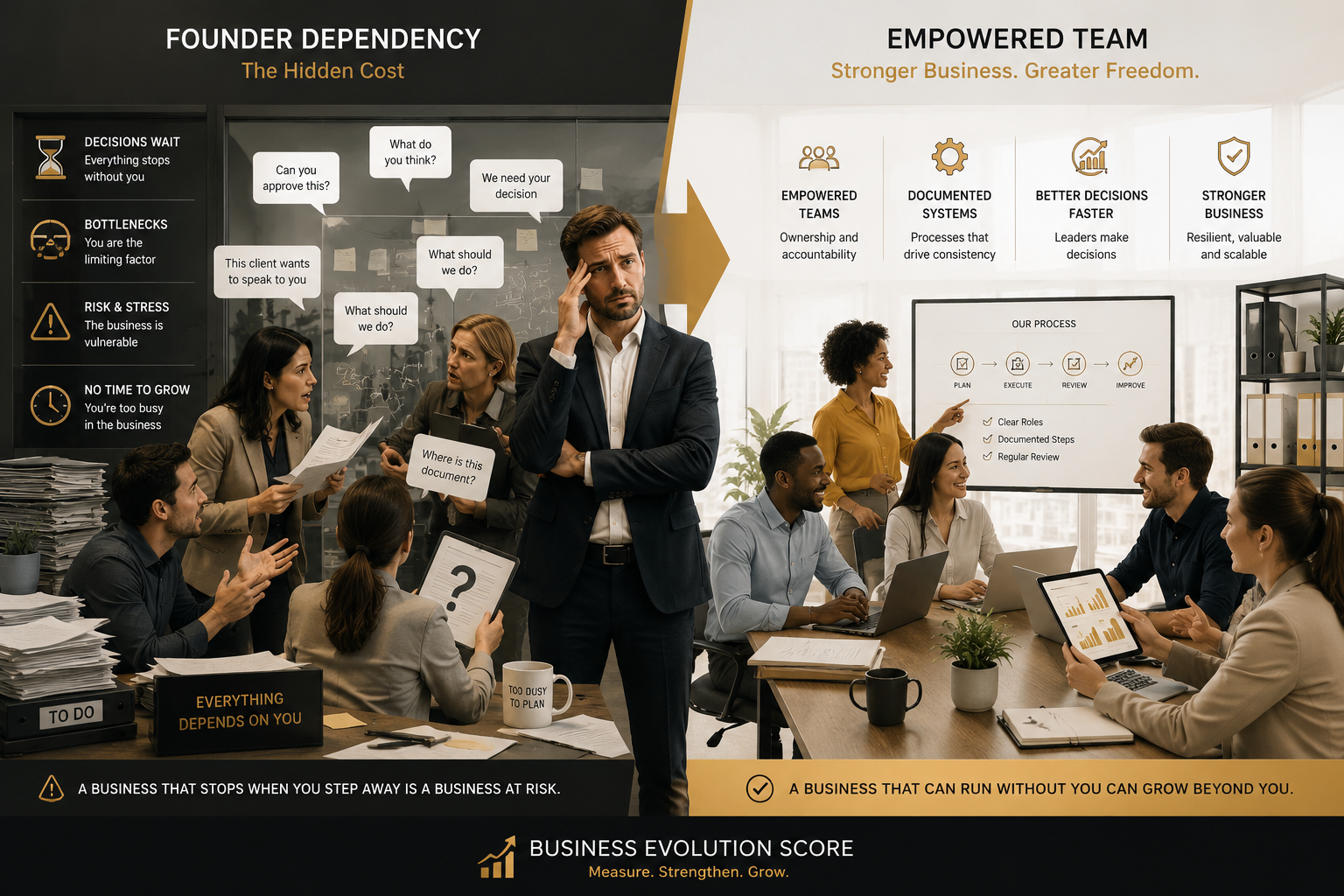
    This is known as founder dependency.

    When a business depends on one person to keep everything moving, growth becomes slower, risk increases and the long-term value of the business declines.


    What Is Founder Dependency?

    Founder dependency occurs when the owner becomes central to almost every part of the business.

    Examples include:

    • Clients only want to speak to the owner.
    • Staff wait for the owner to make decisions.
    • Sales stop when the owner isn’t involved.
    • Important knowledge exists only in the owner’s head.
    • The business struggles whenever the owner is away.

    Many small businesses start this way.

    The challenge is recognising when founder involvement becomes founder dependency.


    The Hidden Cost of Founder Dependency

    Founder dependency affects far more than the owner’s workload.

    It influences almost every aspect of the business.

    Growth Slows Down

    Every decision eventually waits for one person.

    As the business grows, this creates bottlenecks that limit capacity.


    Teams Stop Taking Ownership

    When employees believe every decision needs approval, initiative disappears.

    Strong People & Leadership encourages accountability and empowers teams to solve problems confidently.


    Customers Become Attached to One Person

    Customers often build strong relationships with founders.

    While this creates trust, it also creates risk.

    If every important relationship depends on one individual, the business becomes vulnerable.


    Business Value Declines

    Businesses that rely heavily on their founders are generally more difficult to sell.

    Potential buyers want systems, capable teams and predictable performance—not a business that depends on one person’s daily involvement.


    Founder Dependency Is Also a Risk

    One of the seven pillars of the Business Evolution Framework is Resilience & Risk.

    Founder dependency is one of the biggest risks facing many growing businesses.

    Illness, holidays or unexpected life events should not bring the business to a standstill.

    Resilient businesses are designed to continue operating even when the founder steps away.


    Reducing Founder Dependency

    Reducing founder dependency doesn’t mean becoming less involved.

    It means building a stronger business.

    Practical steps include:

    • Document important processes.
    • Delegate decision-making.
    • Develop future leaders.
    • Build systems instead of relying on memory.
    • Encourage accountability across the team.

    These improvements create a business that is stronger, healthier and easier to grow.


    Building a Business Beyond Yourself

    As I discuss in The Purposeful Entrepreneur, one of the greatest transitions for any entrepreneur is moving from being the business to building a business that can succeed without constant founder involvement.

    That shift creates freedom for the owner while making the business more resilient and valuable over the long term.


    Measure Your Founder Dependency

    The Business Evolution Score assesses founder dependency as part of its People & Leadership and Resilience & Risk pillars.

    Rather than relying on assumptions, you’ll receive practical insights into how dependent your business is on you and the steps you can take to strengthen it.

    If you’re wondering whether your business could continue operating without you for two weeks, it’s worth finding out.

    Take the free Business Evolution Score assessment and discover where your business stands.

    👉 Get My Free Business Evolution Score

  • Why Your Business Isn’t Growing (Even When Sales Are Increasing)

    Why Your Business Isn’t Growing (Even When Sales Are Increasing)

    Why your business isn’t growing is a question many business owners ask themselves, especially when sales are increasing.

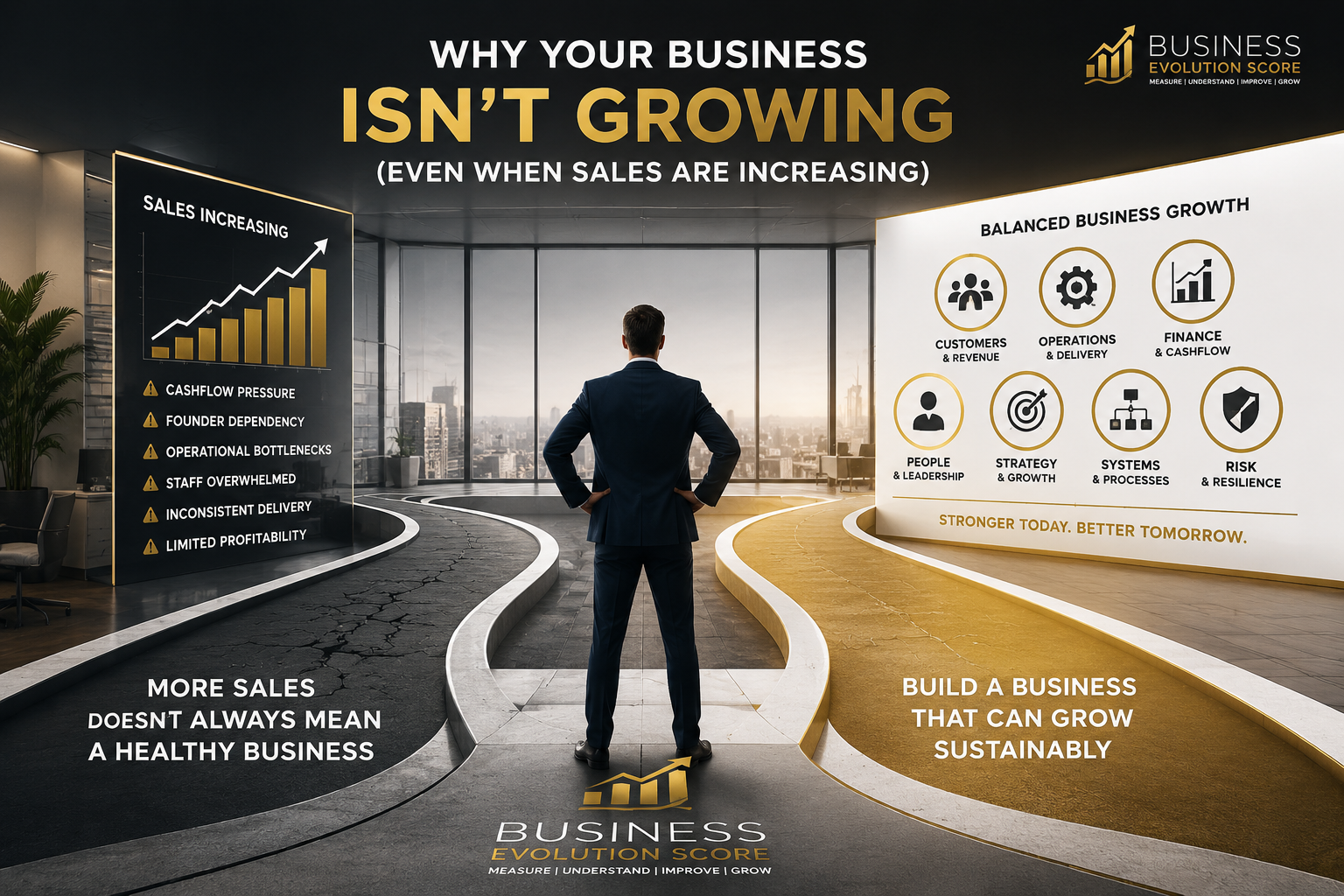
    The truth is that higher revenue doesn’t always mean a healthier business. Growth can expose weaknesses in operations, leadership, cashflow and strategy that eventually limit future success.

    Understanding these hidden constraints is the first step towards building a stronger, more resilient business.


    Why Your Business Isn’t Growing Despite Increasing Sales

    Revenue is important.

    Without customers, there is no business.

    But revenue is only one part of the picture.

    A business can increase sales while experiencing:

    • Declining profitability
    • Worsening cashflow
    • Operational bottlenecks
    • Founder burnout
    • Customer service issues
    • Increasing business risk

    Growth only creates value when the business has the capability to support it.

    The Customers & Revenue pillar measures how consistently your business turns opportunities into predictable income.


    Five Hidden Reasons Businesses Stop Growing

    Many growing businesses encounter the same challenges.

    1. Everything Depends on the Founder

    If every important decision comes through the owner, growth eventually slows.

    The founder becomes the bottleneck.

    Strong People & Leadership capability becomes essential as the business grows.


    2. Marketing Outpaces Operations

    Successful marketing creates demand.

    But if Operations & Delivery can’t consistently deliver, customers become disappointed and staff become overwhelmed.

    Sales and delivery need to evolve together.


    3. Cashflow Doesn’t Keep Up

    Growing businesses often require:

    • More inventory
    • More staff
    • Additional equipment
    • Larger facilities

    Without strong Finance & Cashflow management, higher sales can actually increase financial pressure.


    4. Systems Haven’t Matured

    Many businesses operate successfully using spreadsheets, memory and informal processes.

    As the business grows, these approaches become increasingly difficult to manage.

    Documented systems improve consistency and reduce risk.


    5. There Is No Clear Strategic Direction

    Sometimes businesses become busy without becoming better.

    Activity isn’t the same as progress.

    Businesses that actively invest in Strategy & Growth are far better positioned to identify opportunities while avoiding unnecessary distractions.


    How to Build a Business That Can Grow Sustainably

    Strong businesses don’t simply chase higher revenue.

    They improve capability across every important part of the business.

    That includes:

    • Attracting the right customers
    • Managing finances effectively
    • Improving operations
    • Developing people
    • Reducing business risk
    • Planning for sustainable growth

    Growth becomes far more predictable when these areas improve together.


    Measure Your Business Evolution Score

    This is why the Business Evolution Framework measures far more than sales alone.

    Rather than focusing on a single number, the framework evaluates seven key business areas that influence long-term performance, resilience and growth.

    The result is a more complete understanding of where your business is strong, where hidden risks exist and what improvements will have the greatest impact.

    If you’ve been wondering why your business isn’t growing, the answer often lies in the capabilities that support long-term success rather than sales alone.

    If your business feels busy but growth has stalled, the problem may not be sales at all.

    It may be that another part of the business is limiting your ability to move forward.


    Sustainable Growth Requires Balance

    Businesses rarely stop growing because of a single problem.

    More often, growth slows because several small weaknesses combine over time. A business may have strong sales but weak cashflow, or excellent marketing but poor operational capacity. Identifying these imbalances early allows business owners to focus on the improvements that will create the greatest long-term impact.

    The strongest businesses continuously review and strengthen every area of the business rather than relying on revenue growth alone.


    Measure More Than Revenue

    Every business reaches a point where working harder stops producing better results.

    Understanding the real constraints is the first step towards building a stronger, healthier and more valuable business.

    Ready to discover why your business isn’t growing? Take your free Business Evolution Score assessment and receive personalised insights, practical recommendations and a clear roadmap to build a stronger, healthier business.


    Ready to Measure Your Business Evolution?

    The free Business Evolution Score assessment evaluates your business across seven critical areas, helping you identify strengths, risks and the next actions that will have the biggest impact.

    Whether you’re focused on growth, cashflow, marketing, leadership or resilience, you’ll receive a personalised Business Evolution Score along with practical recommendations to help your business evolve.
  • What Is a Business Health Framework? A Practical Guide for Small Business Owners

    What Is a Business Health Framework? A Practical Guide for Small Business Owners

    Running a business is demanding. Between serving customers, managing cashflow, leading your team and planning for the future, it’s easy to spend every day working in the business instead of stepping back to work on it.

    That’s why many business owners don’t realise there’s a problem until it becomes impossible to ignore.

    Sales begin to slow.

    Cashflow becomes unpredictable.

    The business depends too heavily on the owner.

    Growth starts creating more stress than opportunity.

    A Business Health Framework helps you identify these issues before they become serious problems.

    What Is a Business Health Framework?

    A Business Health Framework is a structured way of measuring the overall health of a business.

    Rather than focusing on a single metric such as revenue or profit, it evaluates the core areas that determine whether a business is stable, resilient and capable of sustainable growth.

    Just as a doctor looks at more than one vital sign to assess a person’s health, a business health framework considers multiple aspects of a business to provide a complete picture.

    The goal isn’t to judge a business. It’s to help business owners understand where they stand today and identify what they should improve next.

    Why Business Health Matters

    Many businesses appear successful from the outside while quietly carrying significant risks.

    A business may have:

    • Growing sales but poor cashflow.
    • Loyal customers but no consistent marketing.
    • Strong profits but heavy founder dependency.
    • Great products but inefficient systems.
    • A capable team but no clear strategy.

    These weaknesses often remain hidden until growth, economic uncertainty or unexpected events expose them.

    Measuring business health helps identify these issues early, giving owners the opportunity to improve before they become costly.

    Why Financial Reports Aren’t Enough

    Financial reports are essential, but they only tell part of the story.

    They show what has already happened.

    They don’t tell you:

    • Whether customers will continue buying.
    • Whether your marketing consistently generates leads.
    • Whether your team can operate without constant supervision.
    • Whether one major client represents too much of your revenue.
    • Whether your business could continue operating during unexpected disruption.

    Healthy businesses are built on more than financial performance.

    They rely on strong systems, capable leadership, effective marketing and sound decision-making.

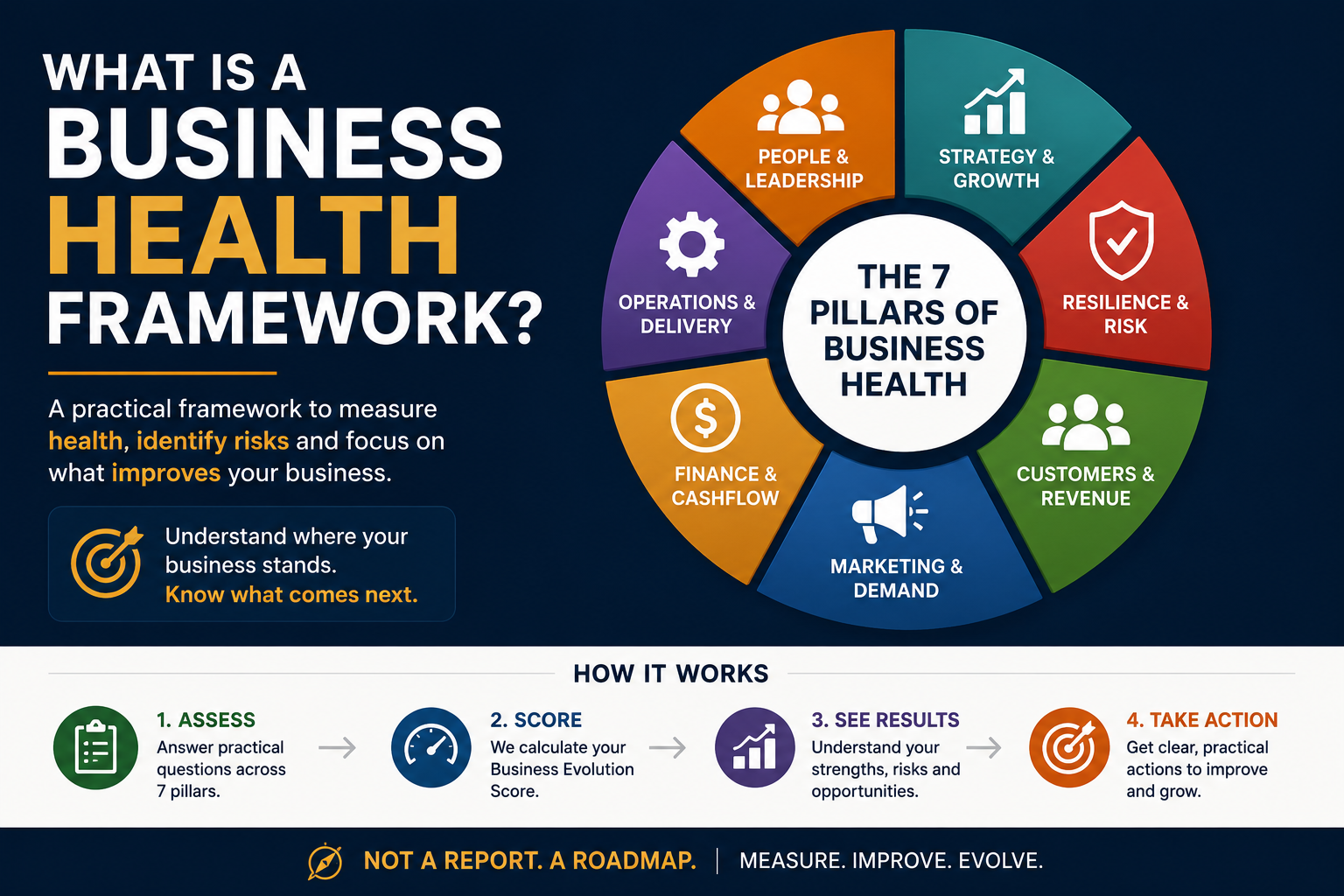
    The Seven Pillars of Business Health

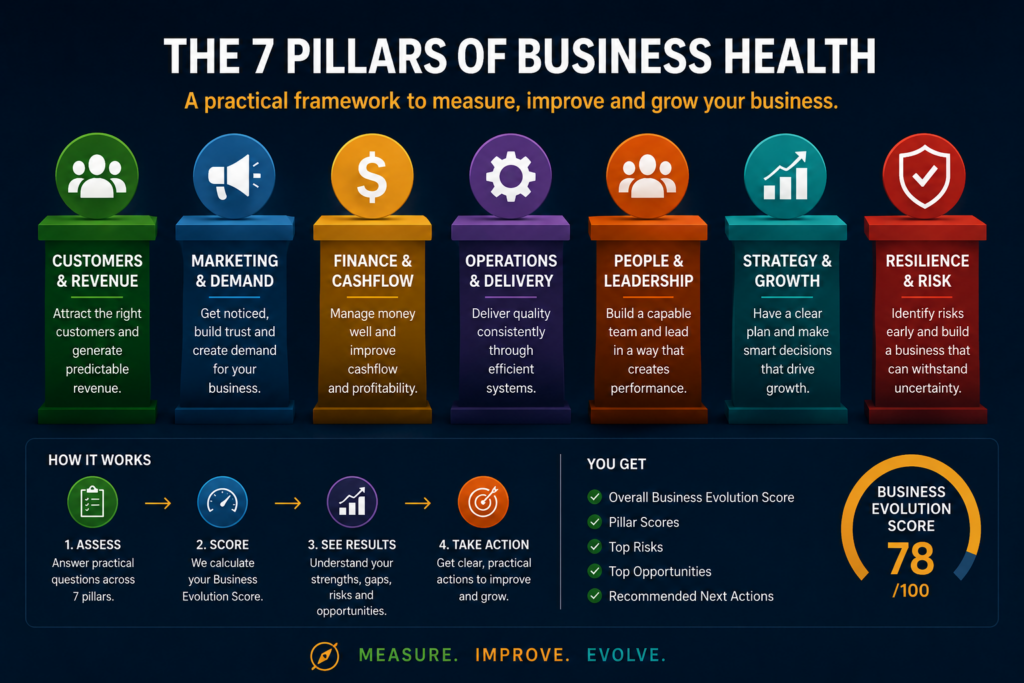
    Business Evolution Score framework infographic showing the seven pillars of business health, assessment process and business score for small businesses.
    The Business Evolution Score framework measures business health across seven pillars, helping entrepreneurs and small business owners understand where they stand and what to improve next.

    The Business Evolution Score framework measures business health across seven practical areas.

    1. Customers & Revenue

    Can your business consistently attract customers and convert opportunities into predictable revenue?

    This pillar focuses on sales processes, customer retention and revenue consistency.

    Learn more about Customers & Revenue.

    2. Marketing & Demand

    Can the right customers find and trust your business?

    This pillar evaluates visibility, lead generation, brand positioning and marketing consistency.

    Learn more about Marketing & Demand.

    3. Finance & Cashflow

    Do you have control over your finances?

    This pillar measures cashflow management, profitability, forecasting and financial planning.

    Learn more about Finance & Cashflow.

    4. Operations & Delivery

    Can your business deliver consistently as it grows?

    This area focuses on systems, documentation, quality and operational efficiency.

    Learn more about Operations & Delivery.

    5. People & Leadership

    Can your business continue operating without depending on you for every decision?

    This pillar assesses delegation, accountability, leadership and team capability.

    Learn more about People & Leadership.

    6. Strategy & Growth

    Do you have a clear direction for your business?

    This pillar evaluates planning, priorities, innovation and long-term growth readiness.

    Learn more about Strategy & Growth.

    7. Resilience & Risk

    How well prepared is your business for uncertainty?

    This pillar considers founder dependency, client concentration, business continuity and overall resilience.

    Learn more about Resilience & Risk.

    Business Health vs Business Maturity

    Business health and business maturity are closely related, but they are not the same thing.

    Many maturity models assume every business should operate like a large corporate organisation.

    That isn’t realistic for most entrepreneurs and small businesses.

    A healthy business doesn’t need complex processes or large teams.

    It needs the right capabilities for its stage of growth.

    The goal is not to become more corporate.

    The goal is to become more capable, more resilient and better prepared for the future.

    How Often Should You Measure Business Health?

    Business health isn’t something you measure once.

    As your business grows, your strengths, challenges and priorities will change.

    For most small businesses, reviewing business health every 90 days provides enough time to implement improvements while still measuring meaningful progress.

    This creates a simple improvement cycle:

    Assess → Improve → Measure Progress

    Over time, these regular assessments help business owners make better decisions, reduce risk and build stronger businesses.

    Understanding Your Business Through Business Evolution Score

    The Business Evolution Score (BES) was created to give entrepreneurs and small business owners a practical way to measure business health.

    In around 10 minutes, the assessment evaluates your business across seven key areas and provides a personalised report including:

    • Your overall Business Evolution Score.
    • Individual scores for each business area.
    • Your strongest capabilities.
    • Improvement priorities.
    • Business risks.
    • Growth opportunities.
    • Practical recommendations for what to focus on next.

    The assessment is practical, founder-friendly and designed specifically for small businesses—not large corporations.

    Final Thoughts

    Every business has strengths.

    Every business has weaknesses.

    The most successful business owners are not those with perfect businesses, but those who regularly measure, improve and adapt.

    Understanding the health of your business is the first step towards building a stronger, more resilient and more valuable business.

    If you’d like to see where your business stands today, take the free Business Evolution Score assessment and receive your personalised Business Evolution Report in less than 10 minutes.