Tag: delegation

  • The Hidden Cost of Founder Dependency

    The Hidden Cost of Founder Dependency

    Many business owners wear their busyness as a badge of honour.

    They’re involved in every important decision, approve every payment, solve every customer problem and answer every difficult question.

    At first, this feels like good leadership.

    Over time, however, it often becomes one of the biggest barriers to business growth.

    This is known as founder dependency.

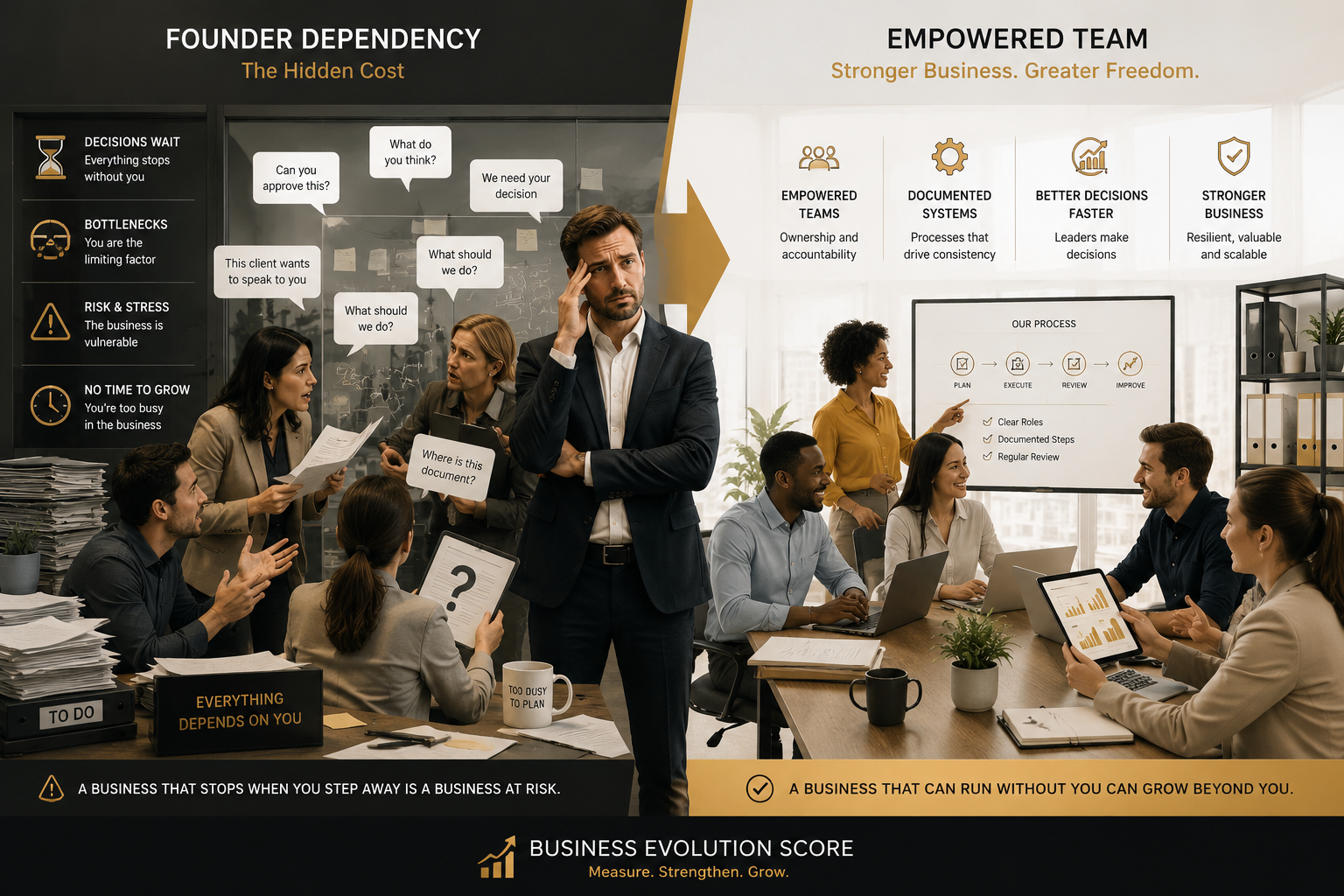
    When a business depends on one person to keep everything moving, growth becomes slower, risk increases and the long-term value of the business declines.


    What Is Founder Dependency?

    Founder dependency occurs when the owner becomes central to almost every part of the business.

    Examples include:

    • Clients only want to speak to the owner.
    • Staff wait for the owner to make decisions.
    • Sales stop when the owner isn’t involved.
    • Important knowledge exists only in the owner’s head.
    • The business struggles whenever the owner is away.

    Many small businesses start this way.

    The challenge is recognising when founder involvement becomes founder dependency.


    The Hidden Cost of Founder Dependency

    Founder dependency affects far more than the owner’s workload.

    It influences almost every aspect of the business.

    Growth Slows Down

    Every decision eventually waits for one person.

    As the business grows, this creates bottlenecks that limit capacity.


    Teams Stop Taking Ownership

    When employees believe every decision needs approval, initiative disappears.

    Strong People & Leadership encourages accountability and empowers teams to solve problems confidently.


    Customers Become Attached to One Person

    Customers often build strong relationships with founders.

    While this creates trust, it also creates risk.

    If every important relationship depends on one individual, the business becomes vulnerable.


    Business Value Declines

    Businesses that rely heavily on their founders are generally more difficult to sell.

    Potential buyers want systems, capable teams and predictable performance—not a business that depends on one person’s daily involvement.


    Founder Dependency Is Also a Risk

    One of the seven pillars of the Business Evolution Framework is Resilience & Risk.

    Founder dependency is one of the biggest risks facing many growing businesses.

    Illness, holidays or unexpected life events should not bring the business to a standstill.

    Resilient businesses are designed to continue operating even when the founder steps away.


    Reducing Founder Dependency

    Reducing founder dependency doesn’t mean becoming less involved.

    It means building a stronger business.

    Practical steps include:

    • Document important processes.
    • Delegate decision-making.
    • Develop future leaders.
    • Build systems instead of relying on memory.
    • Encourage accountability across the team.

    These improvements create a business that is stronger, healthier and easier to grow.


    Building a Business Beyond Yourself

    As I discuss in The Purposeful Entrepreneur, one of the greatest transitions for any entrepreneur is moving from being the business to building a business that can succeed without constant founder involvement.

    That shift creates freedom for the owner while making the business more resilient and valuable over the long term.


    Measure Your Founder Dependency

    The Business Evolution Score assesses founder dependency as part of its People & Leadership and Resilience & Risk pillars.

    Rather than relying on assumptions, you’ll receive practical insights into how dependent your business is on you and the steps you can take to strengthen it.

    If you’re wondering whether your business could continue operating without you for two weeks, it’s worth finding out.

    Take the free Business Evolution Score assessment and discover where your business stands.
    👉 Get My Free Business Evolution Score

  • Why Delegation Is So Difficult: The Hidden Growth Barrier for Small Business Owners

    Why Delegation Is So Difficult: The Hidden Growth Barrier for Small Business Owners

    Most business owners know they should delegate more.

    They’ve read the books.

    They’ve attended the seminars.

    They’ve heard the advice countless times:

    “Work on the business, not just in it.”

    Yet every morning they find themselves approving invoices, answering routine questions, solving customer issues and making decisions their team could probably handle.

    The problem isn’t that founders don’t understand delegation.

    The problem is that delegation is far more difficult than it sounds.

    For many entrepreneurs, their business exists because they cared more, worked harder and solved problems faster than anyone else.

    Those same strengths that helped build the business can eventually become the biggest obstacle to its growth.

    Learning to delegate isn’t about doing less.

    It’s about building a business that can achieve more without depending on one person.


    Why Delegation Feels So Difficult

    Delegation isn’t just a management skill.

    It’s a mindset shift.

    Many business owners worry that if they hand work to someone else:

    • Quality will drop.
    • Customers won’t be looked after.
    • Mistakes will increase.
    • Problems will take longer to solve.
    • They’ll spend more time fixing work than doing it themselves.

    These concerns are understandable.

    But they often lead to a business where every important decision still depends on the owner.

    That’s not leadership.

    That’s dependency.

    The People & Leadership pillar of the Business Evolution Framework explores how delegation, accountability and leadership capability influence long-term business success.


    The Hidden Cost of Founder Dependency

    When every decision depends on one person, growth slows.

    The owner becomes the bottleneck.

    Team members stop making decisions because they know everything eventually comes back to the founder.

    Customers wait longer.

    Projects take longer.

    Opportunities are missed.

    Ironically, the harder the owner works, the more dependent the business becomes.

    Founder dependency isn’t a sign of commitment.

    It’s a business risk.

    Our article on Founder Dependency: The Growth Problem Most Business Owners Ignore explores this topic in more detail.


    Five Reasons Delegation Fails

    1. There Are No Systems

    People can’t consistently complete work if there is no documented process.

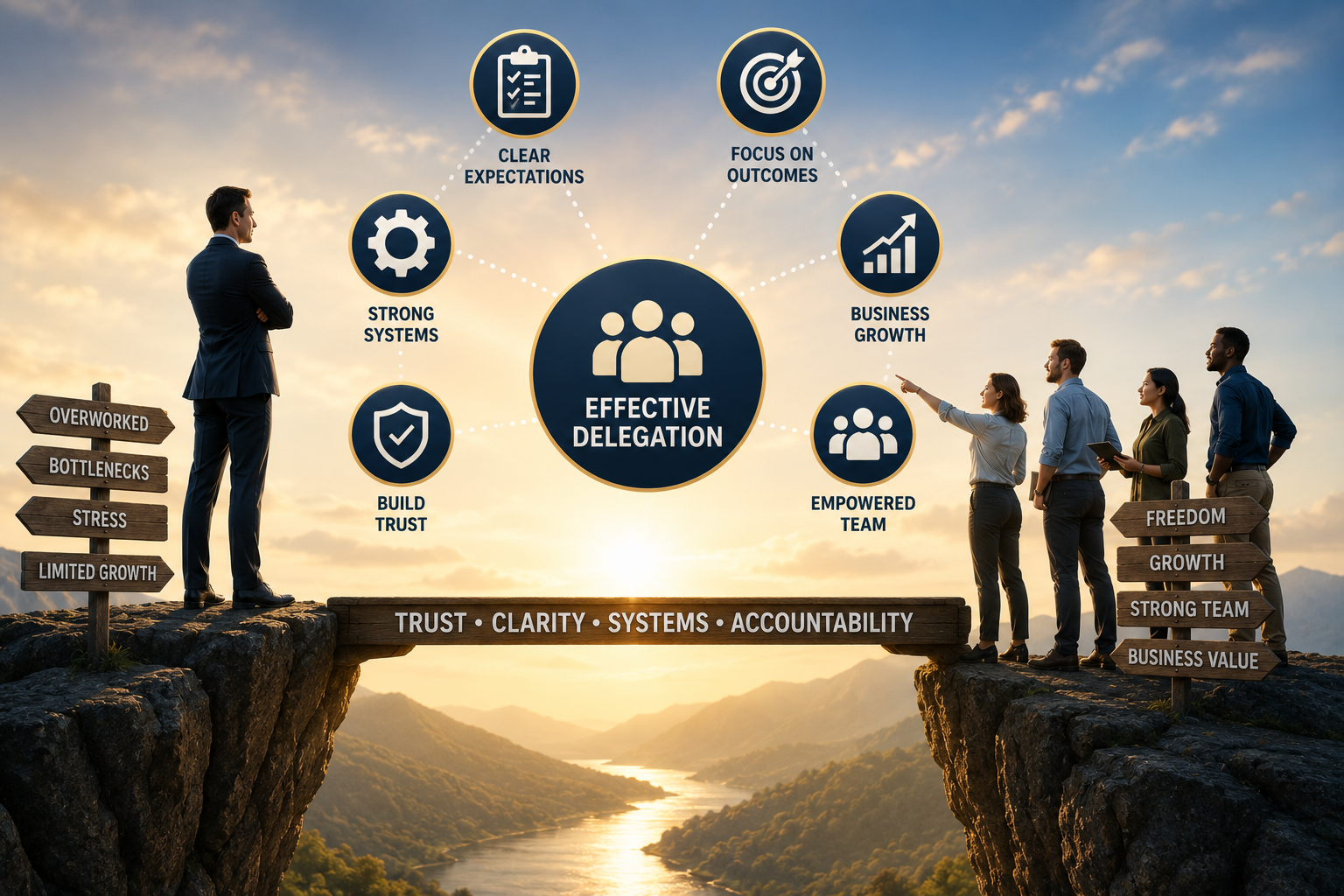
    Effective delegation starts with clear expectations and repeatable systems.

    The Operations & Delivery pillar explains how documented systems support consistency and scalability.


    2. Expectations Are Unclear

    Many business owners delegate tasks but never explain what success looks like.

    Good delegation focuses on outcomes rather than simply assigning work.


    3. Fear of Mistakes

    No one will complete every task exactly as the founder would.

    That doesn’t mean they can’t do it well.

    Occasional mistakes are part of developing capable people.

    Over time, the team improves and the business becomes stronger.


    4. The Owner Doesn’t Let Go

    Delegation isn’t asking someone else to do the work while checking every five minutes.

    Micromanagement creates frustration and destroys confidence.

    Trust grows when people are given responsibility and the opportunity to learn.


    5. Leadership Skills Haven’t Kept Pace

    As businesses grow, the owner’s role changes.

    Success becomes less about doing the work personally and more about building a team that can deliver consistently.

    Leadership is a capability that develops over time.


    Delegation Creates Better Businesses

    Many people think delegation is about saving time.

    It’s much bigger than that.

    Good delegation creates:

    • Faster decision-making
    • Stronger teams
    • Better customer service
    • Greater accountability
    • Improved resilience
    • Increased business value

    Businesses that can operate successfully without constant founder involvement are generally healthier, more resilient and easier to grow.


    Are You Delegating Effectively?

    Ask yourself a few questions.

    • Could your team make decisions without asking you?
    • Can projects continue while you’re away?
    • Are responsibilities clearly defined?
    • Have important processes been documented?
    • Does your team understand what success looks like?
    • Are you solving problems your team could solve themselves?

    If the answer to several of these questions is “no”, delegation may be one of the biggest opportunities for improving your business.


    Delegation Supports Sustainable Growth

    As businesses grow, complexity increases.

    Owners who continue making every decision eventually become the limiting factor.

    Delegation creates capacity.

    Capacity creates growth.

    Growth supported by capable people is far more sustainable than growth supported by one exhausted founder.

    The Strategy & Growth pillar explores how leadership capability supports long-term business success.

    Likewise, resilient businesses are built around teams and systems rather than individual heroes. Learn more in the Resilience & Risk pillar.


    Build a Business That Doesn’t Depend on You

    One of the greatest compliments a business owner can receive isn’t:

    “You’re indispensable.”

    It’s:

    “Your business runs brilliantly, even when you’re not there.”

    Delegation isn’t about becoming less valuable.

    It’s about creating more value through other people.

    The strongest businesses aren’t built by owners who do everything themselves.

    They’re built by leaders who create capable teams, strong systems and a culture of accountability.


    Continue Exploring


    Ready to Measure Your Business Evolution?

    The free Business Evolution Score assessment evaluates your business across seven critical areas, helping you identify strengths, risks and the next actions that will have the biggest impact.

    Whether you’re focused on growth, cashflow, marketing, leadership or resilience, you’ll receive a personalised Business Evolution Score along with practical recommendations to help your business evolve.

  • Founder Dependency: The Growth Problem Most Business Owners Ignore

    Founder Dependency: The Growth Problem Most Business Owners Ignore

    Introduction

    Many small businesses start with a founder who does everything.

    They generate sales, solve problems, manage customers, oversee delivery, handle finances and make most of the important decisions.

    In the early stages this level of involvement is often necessary.

    The problem is that what helps a business survive can eventually prevent it from growing.

    This is known as founder dependency.

    When too much knowledge, responsibility and decision-making sits with one person, the business becomes difficult to scale and vulnerable to disruption.


    What Is Founder Dependency?

    Founder dependency exists when the business relies heavily on the owner for day-to-day operations and key decisions.

    Common signs include:

    • Customers always ask for the owner
    • Team members cannot make decisions independently
    • Key processes exist only in the founder’s head
    • The business slows down when the owner is away
    • Growth creates stress rather than opportunity

    The owner becomes the bottleneck.


    Why Founder Dependency Is Risky

    Growth Becomes Limited

    A founder only has so many hours available.

    Eventually growth reaches a point where the owner cannot personally manage everything.

    Decision-Making Slows Down

    When every decision requires founder approval, work becomes delayed and opportunities can be missed.

    Team Development Suffers

    Employees may avoid taking ownership if they know the owner will ultimately make every decision.

    Business Value Decreases

    A business that depends entirely on its founder is often less attractive to investors or potential buyers.


    Quick Self-Assessment: Is Your Business Too Dependent On You?

    Ask yourself the following questions:

    • Can the business operate effectively for two weeks without you?
    • Can team members make routine decisions without your approval?
    • Are key processes documented and repeatable?
    • Do customers have relationships with the business, or only with you?
    • Would important work continue if you were unavailable tomorrow?

    If you answered “No” to most of these questions, founder dependency may be limiting your growth and increasing business risk.


    How To Reduce Founder Dependency

    Document Key Processes

    Create simple documentation for recurring activities.

    The goal is not complexity.

    The goal is consistency.

    Delegate Outcomes, Not Tasks

    Give team members ownership of results rather than isolated tasks.

    Develop Leaders

    Identify people who can take responsibility for specific areas of the business.

    Build Accountability

    Ensure responsibilities are clearly defined and measured.

    Make Knowledge Transfer A Priority

    Critical information should not live in one person’s head.


    The Goal Is Not To Become Invisible

    Reducing founder dependency does not mean removing the owner from the business.

    It means creating a business that can function effectively without requiring the founder to be involved in every decision and activity.

    The owner should be able to focus on strategy, growth and leadership rather than constantly solving operational problems.


    Related Business Evolution Pillars

    Founder dependency affects more than leadership. It can influence growth, operational performance and business resilience.

    People & Leadership

    The People & Leadership pillar measures how effectively responsibility is shared across the business. Areas such as delegation, accountability, communication and leadership development all contribute to reducing dependence on the owner.

    Resilience & Risk

    Founder dependency is also a business risk. If critical decisions, customer relationships or operational knowledge sit with one person, the business becomes vulnerable when that person is unavailable. The Resilience & Risk pillar evaluates founder dependence, key person risk, knowledge documentation and succession readiness.

    Strategy & Growth

    Many businesses struggle to scale because the owner becomes the bottleneck. Strong growth often requires systems, delegation and leadership capability that allow the business to grow beyond the founder’s direct involvement.


    Final Thoughts

    Many business owners believe growth requires working harder.

    In reality, sustainable growth often requires building systems, developing people and reducing dependency on the founder.

    A healthy business should be able to continue operating even when the owner is not directly involved in every activity.


    Ready to Measure Your Business Evolution?

    The free Business Evolution Score assessment evaluates your business across seven critical areas, helping you identify strengths, risks and the next actions that will have the biggest impact.

    Whether you’re focused on growth, cashflow, marketing, leadership or resilience, you’ll receive a personalised Business Evolution Score along with practical recommendations to help your business evolve.