If I asked you how your business was performing, what would be the first number that comes to mind?
For many business owners, it’s revenue. Others might think about profit, cash in the bank or perhaps the number of new customers they’ve won this month. These are all important measures, and every business owner should keep an eye on them. The problem is that, on their own, they don’t tell you whether your business is actually healthy.
Over the years, I’ve met businesses that appeared to be thriving. Sales were growing, the phones were ringing and the team was expanding. From the outside, they looked like success stories. Yet, after spending a little time with the owners, a different picture often emerged. Cash flow was under pressure, one or two customers accounted for most of the revenue, the owner was working longer hours than ever, and there was no clear plan for the future.
I’ve also met businesses that weren’t growing at breakneck speed. They weren’t making headlines or winning awards, but they had loyal customers, healthy cash reserves, efficient systems and owners who could confidently step away for a few days without worrying that everything would fall apart. Those businesses were healthy.
That experience taught me an important lesson. A successful business and a healthy business are not always the same thing.
Looking Beyond the Financials
When people think about business performance, financial results naturally dominate the conversation. Revenue, profit and cash flow are essential, but they’re outcomes. They tell you what has happened, not necessarily why it happened or whether it can be sustained.
Imagine going for an annual health check. Your doctor wouldn’t base their diagnosis solely on your weight or your blood pressure. They would consider a range of factors before forming a view of your overall health.
Businesses deserve the same approach.
A company might be profitable today because it has one large customer, but what happens if that customer leaves? Another business may have strong sales, but inefficient processes mean every new client creates more stress rather than more profit. A third business might have excellent systems but struggle to generate enough new opportunities because its marketing has been neglected.
Each of these businesses has strengths, but each also carries risks that may not be obvious if you’re only looking at the financial statements.
So, What Is a Business Health Score?
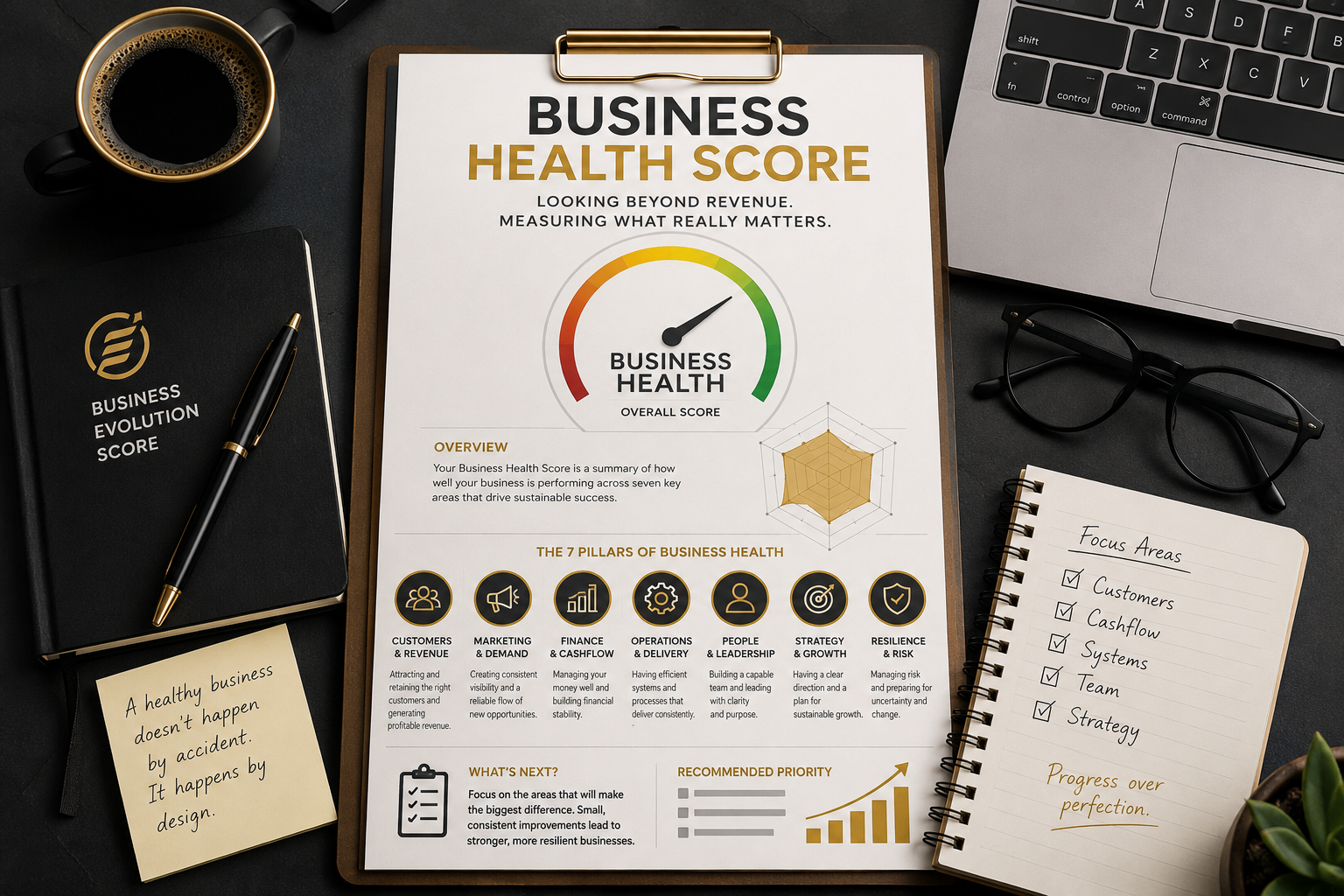
A Business Health Score is a way of measuring the overall strength of your business by looking beyond the numbers.
Rather than asking, “How much money did you make?” it asks questions like:
- Are you consistently attracting the right customers?
- Can your business generate new opportunities without relying solely on referrals?
- Do you understand your cash flow well enough to make confident decisions?
- Are your systems helping the business grow, or are they creating bottlenecks?
- Is your team equipped to support the next stage of growth?
- Do you have a clear strategy, or are you simply reacting to whatever comes next?
When you bring those answers together, you begin to see a much more complete picture of your business.
The Seven Pillars of a Healthy Business
While every business is unique, I’ve found that the same themes appear time and again. Whether the challenge is stalled growth, inconsistent sales or founder burnout, the underlying cause usually sits within one of seven key areas.
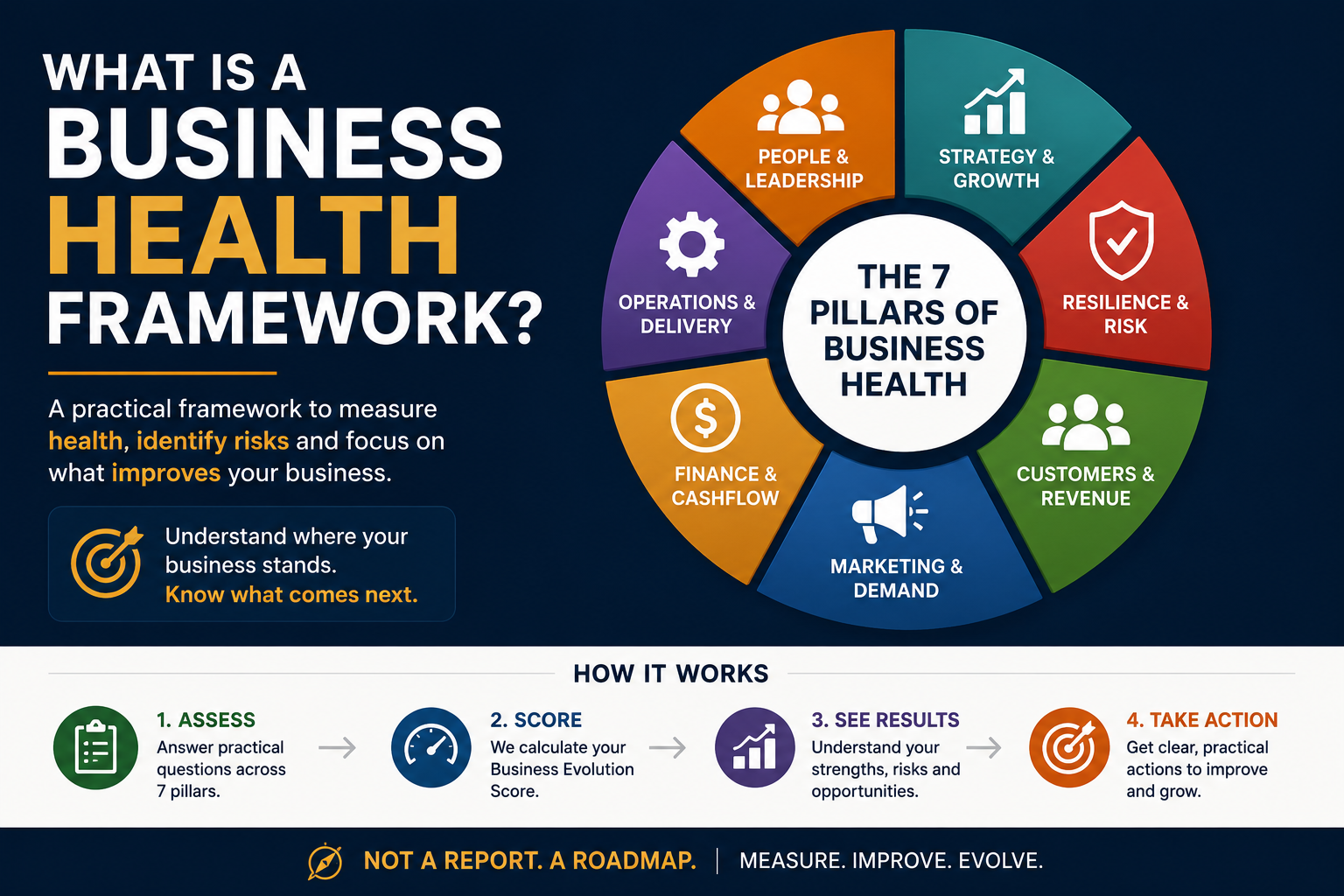
These seven areas form the Business Evolution Framework, a practical model for understanding how different parts of your business work together and where improvements will have the greatest impact.
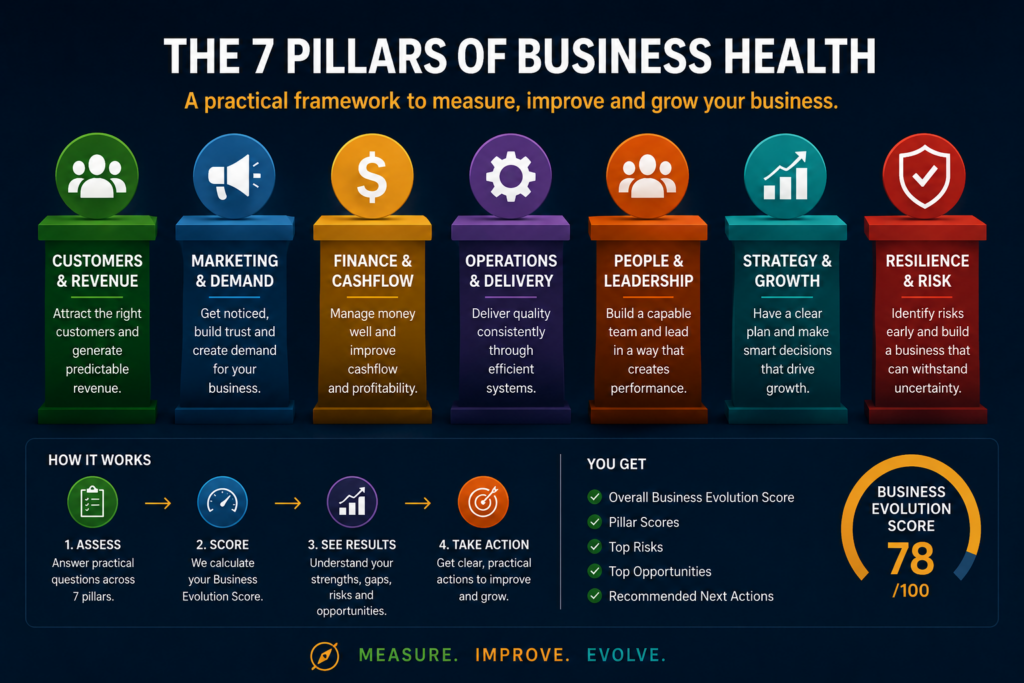
Business Evolution Score measures these seven pillars:
- Customers & Revenue – Building a stable and profitable customer base.
- Marketing & Demand – Creating a consistent flow of new opportunities.
- Finance & Cashflow – Understanding and managing the financial health of the business.
- Operations & Delivery – Developing systems that support efficient growth.
- People & Leadership – Building a capable team with clear direction.
- Strategy & Growth – Knowing where the business is going and how to get there.
- Resilience & Risk – Preparing for uncertainty and reducing unnecessary business risk.
These pillars don’t exist in isolation. Weakness in one area often creates pressure in another. Poor marketing eventually affects cash flow. Weak systems increase founder dependency. A lack of strategy often results in reactive decision-making.
That’s why it’s important to assess the business as a whole rather than focusing on individual problems as they arise.
Healthy Businesses Are Built, Not Found
One of the biggest misconceptions in business is that healthy businesses happen naturally.
They don’t.
Healthy businesses are built through hundreds of small decisions made consistently over time.
They are built by understanding the numbers rather than avoiding them. By documenting processes instead of relying on memory. By developing future leaders instead of trying to do everything yourself. By regularly reviewing where the business is heading instead of simply responding to today’s problems.
None of these actions is particularly exciting on its own, but together they create businesses that are more resilient, more profitable and, perhaps most importantly, more enjoyable to own.
Why Blind Spots Matter
One of the challenges of running a business is that you’re often too close to it.
When you’re dealing with customers, managing staff, solving problems and keeping cash flowing, it’s difficult to step back and see the bigger picture. Small issues become part of everyday life. You adapt to them without realising they’re slowly limiting the business.
I’ve seen businesses where the owner accepted working every weekend because “that’s just part of running a business.” Others assumed inconsistent sales were normal because they’d never built a structured marketing process. Some believed cash flow stress was unavoidable when, in reality, it stemmed from poor forecasting and weak debtor management.
These aren’t failures.
They’re blind spots.
And every business has them.
The value of a Business Health Score isn’t that it gives you a number. The real value is that it helps you identify those blind spots before they become bigger problems.
Progress Over Perfection
One thing I’ve learned over the years is that there is no such thing as the perfect business.
Every business has weaknesses. Every owner has areas they could improve. Even well-established companies continue refining their systems, developing their people and adapting to changing markets.
The goal isn’t to score 100%.
The goal is to understand where you are today, identify the areas that will make the biggest difference, and keep improving over time. Business is an ongoing journey of evolution, not a destination where everything is finally “finished.”
Small improvements, applied consistently, often produce far greater results than dramatic changes made once every few years.
Why I Created Business Evolution Score
Business Evolution Score grew out of a simple belief: business owners deserve a practical way to understand the health of their business.
Not another personality test.
Not another generic online quiz.
And certainly not a report full of consultant jargon.
I wanted to create something that would help entrepreneurs step back from the daily demands of running a business, assess where they stand today and receive practical guidance on what to improve next.
The assessment doesn’t judge your business. It helps you understand it.
Because once you understand your business more clearly, you can make better decisions, reduce unnecessary risks and build something that is not only successful, but sustainable.
Find Out How Healthy Your Business Is
If you’ve never taken a step back to assess the overall health of your business, now is a good time to start.
The free Business Evolution Score assessment takes just a few minutes to complete. You’ll receive an overall Business Health Score, insights across each of the seven pillars, practical recommendations and a personalised 90-day action plan designed to help you focus on the improvements that matter most.
After all, building a better business doesn’t start by working harder.
It starts by understanding where your business stands today—and knowing where to focus next.
Related Reading
If you’d like to explore business health in more detail, you may also find these guides useful:
- Business Health Assessment Explained: The Complete Guide
- The Business Evolution Framework
- Finance & Cashflow
- Strategy & Growth
Ready to Measure Your Business Evolution?
The free Business Evolution Score assessment evaluates your business across seven critical areas, helping you identify strengths, risks and the next actions that will have the biggest impact.
Whether you’re focused on growth, cashflow, marketing, leadership or resilience, you’ll receive a personalised Business Evolution Score along with practical recommendations to help your business evolve.
Author’s Note
Michael Hamilton is an entrepreneur, author of The Purposeful Entrepreneur, and the founder of Business Evolution Score. Having built and worked with businesses across multiple industries, he created Business Evolution Score to give business owners a practical framework for understanding, measuring and improving the health of their business.