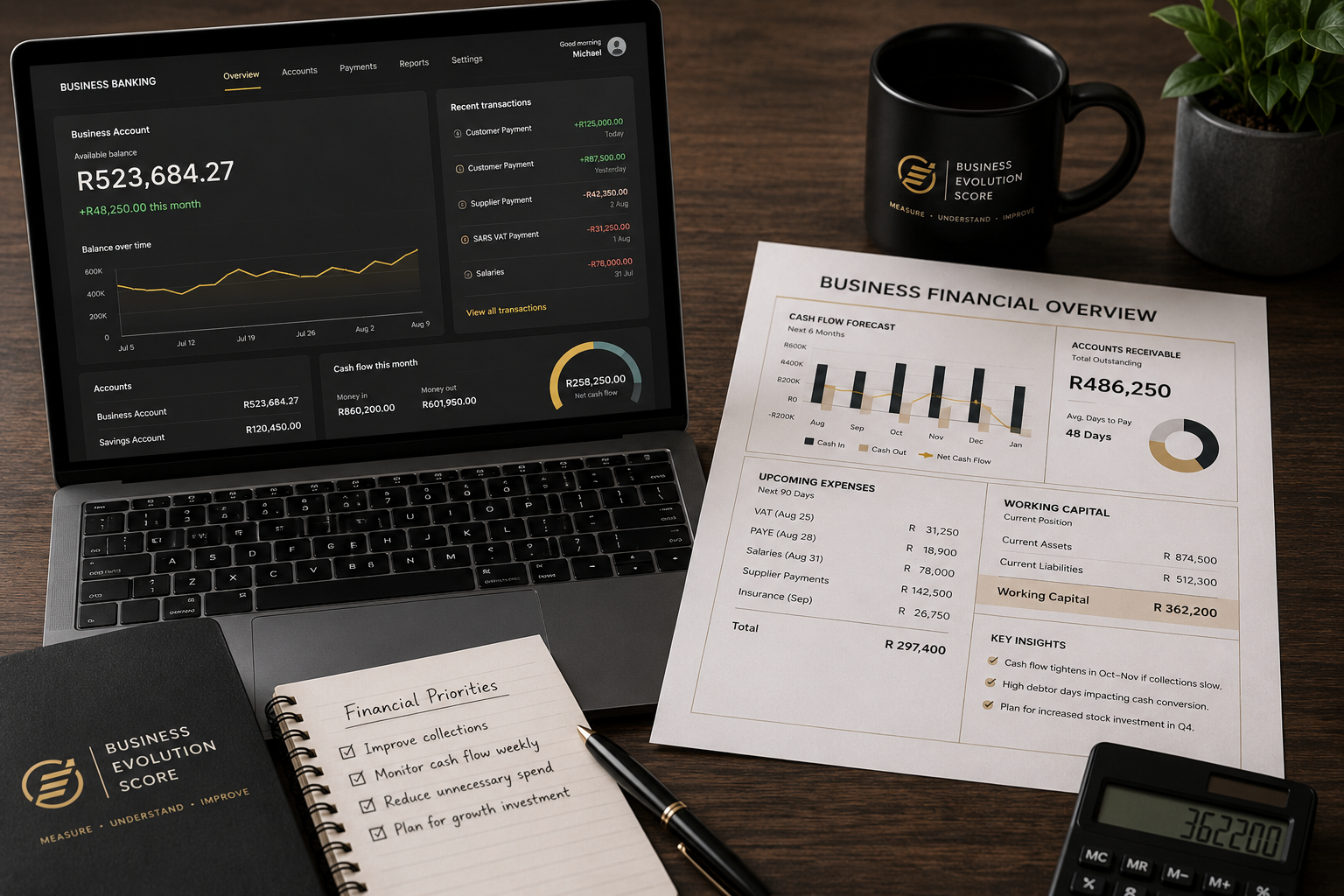
For many small business owners, the bank balance becomes an unofficial business dashboard. But business financial health is about far more than how much cash happens to be sitting in the account today.
You open your banking app in the morning, see what has come in, check what needs to go out, and make a quick judgement about how things are going.
If there is enough money in the account, things feel reasonably healthy. If the balance is getting uncomfortable, the alarm bells start ringing.
I understand why we do it. Cash is immediate. It is real. You don’t need an accounting qualification to understand that R500,000 in the bank feels considerably better than R15,000.
The problem is that your bank balance tells you where your cash is right now.
It doesn’t necessarily tell you where your business is going.
And those are two very different things.
A Healthy Bank Balance Can Hide an Unhealthy Business
Imagine you’ve just had a particularly good month. Several large customers paid outstanding invoices, a new client paid a deposit, and there is more cash sitting in the account than there has been for months.
It feels good.
But some of that money may already effectively belong somewhere else.
VAT may be due. Salaries are approaching. Suppliers haven’t invoiced you yet. A large annual insurance payment is coming. That customer deposit may need to fund several months of delivery before you have actually earned the revenue.
Meanwhile, sales for the next two months could be looking decidedly thin.
The bank balance isn’t wrong.
It’s simply incomplete.
The opposite can also happen. A fundamentally profitable business can experience a frightening cash squeeze because customers are paying slowly, stock has been purchased ahead of demand or the business is growing faster than its working capital can support.
That’s why cash in the bank and financial health are not the same thing.
The Real Question Is Whether Your Numbers Help You Make Decisions
Having financial reports doesn’t automatically mean you have good financial information either.
Plenty of businesses produce management accounts, income statements and balance sheets. The reports arrive every month, somebody looks at them, they get filed away, and everyone carries on.
The more useful question is:
Can you use those numbers to make better decisions?
If you’re considering hiring another employee, do you understand what that will do to cash flow over the next six months?
If sales are increasing but cash is getting tighter, can you explain why?
Do you know which products, services or customers are genuinely profitable?
If you lose a major customer, do you understand how quickly you would need to reduce costs?
If you’re planning significant growth, do you know how much additional working capital that growth will require?
Good financial information should help you answer questions like these before they become problems.
That means the information needs to be accurate, timely and understandable.
A beautifully prepared report arriving three months after the decisions needed to be made isn’t particularly useful.
Profit and Cash Are Not the Same Thing
This is one of the most important concepts for any business owner to understand.
A business can make a profit and still run out of cash.
Suppose you complete R200,000 worth of work this month and invoice your customers. On your income statement, that revenue may contribute towards a healthy profit.
But if those customers only pay you in 60 days, you haven’t received the cash yet.
Your employees still need to be paid.
Your suppliers still expect payment.
Rent, software, insurance, vehicles and every other operating expense continue regardless of when your customers eventually settle their invoices.
Now add growth.
You win more customers, hire another employee and increase your delivery capacity. Revenue climbs. Profitability on paper improves.
And strangely, the bank account becomes more uncomfortable.
Growth consumes cash before it produces cash in many businesses.
That’s where working capital becomes incredibly important.
Working Capital Isn’t Just an Accounting Term
Working capital sounds like something your accountant discusses with your finance team.
For a small business owner, it’s much more practical than that.
It’s essentially about whether the normal movement of money through your business gives you enough breathing room to operate.
Think about the journey.
You may need to spend money on people, stock, materials, advertising or suppliers before you receive payment from your customer.
The longer that gap becomes, the more cash your business needs to fund its everyday operations.
A few seemingly small changes can make a significant difference:
- Customers start paying in 60 days instead of 30.
- Stock sits for an extra month before being sold.
- Suppliers shorten their payment terms.
- Revenue grows rapidly and you need additional people before customers begin paying.
- One large customer delays payment unexpectedly.
None of those things necessarily means the business is unprofitable.
But they can create serious pressure.
This is one reason the Finance & Cashflow pillar of the Business Evolution Score looks beyond simply whether a business is making money. Financial health also depends on visibility, control and the ability to anticipate what is coming.
Growth Creates Its Own Financial Demands
There’s another financial question that growing businesses sometimes overlook:
What will the next version of this business require?
The business you operate today may be adequately funded.
The business you’re trying to build may not be.
Growth might require new equipment, larger premises, additional vehicles, technology, inventory or more employees. Perhaps you’ll need to invest heavily in marketing before the resulting revenue appears.
Those investments have to come from somewhere.
You may fund them from retained profits. You might use debt. You could bring in shareholders or investors. In some cases, slowing the growth rate and allowing the business to fund itself may be the sensible choice.
There isn’t one universally correct answer.
But discovering halfway through a growth plan that you don’t have enough capital is rarely the ideal approach.
Good financial planning gives you the opportunity to make those decisions deliberately.
Your Accountant Cannot Make Every Financial Decision for You
A good accountant is incredibly valuable.
So is a good bookkeeper, financial manager or CFO.
But ultimately, the owner still needs to understand the financial story of the business.
You don’t need to become an accountant.
You don’t need to spend your evenings studying debits and credits.
But you should be able to look at the important numbers and understand what they’re telling you.
At minimum, most owners should have a reasonable grasp of:
- how much revenue the business generates;
- whether that revenue is profitable;
- where the major costs are;
- how much cash the business has available;
- what money is owed by customers;
- what the business owes;
- what the next few months are likely to look like; and
- what financial commitments or investments are approaching.
The objective isn’t financial sophistication for its own sake.
It’s decision-making confidence.
Better Financial Visibility Gives You More Options
One of the hardest situations in business is discovering a problem when there is very little time left to solve it.
If you realise today that cash will run out on Friday, your options are limited.
If your forecast tells you that cash could become tight four months from now, you have choices.
You can improve collections.
Delay an investment.
Renegotiate supplier terms.
Reduce unnecessary expenditure.
Increase sales activity.
Arrange funding.
Change the timing of a new hire.
The earlier you can see something coming, the more choices you have.
And that, for me, is one of the biggest benefits of good financial information.
It isn’t simply about knowing your numbers.
It’s about giving yourself enough visibility to make decisions while you still have options.
Financial Health Is About Control, Not Perfection
Small businesses don’t need the reporting infrastructure of multinational corporations.
A ten-person company doesn’t need a finance department producing a 70-page monthly board pack.
That’s not the point.
The financial systems should be appropriate for the size, complexity and stage of the business.
A smaller company may only need a handful of reliable numbers reviewed consistently. A larger or rapidly growing business will naturally require more sophisticated forecasting, reporting and financial controls.
What matters is whether you have enough visibility to understand what is happening and enough foresight to prepare for what is coming.
Your bank balance is part of that picture.
It’s just not the whole picture.
How Healthy Is the Financial Side of Your Business?
Finance & Cashflow is one of the seven areas measured by the Business Evolution Score because financial strength isn’t simply about how much money happens to be sitting in the bank today.
It’s about profitability, cash flow, financial visibility and having enough control to make informed decisions about what happens next.
The free Business Evolution Score assessment looks across Finance & Cashflow together with Customers & Revenue, Marketing & Demand, Operations & Delivery, People & Leadership, Strategy & Growth, and Resilience & Risk.
You’ll receive your overall Business Health Score, scores across all seven pillars, key risks and opportunities, practical recommendations and a personalised 90-day action plan.
Take the Business Evolution Score →
Author’s Note
Michael Hamilton is an entrepreneur, author of The Purposeful Entrepreneur, and founder of Business Evolution Score. Having built and worked with businesses across multiple industries, he created Business Evolution Score to give business owners a practical framework for understanding, measuring and improving the health of their businesses