Running a business is demanding. Between serving customers, managing cashflow, leading your team and planning for the future, it’s easy to spend every day working in the business instead of stepping back to work on it.
That’s why many business owners don’t realise there’s a problem until it becomes impossible to ignore.
Sales begin to slow.
Cashflow becomes unpredictable.
The business depends too heavily on the owner.
Growth starts creating more stress than opportunity.
A Business Health Framework helps you identify these issues before they become serious problems.
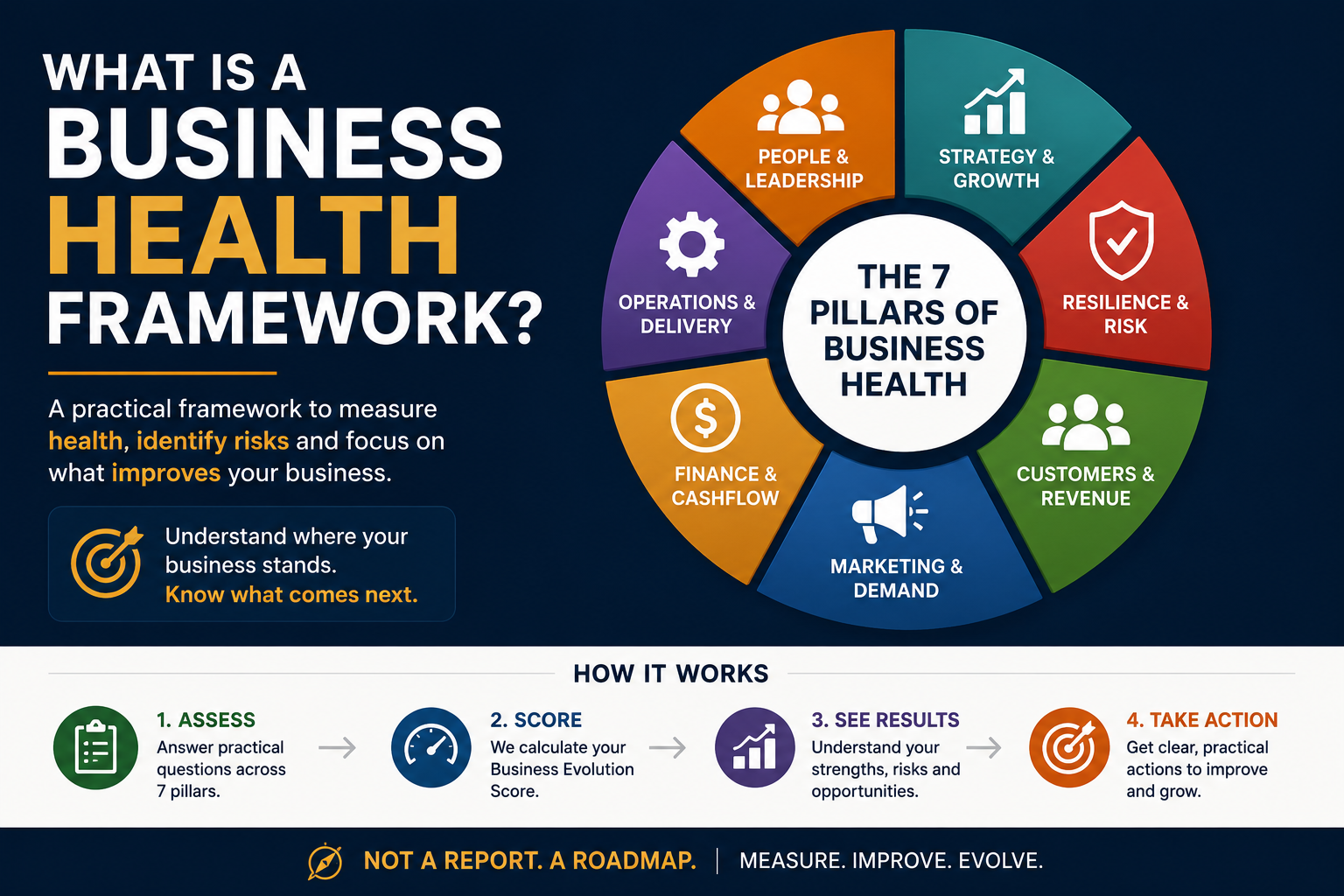
What Is a Business Health Framework?
A Business Health Framework is a structured way of measuring the overall health of a business.
Rather than focusing on a single metric such as revenue or profit, it evaluates the core areas that determine whether a business is stable, resilient and capable of sustainable growth.
Just as a doctor looks at more than one vital sign to assess a person’s health, a business health framework considers multiple aspects of a business to provide a complete picture.
The goal isn’t to judge a business. It’s to help business owners understand where they stand today and identify what they should improve next.
Why Business Health Matters
Many businesses appear successful from the outside while quietly carrying significant risks.
A business may have:
- Growing sales but poor cashflow.
- Loyal customers but no consistent marketing.
- Strong profits but heavy founder dependency.
- Great products but inefficient systems.
- A capable team but no clear strategy.
These weaknesses often remain hidden until growth, economic uncertainty or unexpected events expose them.
Measuring business health helps identify these issues early, giving owners the opportunity to improve before they become costly.
Why Financial Reports Aren’t Enough
Financial reports are essential, but they only tell part of the story.
They show what has already happened.
They don’t tell you:
- Whether customers will continue buying.
- Whether your marketing consistently generates leads.
- Whether your team can operate without constant supervision.
- Whether one major client represents too much of your revenue.
- Whether your business could continue operating during unexpected disruption.
Healthy businesses are built on more than financial performance.
They rely on strong systems, capable leadership, effective marketing and sound decision-making.
The Seven Pillars of Business Health
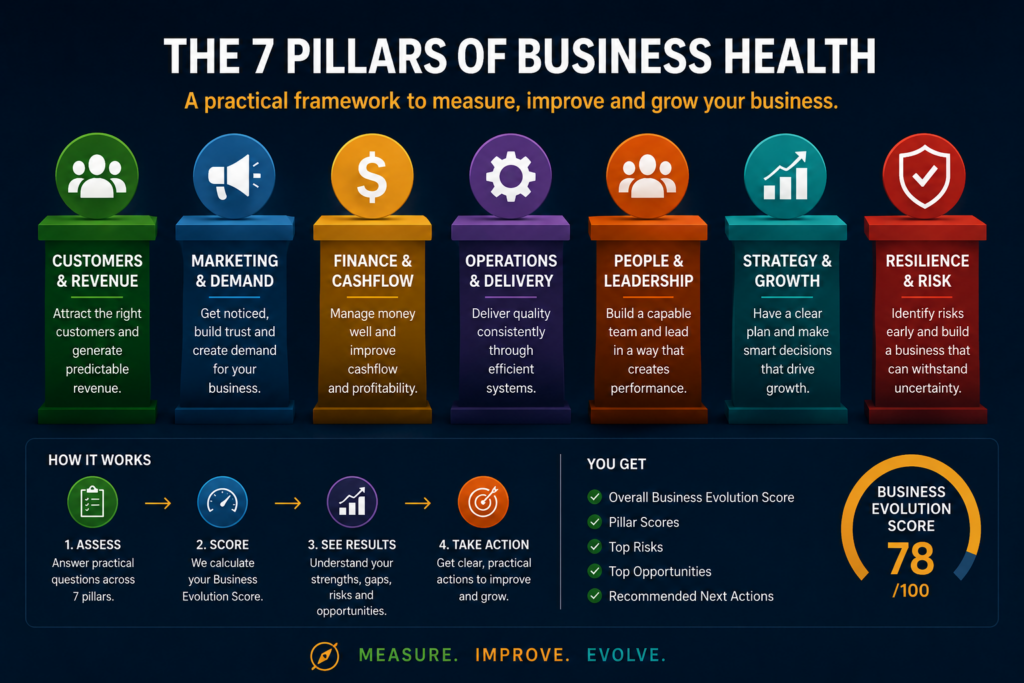
The Business Evolution Score framework measures business health across seven practical areas.
1. Customers & Revenue
Can your business consistently attract customers and convert opportunities into predictable revenue?
This pillar focuses on sales processes, customer retention and revenue consistency.
Learn more about Customers & Revenue.
2. Marketing & Demand
Can the right customers find and trust your business?
This pillar evaluates visibility, lead generation, brand positioning and marketing consistency.
Learn more about Marketing & Demand.
3. Finance & Cashflow
Do you have control over your finances?
This pillar measures cashflow management, profitability, forecasting and financial planning.
Learn more about Finance & Cashflow.
4. Operations & Delivery
Can your business deliver consistently as it grows?
This area focuses on systems, documentation, quality and operational efficiency.
Learn more about Operations & Delivery.
5. People & Leadership
Can your business continue operating without depending on you for every decision?
This pillar assesses delegation, accountability, leadership and team capability.
Learn more about People & Leadership.
6. Strategy & Growth
Do you have a clear direction for your business?
This pillar evaluates planning, priorities, innovation and long-term growth readiness.
Learn more about Strategy & Growth.
7. Resilience & Risk
How well prepared is your business for uncertainty?
This pillar considers founder dependency, client concentration, business continuity and overall resilience.
Learn more about Resilience & Risk.
Business Health vs Business Maturity
Business health and business maturity are closely related, but they are not the same thing.
Many maturity models assume every business should operate like a large corporate organisation.
That isn’t realistic for most entrepreneurs and small businesses.
A healthy business doesn’t need complex processes or large teams.
It needs the right capabilities for its stage of growth.
The goal is not to become more corporate.
The goal is to become more capable, more resilient and better prepared for the future.
How Often Should You Measure Business Health?
Business health isn’t something you measure once.
As your business grows, your strengths, challenges and priorities will change.
For most small businesses, reviewing business health every 90 days provides enough time to implement improvements while still measuring meaningful progress.
This creates a simple improvement cycle:
Assess → Improve → Measure Progress
Over time, these regular assessments help business owners make better decisions, reduce risk and build stronger businesses.
Understanding Your Business Through Business Evolution Score
The Business Evolution Score (BES) was created to give entrepreneurs and small business owners a practical way to measure business health.
In around 10 minutes, the assessment evaluates your business across seven key areas and provides a personalised report including:
- Your overall Business Evolution Score.
- Individual scores for each business area.
- Your strongest capabilities.
- Improvement priorities.
- Business risks.
- Growth opportunities.
- Practical recommendations for what to focus on next.
The assessment is practical, founder-friendly and designed specifically for small businesses—not large corporations.
Final Thoughts
Every business has strengths.
Every business has weaknesses.
The most successful business owners are not those with perfect businesses, but those who regularly measure, improve and adapt.
Understanding the health of your business is the first step towards building a stronger, more resilient and more valuable business.
If you’d like to see where your business stands today, take the free Business Evolution Score assessment and receive your personalised Business Evolution Report in less than 10 minutes.